India's share in global market capitalisation has slipped to 3% in May 2026, marking a 50-month low and down from 3.3% in February 2026, according to Motilal Oswal data. This represents a significant decline from India's peak share of 4.6% in September 2024, when the country held the sixth position globally. The US continues to lead with a 47.9% share, followed by China at 9.2%, Japan at 5.2%, Hong Kong at 4.4%, and India at $4.4 trillion market cap in sixth position. As per Motilal Oswal, India remains among the top 10 contributors to global market capitalisation, though the decline highlights sharp underperformance compared to several Asian peers that are scaling fresh record highs.
The surge in South Korean equities has been primarily driven by semiconductor giants benefiting from the global artificial intelligence boom. Samsung Electronics Co and SK Hynix Inc, newly minted members of the US$1 trillion valuation club, have powered South Korea's equity surge, lifting the Kospi's 2026 gains to more than 100% through their dominance in AI memory chips. Samsung shares are up 196% in the past 12 months, while SK Hynix has exploded 329% higher. The contrast is particularly stark in technology-heavy markets, with South Korean chipmakers Samsung Electronics and SK Hynix surging this year, lifting the KOSPI 109% higher while Taiwan's Taiex has advanced 57.3%. However, analysts caution that the rally has been heavily concentrated in a handful of stocks, with Asset Value Investors noting that Samsung and SK Hynix have done the heavy lifting through the memory cycle.
Investor sentiment toward Indian equities has weakened amid the country's relatively lower exposure to AI-led investment opportunities and continued pressure from subdued earnings growth. Persistent weakness in the rupee and elevated crude oil prices have also fuelled inflation concerns, prompting overseas investors to remain net sellers for most of 2026 and withdraw billions of dollars from domestic equities. Among major global markets, Korea (+28%), Taiwan (+15%), Japan (+12%), MSCI EM (+9%), the US (+5%), Germany (+3%), and the UK (+0%) ended higher or flat on a month-on-month basis, while Indonesia (-12%), Brazil (-7%), India (-2%), and China (-1%) ended lower during the same period. The MSCI India Index has declined 11% over the past one year, sharply underperforming the MSCI Emerging Markets Index, which gained 51% during the same period.
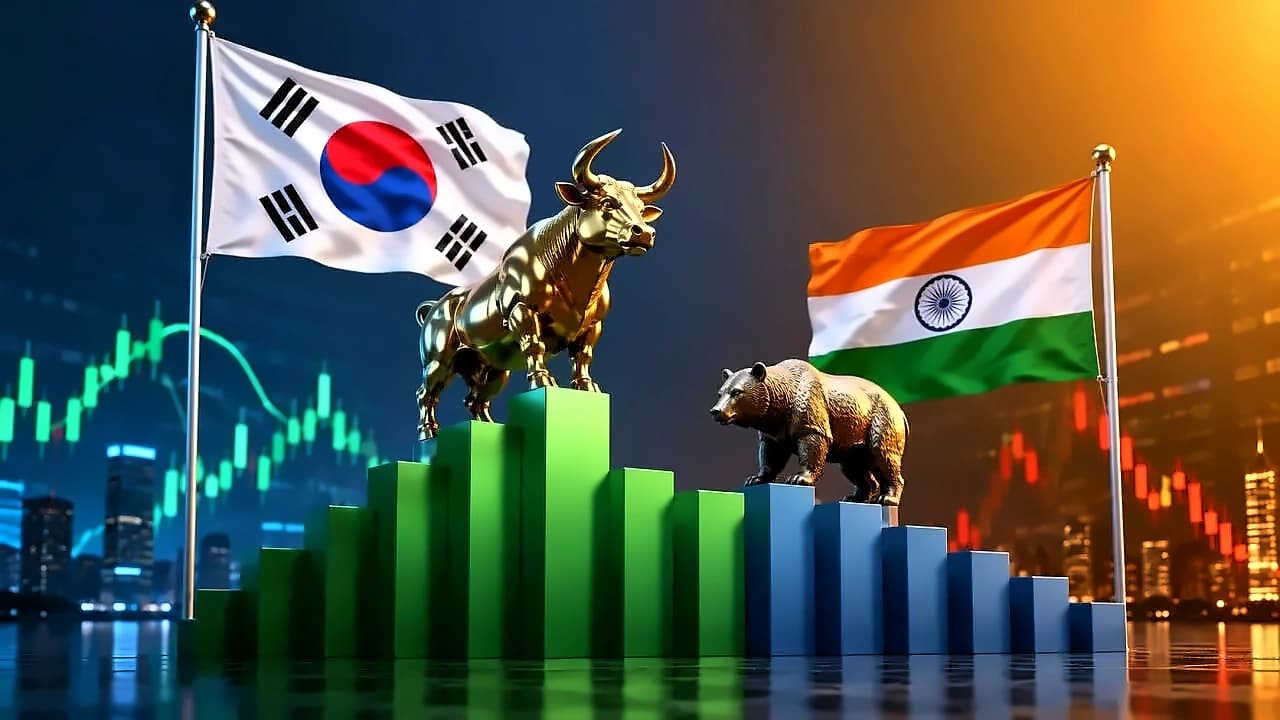
Global market capitalisation has risen by 28.3% (or USD 36.5 trillion) over the past 12 months, while India's market capitalisation has declined by 5.6% during the same period. Korea recorded the highest increase at 168%, followed by Taiwan (101%), China (48%), the US (28%), Japan (24%), and Brazil (22%). Barring Indonesia and India, all major global markets witnessed an increase in market capitalisation over the last 12 months. The MSCI India Index is currently trading at a 17% premium to the MSCI EM Index, below its historical average premium of 73%. The underperformance in domestic equities has also dragged down India's market-cap-to-GDP ratio to 115%, compared to 126% in 2025, with the ratio remaining highly volatile in recent years.
India's decline in global rankings comes as the broader market landscape shows significant shifts, with the country struggling to benefit from the AI-driven investment boom. The divergence highlights how the AI era is increasingly rewarding countries that control strategic technologies and critical supply chains. For India, the challenge is no longer whether AI will drive growth, but whether its semiconductor ecosystem can capture a meaningful share of the value created by that growth. As per Motilal Oswal, experts say India possesses the demand and strategic imperative to become more than just an AI consumer, but warn that "to become an AI infrastructure producer, India needs to build with patience and depth." The country's position as an AI consumer rather than a producer remains a key distinction, as value creation in the AI era shifts from software applications alone to the hardware and semiconductor ecosystem that powers them.