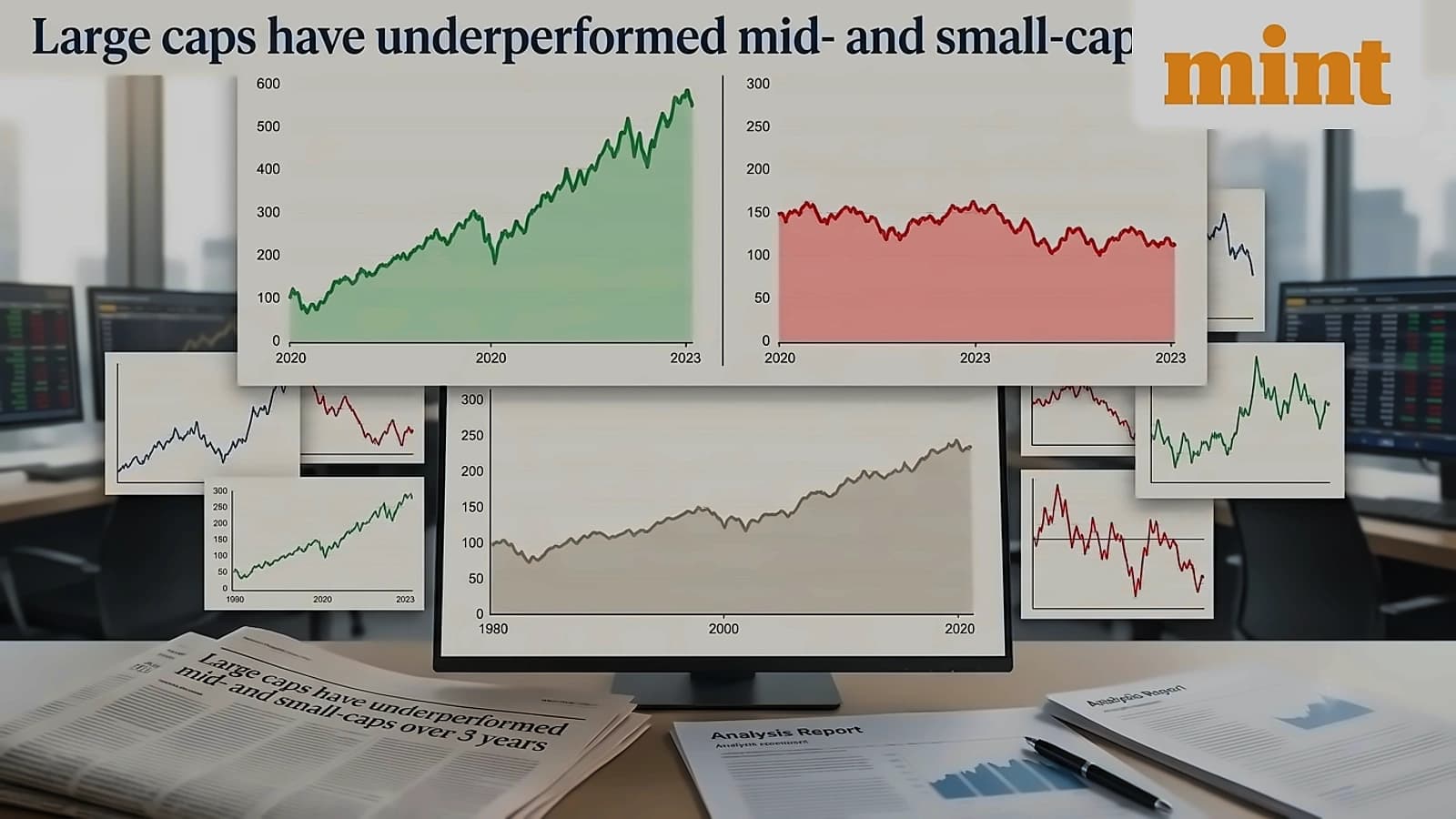
The share of Nifty 50 companies in the total market capitalisation of National Stock Exchange (NSE)-listed universe hit a 16-month low of 42.2% in April, according to The Financial Express. This represents a decline from the 43.6-44.1% share recorded in the previous five months and is significantly down from 62.3% in FY14. The fall comes amid persistent foreign outflows from equities, unsettled geopolitical crisis in West Asia, consequent pressure on crude oil prices and the rupee, and potential risks on economic growth and inflation.
While the market cap of Nifty 50 companies continues to have the highest share, other segments have been rising over the years. According to NSE's Market Pulse report, the Nifty Midcap 150 accounted for the second highest share of 21.1% of the total in April, followed by the Nifty Next 50 at 15.8%, and then the Nifty Smallcap 250 at 10.3%. Over the last five years, the compound annual growth rate (CAGR) of Nifty 50 was 10.4%, slower than the Nifty Midcap 150 and the Nifty Smallcap 250 which rose 19.2% and 18.1% respectively, indicating that mid- and small-cap companies are increasingly contributing to market breadth and long-term returns.
In the first four months of 2026, the aggregate market cap of the NSE-listed universe declined over 2%, with the 6% fall of Nifty 50 stocks contributing the most. However, the impact was partially offset by the near 7% rise in the market cap of Nifty Midcap 150 stocks, 8.1% rise in the Nifty Smallcap 250, and the 9.2% increase in the Nifty Microcap 250, as per the report. The headline 50-stock index snapped a four-month losing streak in April, marking its strongest rise of 7.5% in 28 months amid expectations of a ceasefire in West Asia, though it fell again in May as failed US-Iran talks and surge in global crude oil prices triggered investor panic.
Constituents that contributed to the Nifty 50's rise in April were HDFC Bank (0.6%), Reliance Industries (0.6%), Bajaj Finance (0.4%), Bharti Airtel (0.3%), and Axis Bank (0.3%). On the other hand, stocks that primarily dragged down the index were Infosys (-0.2%) and HCL Technologies (-0.1%). The sharp sell-off in information technology limited the returns of the Nifty 50, while the rise in financials, industrials, consumer discretionary, materials and consumer staples cushioned the index from a steeper fall.
In the middle of May, the Nifty 50 was trading at a 12-month forward price-to-equity (PE) ratio of 19.5x, higher than the 18x hit in April, but 5% lower than the historical mean. The Indian market remains at a premium to emerging markets, with MSCI India currently trading at a 78% premium to such peers, up from 60% in January, but lower than the peak of 91% in 2025 and 110% in 2024.