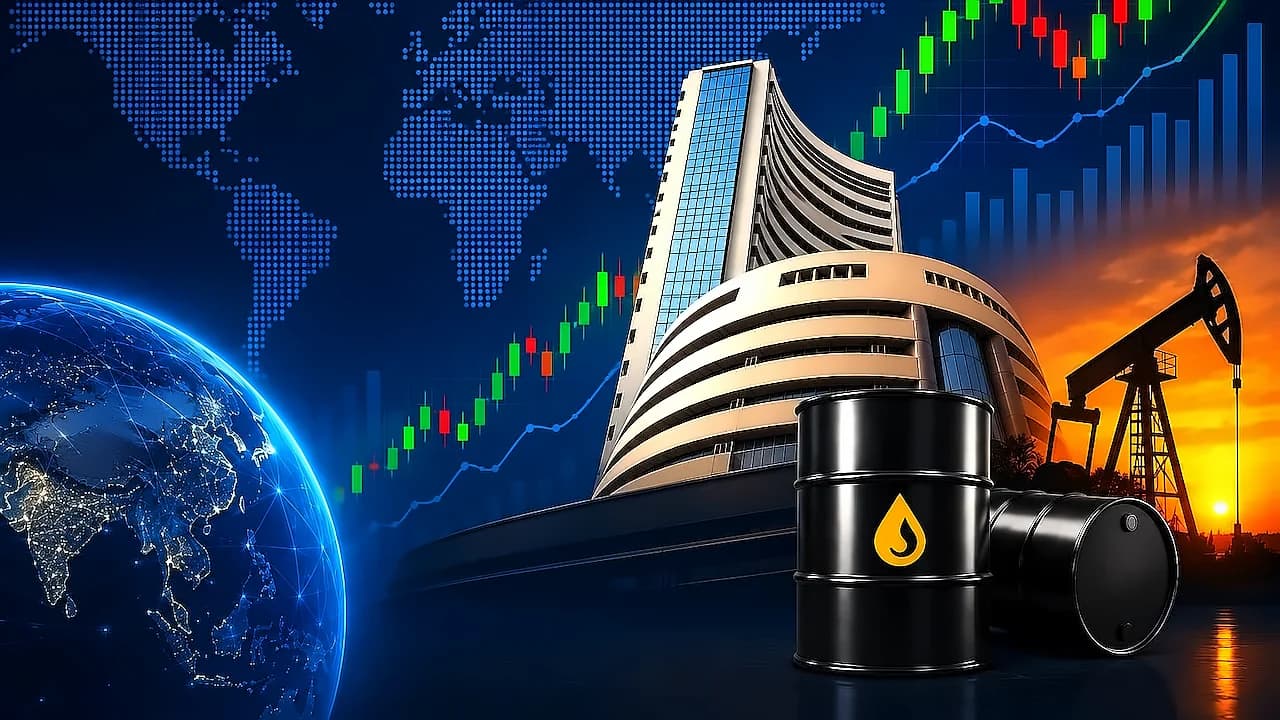
Indian equity markets are facing significant pressure as Brent crude oil prices rose 0.17% to $91.02 per barrel, adding to concerns over inflation and the economic impact of prolonged geopolitical tensions. According to Shrikant Chouhan, Head of Equity Research at Kotak Securities, markets remained under pressure as there have been no positive cues from the US-Iran talks, especially with the MOU having expired and crude oil prices moving higher. The pressure on crude prices could also have implications for the Indian rupee, inflation and foreign investor flows, making developments in the oil market particularly important for investors in the near term. As per Geojit Investments Limited, concerns over rising US bond yields and faltering global market indicators have further contributed to the cautious investor stance.
As of Tuesday, the Sensex is trading at 77,235.46, down 492.70 points or 0.63% while the Nifty 50 stands at 24,154.90, declining 132.75 points or 0.55%. According to The Hindu BusinessLine, the Nifty 50 opened at 24,343.45 and the Sensex at 77,892.92 before sliding further in early trade. The Nifty has slipped below the 24,300 area, a widely watched technical level that can weaken trader confidence. The index fell 493.80 points, or 0.63%, to 77,234.36 during fag-end trading, marking its third consecutive session of losses. The Nifty has extended its losing streak to six sessions, with the previous session seeing the Nifty 50 close at 24,154.90, down 132.75 points or 0.55%, while the Sensex dropped 492.70 points or 0.63% to close at 77,235.46. The price adjustments on account of the Closing Auction Session (CAS) resulted in the benchmark indices dropping nearly 0.2% in the last 15 minutes before trade close.
The current market decline is particularly affecting IT and PSU banks sectors, which have become key areas of concern for investors. Among the Sensex constituents, Asian Paints, Infosys, HCL Technologies, Bharti Airtel, Tata Consultancy Services, and Hindustan Unilever were among the biggest losers. The weakness in these heavyweight sectors is making the indices struggle to recover decisively. Nifty IT was down 1.89%, leading the sectoral losses amid fears of sustained high interest rates that threaten global technology expenditure. The Nifty PSU Bank slid 0.81%, reflecting continued pressure on public sector banking stocks. However, some sectors showed resilience with Nifty Auto edging up by 0.27%, Nifty Media rising 0.28%, and Nifty Pharma by 0.17%. The Nifty FMCG decreased by 0.78%, while Nifty Metal fell 0.59%. Axis Bank, Power Grid Corporation, Mahindra & Mahindra, and Bajaj Finance were among the gainers. Nifty Midcap 150 fell 0.4%, while Nifty Smallcap 250 rose 0.2%. Of the total 4,530 stocks on the BSE, 1,890 advanced and 2,426 declined.
Despite the market decline, Foreign Institutional Investors (FPIs) net bought shares worth ₹1,651.5 crore on Tuesday, while Domestic Institutional Investors were buyers to the tune of ₹2,579 crore, providing some support to the markets. According to Shrikant Chouhan from Kotak Securities, oil sustaining above the $85 mark is a key concern, as it raises inflationary risks, which is already reflected in the sharp rise in US 10-year and 30-year bond yields. He noted that we believe this could lead to outflows from both emerging and developed equity markets. In Asia, Japan fell 2.5%, South Korea declined 1.55%, Taiwan dropped 1.2%, while China advanced 0.2% and Hong Kong rose 0.1%. The STOXX 600 index was down 0.5% at the time of going to press.
According to Dharmesh Shah, Head of Technical Research at ICICI Securities, the market's sentiment has shifted, with the index now consolidating within the 24,000-24,500 range, and this phase of consolidation could continue over the next few trading sessions. Shah said after 1,100-point rally, the Nifty is undergoing a retracement and may find support in the 23,900-24,000 zone before resuming its upward trajectory towards the upper end of the channel at 24,500-24,600. Technical indicators suggest the indices could move in a band in the near term. While Q1 earnings was better than expected, a decline in crude oil prices, a reversal in US 10-year bond yields, or a de-escalation of tensions in West Asia could act as positive catalysts and trigger the market's next rally.