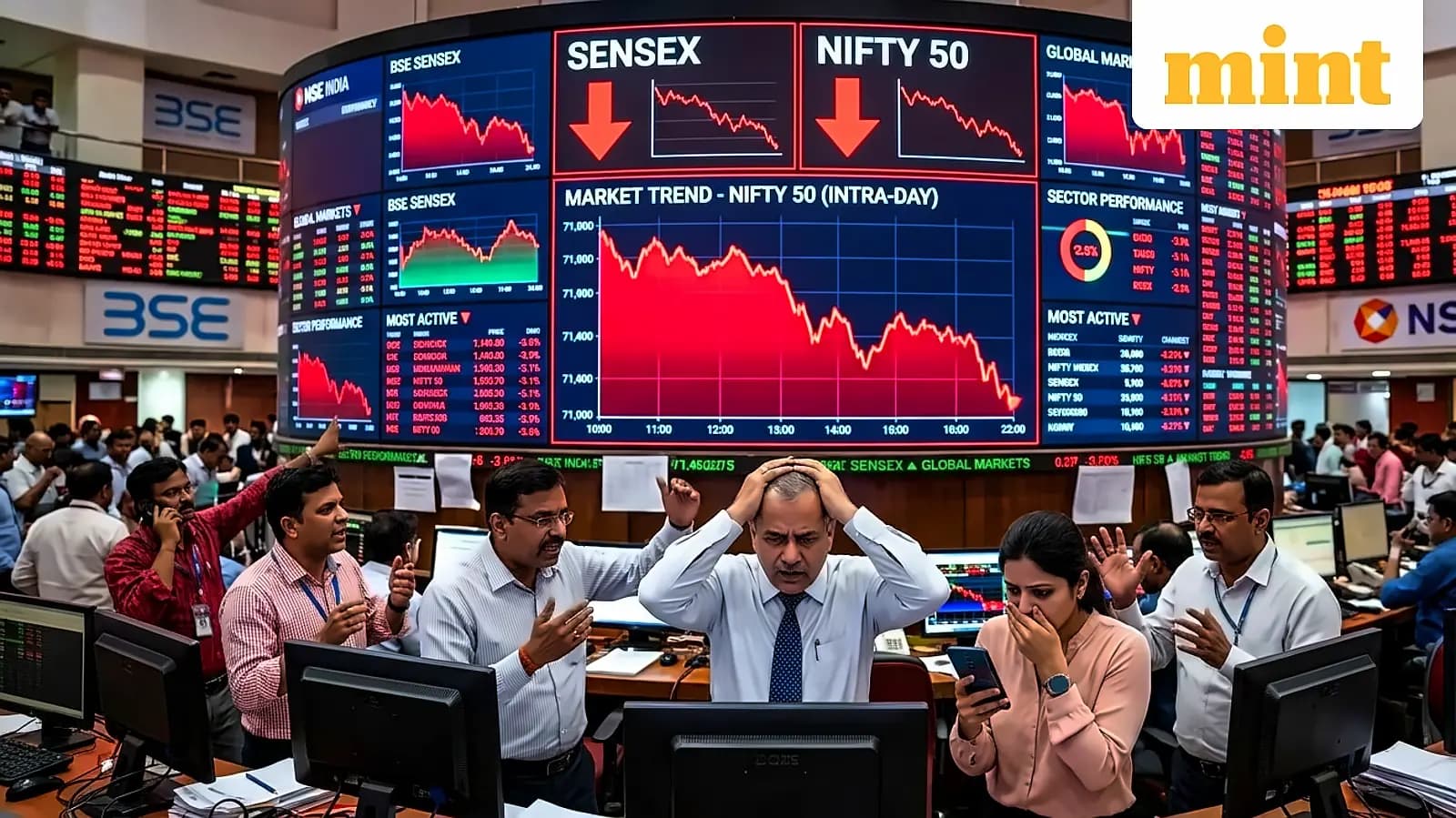
Indian stock markets opened sharply lower on Monday, with BSE Sensex crashing more than 300 points and testing 77,700 levels, while NSE Nifty 50 slipped 14.10 points to trade under 24,351.90 as of 9:03 AM. According to The Hindu, market benchmark indices Sensex and Nifty declined in early trade on Monday (August 17, 2026) as the prolonged U.S.-Iran impasse weighed heavily on investors' sentiment. The subdued domestic cues come after Indian equities faced profit-booking last week, with the Nifty and Sensex both ending the week lower. As per Religare Broking, investor sentiment remained subdued amid a renewed rise in crude oil prices, with Brent crude moving towards the $90 per barrel mark as hopes of an early US-Iran agreement faded. The mixed global backdrop is likely to keep investors selective, with market participants also watching developments in crude oil and geopolitical tensions for fresh direction.
In a troubling trend, Nifty and Sensex slipped for a fifth day on Monday, as escalating oil prices and struggling IT stocks soured investor confidence. According to The Economic Times, benchmark indices Nifty and Sensex extended their decline to fifth straight session on Monday, as a sharp rise in oil prices weighed on investor sentiment. The broader market represented by Nifty Midcap 150 and Smallcap 100 also opened in the red, down 0.3% and 0.15% respectively. IT and PSU stocks were the major drags, while pharma and metal stocks edged higher soon after the opening bell. Among Sensex constituents, Major laggards included HUL, Bajaj Finserv, UltraTech Cement, State Bank of India, L&T and NTPC, while Eternal, BEL, Axis Bank, and M&M gained marginally. However, Bucking the trend, Bajaj Finance, Eternal and Titan shares were trading in the green with marginal gains.
Among the top gainers in early trade were Eternal (up 1.7%), Titan (up 1.4%), Adani Ports (up 0.7%), and Bajaj Finance (up 0.6%). According to NSE data, out of the 50 stocks listed under NIFTY50, 39 stocks were trading in the red zone, while 11 stocks were trading positive as of the morning market hours. Among the top laggards, Tata Steel, Axis Bank, InterGlobe Aviation, Tech Mahindra, Power Grid and ITC were among the major decliners. The GIFT NIFTY futures of the August contract were trading 0.17% lower at 24,422.50 points before the opening bell, indicating a marginally higher opening as investors continue to assess the mixed global market cues.
Oil prices gained 1% in early Asian trade on Monday as tanker traffic through the Strait of Hormuz slowed over the weekend, with no peace deal in sight between the United States and Iran to end the conflict in the Middle East. According to The Economic Times, Brent crude futures rose 60 cents, or 0.7%, to $89, while U.S. West Texas Intermediate crude futures slipped 40 cents to $83 a barrel. The unresolved U.S.-Iran standoff continues to underpin crude oil prices, leaving oil-importing economies such as India more vulnerable to inflationary pressures and currency volatility. Over the weekend, Iranian Foreign Minister Abbas Araqchi said Iran had not decided to resume talks with the U.S., while U.S. President Donald Trump called on Americans to accept slightly higher gasoline prices while the conflict continues. Higher crude prices remain an important variable for Indian markets as investors assess their potential implications for inflation, the rupee and corporate earnings.
The S&P 500 slipped 0.2% on Friday to close at 7,785.76, retreating after a record-setting session, but still posted its third straight weekly gain. According to The Economic Times, the Nasdaq Composite fell 0.3% to 26,729.16, while the Dow Jones Industrial Average declined 107.58 points, or 0.2%, to end at 53,732.41. The mixed performance on Wall Street followed a period of heightened investor focus on interest rate expectations and global economic signals. For the week, the S&P 500 gained 0.4%, while the Nasdaq rose 0.1% for its third consecutive weekly advance. Asian shares were largely subdued on Monday as investors remained focused on oil prices, which posted sizeable gains last week amid a lack of progress towards ending the Iran war, keeping inflation risks tilted higher. MSCI's broadest index of Asia-Pacific shares outside Japan was flat, while Japan's Nikkei gained 0.4%.
According to VK Vijayakumar, Chief Investment Strategist at Geojit Investments Limited, the market is expected to remain in the 24,000-24,600 range in the near term until fresh triggers emerge to break the range. As per The Economic Times, Vijayakumar said crude oil prices at $89, with no immediate resolution to the crisis in sight, are likely to limit any upside in the market. The Nifty is also being weighed down by the weak performance of major IT and large banking stocks. Vijayakumar said investors should look beyond the Nifty 50 for short-term opportunities, with considerable stock-specific action likely in the mid- and small-cap segments. According to Shrikant Chouhan, Head of Equity Research at Kotak Securities, the short-term market outlook remains weak, while a sustained move above 24,200 for the Nifty and 77,500 for the Sensex could trigger a technical rebound. If these levels hold, the Nifty could move towards 24,500, while the Sensex could target 78,400, with further strength potentially taking the indices towards 24,700 and 79,000 respectively.