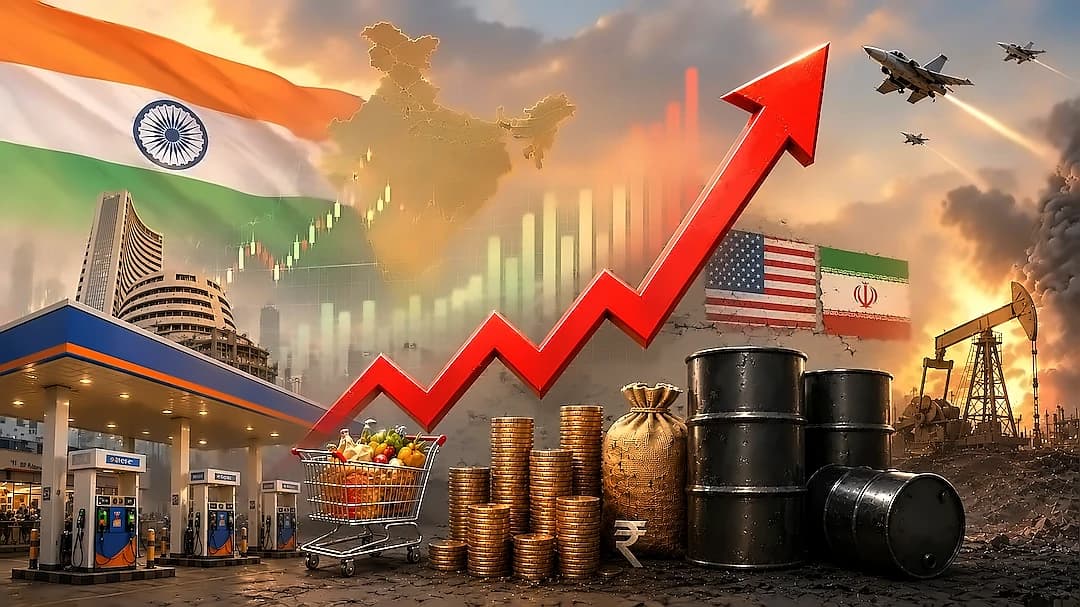
India's economy demonstrated remarkable resilience during 2025-26, with real GDP growth estimated at 7.7 per cent, accelerating from 7.1 per cent in the previous year, according to SEBI's Annual Report 2025-26. The Securities and Exchange Board attributed this performance to robust domestic demand, government capital expenditure, and a strong services sector. Private consumption and investment remained the primary growth drivers, accounting for 56.7 per cent and 31.9 per cent of nominal GDP respectively. Looking ahead, the IMF projects 6.5 per cent growth for India in 2026-27, significantly outpacing global growth of 3.1 per cent. India's relatively strong domestic fundamentals, fiscal consolidation, improving inflation dynamics, stronger corporate balance sheets, and resilient domestic institutional investment are expected to support its relative outperformance. Latest OPEC data for Q2 2026 confirms that consumption indicators held up, unemployment was broadly stable, industrial production growth remained firm and non-food credit growth strengthened further, while the services sector continued to provide steady momentum.
Indian equities faced significant headwinds in 2025-26, with the Nifty 50 and broader indices declining around 14 per cent in US dollar terms. According to SEBI's report, this weakness reflected sustained foreign portfolio investor (FPI) selling, rupee depreciation, valuation concerns, slower earnings growth, and the impact of the Middle East conflict. FPI equity outflows from India reached a record USD 19.7 billion during the year. However, domestic institutional investors, particularly mutual funds, provided significant support through robust investment flows. Despite these challenges, SEBI remains optimistic about India's potential to outperform globally, noting that a restructuring of global supply chains could create new investment opportunities for India. The rupee has been among the weaker major emerging-market currencies, weakening to record lows against the dollar as higher energy costs weighed on the external balance, with inflation risks rising accordingly.
SEBI has identified three key external risks that could significantly impact Indian markets in 2026-27. A prolonged Middle East conflict and crude oil prices above USD 100 per barrel remain the most significant concern, as India relies heavily on imported crude oil. Higher energy costs could push up the country's import bill and put pressure on the current account deficit, while also creating additional inflationary pressure. Geopolitical tensions and volatile foreign investment flows represent another major risk factor, with sustained foreign capital outflows potentially limiting market recovery. The regulator noted that a sustained easing of tensions in the Middle East and return to more stable energy prices could prove particularly important for restoring foreign investor confidence and improving capital flows to Indian equities. Latest developments show that renewed geopolitical tensions have revived external downside risks via the energy import bill and the currency, with the monsoon being the principal domestic risk as El Niño continues to threaten crop yields and rural incomes.
Despite external challenges, SEBI's assessment presents a mixed but ultimately positive picture for Indian financial markets in 2026-27. Strong domestic demand, economic growth, improving inflation trends, corporate financial strength, and steady domestic institutional participation provide a solid foundation. However, markets remain exposed to developments that India cannot directly control. The regulator sees potential opportunities emerging from changes in global supply chains, as companies look to diversify production and sourcing networks, which could attract additional investment and strengthen India's position as a global manufacturing and investment destination. For investors, the coming year is likely to involve balancing India's domestic strengths with a potentially volatile global environment, where the effectiveness of domestic resilience in translating into market performance will depend significantly on external factors beyond India's control. India's near-term outlook remains robust, supported by a resilient services sector, steady momentum in investment and firm industrial activity, with industrial production accelerating in June and capital goods output being particularly strong.