India's economic story remains on a path of 'cautious resilience' in the near term, even as global uncertainties continue to grow, according to the Finance Ministry's Monthly Economic Review for May 2026. The ministry noted that strong domestic fundamentals support growth, with strong services exports, adequate foreign exchange reserves and a stable labour market providing a firm foundation. However, the department cautioned that the ongoing Middle East conflict, rising crude oil prices and the prospect of a below-normal monsoon call for sustained policy vigilance across monetary, fiscal and structural dimensions. The ministry emphasized that navigating the current financial year, which ends March 2027, will require agility across all policy dimensions to safeguard growth momentum and keep inflation durably anchored.
India's industrial and services sectors demonstrated robust performance in February 2026, with the Purchasing Managers Index (PMI) for manufacturing rising to a four-month high of 56.9 while the services PMI stood at 58.1, indicating sustained expansion across both sectors. Industrial activity was supported by strong performance in domestic demand-driven segments such as steel and cement, with steel production growing by 7.2% and cement output by 9.3% in February 2026, reflecting continued infrastructure momentum and public capital expenditure support. Considering the demand side, retail automobile sales expanded by 25.2% YoY in February 2026, with strong growth across two-wheelers, commercial vehicles and tractors, while digital payments volume increased by 26.6%, indicating resilient consumption demand.
India's external sector remains supported by resilient services exports, strong foreign exchange reserves, and diversified trade linkages, even as rising crude oil prices and West Asia disruptions increase near-term risks. During April-February FY26, total exports of goods and services grew by 5.8% YoY to $790.9 billion, with merchandise exports growing modestly by 1.8% while non-petroleum, non-gems and jewellery exports increased by 5.7%, led by strong growth in electronic goods exports. Services exports remained the key strength of the external sector, rising by 10.2% to $387.9 billion and generating a net services surplus of $201 billion, covering 64.7% of the merchandise trade deficit. Total imports rose by 7.4% to $900.5 billion, resulting in a total trade deficit of $109.7 billion. India's foreign exchange reserves remained comfortable at $709.8 billion as of March 13, 2026, providing over 11 months of import cover and covering around 95% of external debt outstanding, strengthening resilience against global volatility.
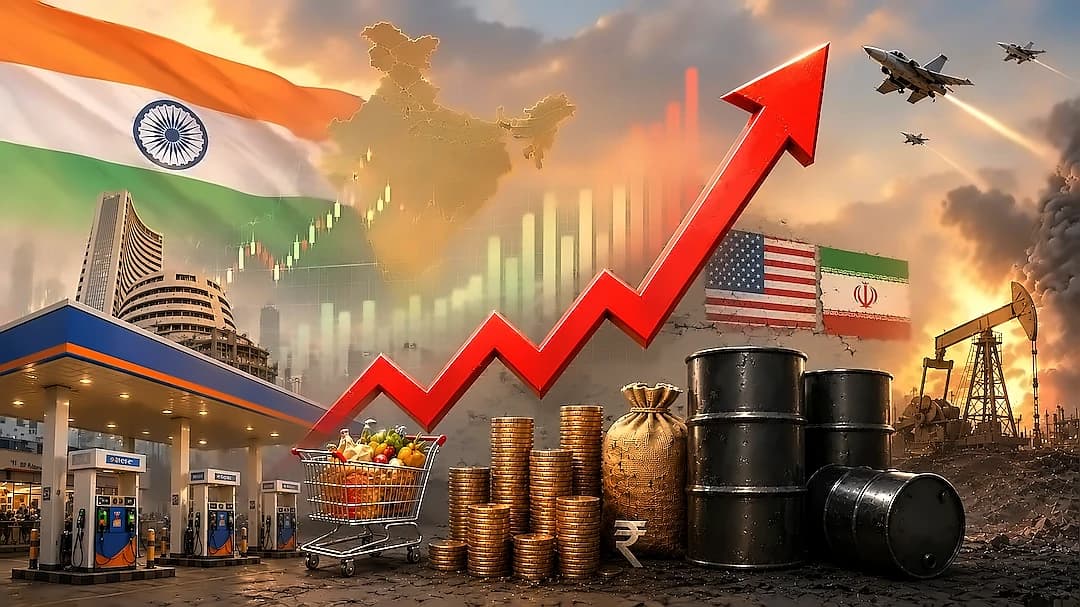
The Finance Ministry has flagged emerging inflation risks in the economy, warning that rising wholesale prices, elevated energy costs and recent increases in petrol and diesel prices could gradually pass through to consumers in the coming months. In its Monthly Economic Review for May 2026, the ministry said the current divergence between retail and wholesale inflation indicates that upstream cost pressures are building in the economy. While India's retail inflation remained well within the RBI's tolerance band at 3.48% in April 2026, wholesale price inflation surged to a 42-month high of 8.3%, creating significant concerns. The ministry noted that a below-normal monsoon could further add to food price pressures, with the India Meteorological Department lowering its 2026 southwest monsoon forecast to 90% of the long-period average from the earlier predicted 92%. The recent hike in petrol and diesel prices by ₹7.35 and ₹7.53 per litre respectively may activate both direct and indirect transmission channels across the economy.
The West Asia conflict has accelerated significant foreign investor exodus from Indian markets, with foreign portfolio investors recording cumulative outflows of $23.6 billion from Indian markets since the onset of the conflict through May 21. After recording net inflows in February, FPIs have made a beeline for the exit, with the bulk of outflows concentrated in the equity segment reflecting heightened global risk aversion and portfolio rebalancing away from emerging-market assets. The ministry cautioned that higher crude oil prices and slowing growth in major economies are creating challenges that India cannot fully insulate itself from, with the global environment becoming materially more challenging since the onset of the West Asia conflict. Despite these headwinds, several parts of the economy continued to perform well, with e-way bill generation, manufacturing and services PMI, and electricity consumption remaining in expansionary territory.
The Finance Ministry emphasized that policy will need to remain agile across monetary, fiscal, and structural dimensions to navigate this period of compounded uncertainty, with second-round inflationary effects and their persistence must be evident in the data for policy responses to be triggered. The ministry noted that strong services exports and sustained investment commitments continue to provide support to growth, while managing growth and inflation in FY27 will require careful policy action as global uncertainties continue. The report cautioned that a deficient monsoon may also pose headwinds to India's overall consumption demand, the largest contributor to GDP, with any significant rainfall deficit coupled with current geopolitical conditions potentially translating into food inflation and weakening rural demand. Despite multiple headwinds, India is building resilience through infrastructure, manufacturing incentives, and reduced import dependence, positioning itself as an investment destination amidst global uncertainty.