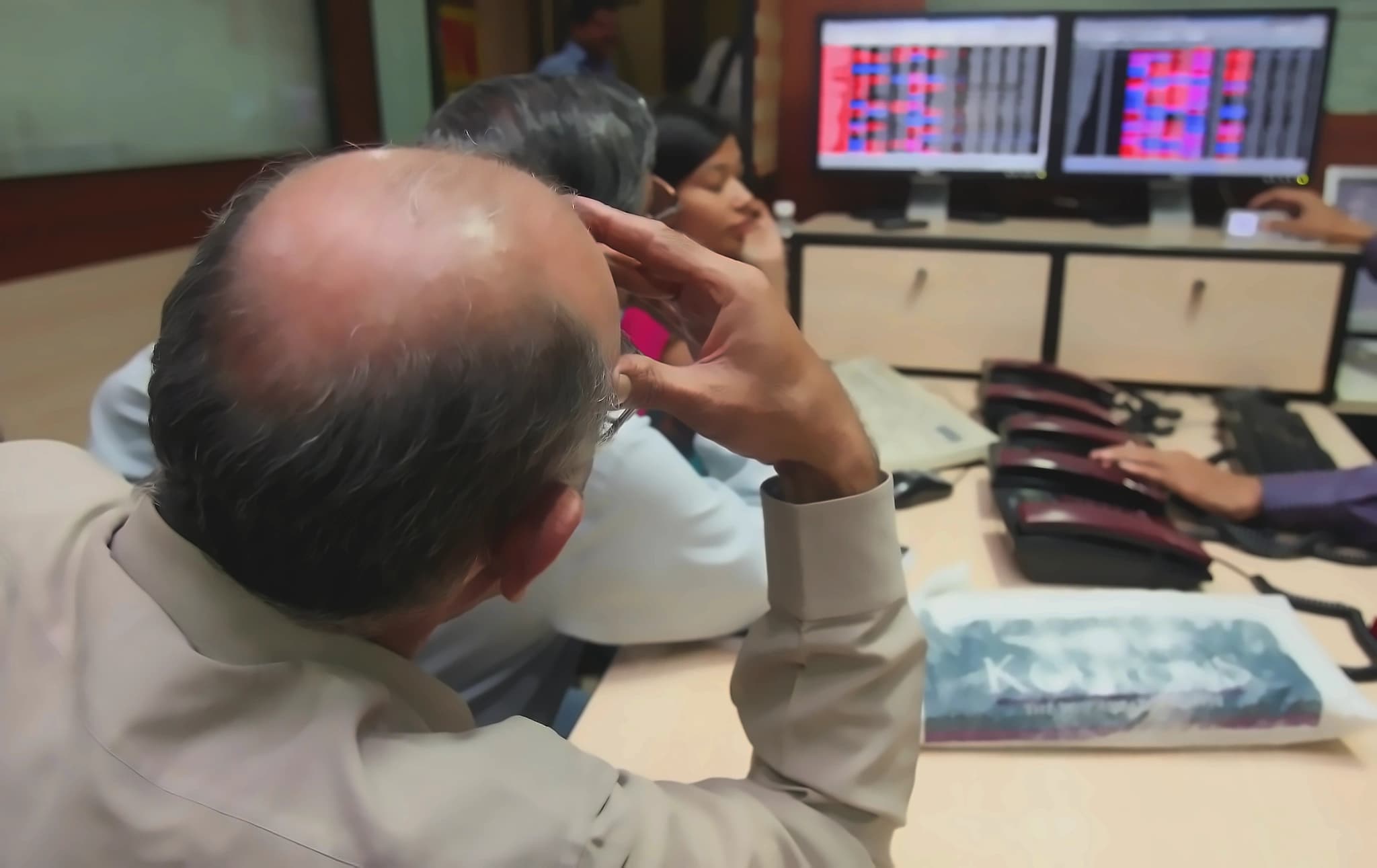
The Indian stock market benchmarks ended in the red on Tuesday, with BSE Sensex closing 417 points, or 0.54%, lower at 76,886.91 and NSE Nifty 50 declining 97 points, or 0.40%, to settle at 23,995.70. According to The Hindu BusinessLine, the session was volatile from the start with the Nifty opening at 24,050.65, climbing to an intraday high of 24,181.80, but failing to hold gains and drifting to a low of 23,957.05 before closing near the 24,000 mark. The decline was primarily attributed to banking heavyweights dragging the market lower, with the Nifty Bank index underperforming, falling 863.95 points or 1.45% to close at 55,400.35 - marking its fifth consecutive session of decline and a fresh breakdown below last week's low. However, the broader market showed resilience with Nifty Midcap 100 index gaining 0.28% after breaking above the key resistance zone of 60,350–60,400 and Nifty Smallcap 100 index advancing 0.42%, clearing the 17,900–17,920 range. This divergence suggests selective buying interest in smaller stocks even as large-cap sentiment remained cautious.
Global crude oil benchmark Brent Crude futures surged past $110 per barrel, jumping 2.97% to hit $111.4 per barrel, extending its winning run to the seventh session as reported by The Hindu BusinessLine. On the domestic front, domestic crude futures rose over 3% to near ₹9,400 per barrel, while natural gas jumped more than 7%. The ongoing US-Iran conflict and disruptions in the Strait of Hormuz have pushed Brent crude oil prices above $100 per barrel. Given that India imports nearly 85% of its oil needs, the resulting rise is likely to squeeze margins for oil PSUs, while the weakening rupee could further aggravate pressure on these companies. Among sectoral movers, Oil & Gas emerged as the top sectoral gainer, rising around 1.5%, with ONGC and Adani Enterprises leading the charge. Metals, Chemicals and select pharma stocks also attracted buying, while precious metals came under pressure despite the risk-off backdrop, with MCX gold falling over 0.8% and silver dropping around 1.8% as analysts noted a rotation of inflation-hedge capital toward energy assets.
The banking sector faced significant pressure following the Reserve Bank of India's finalisation of the Expected Credit Loss (ECL) framework, which shifts banks to a forward-looking provisioning model. As per The Hindu BusinessLine, PSU Banks declined nearly 2% and private banks slipped close to 1%, with Axis Bank and State Bank of India among the notable laggards. The Bank Nifty fell 863.95 points or 1.45% to close at 55,400.35, marking its fifth consecutive session of decline and a fresh breakdown below last week's low. In the 'Directions on Asset Classification, Provisioning, and Income Recognition for Commercial Banks', the RBI said banks had given feedback seeking more time for the transition as they needed to build databases and models and upgrade systems. Declining to accept the feedback on the draft first issued on October 7, 2025, the RBI said banks have been provided a one-year timeline to prepare their internal systems for implementation of the new framework. Foreign institutional investors have been net sellers of ₹44,281 crore through April, adding to the liquidity pressure and maintaining the defensive, sector-specific approach expected by market participants.
As reported by Mint, Abhinav Tiwari of Bonanza noted that OMCs remain vulnerable in the near term due to pricing controls, as the government has kept retail prices of fuel unchanged. Devarsh Vakil, Head of Prime Research at HDFC Securities, expects a weak outlook for OMCs as rising crude oil prices are likely to compress their marketing margins. He added that every 50 paise per litre change in fuel margins could lead to a 7–10% impact on EBITDA. An increase in crude oil prices typically weighs on OMCs since crude forms the majority of their input costs, with rising prices increasing the cost of refining and producing fuel. However, Oil & Gas emerged as the top sectoral gainer, rising around 1.5%, with ONGC and Adani Enterprises leading the charge despite the challenging environment. The Indian rupee also weakened further, crossing the 94.5 level against the US dollar, reflecting elevated energy costs and persistent geopolitical uncertainty, while India VIX eased marginally by 1.80% to close at 18.04 though analysts noted the cooling in volatility has not translated to improved market breadth.
From the Sensex basket, Oil and Natural Gas Corporation Ltd, Adani Enterprises Ltd, Coal India Ltd, Nestle India Ltd, Reliance Industries Ltd and Bharti Airtel Ltd were the major gainers, while InterGlobe Aviation Ltd, HCL Technologies Ltd, Axis Bank Ltd, Shriram Finance Ltd, UltraTech Cement Ltd and Infosys Ltd were the biggest laggards. Within the Nifty pack, Tata Chemicals, Oil India and Indus Towers were the top gainers, while Eternal, InterGlobe Aviation, HCLTech and Axis Bank led declines. Maruti Suzuki fell nearly 3% after reporting margins below estimates, and Dalmia Bharat dropped more than 3% after topline growth missed estimates. Cohance Life extended gains from the previous session and rose 13% in Tuesday's trade, while Reliance added to the previous session's gains and rose more than 5% over the last two sessions. According to The Hindu BusinessLine, Coal India topped Nifty 50 gainers with a 2.76% rise, while SBI (-0.89%), Eternal (-0.55%), IndiGo (-0.54%), Axis Bank (-0.46%), and Trent (-0.46%) were among the top losers. 293 of the Nifty 500 stocks ended in the red, with the advance-decline ratio skewed in favour of declines, though both the Midcap/Nifty and Smallcap/Nifty ratio charts scaled fresh highs, reinforcing the ongoing trend of broader market outperformance.