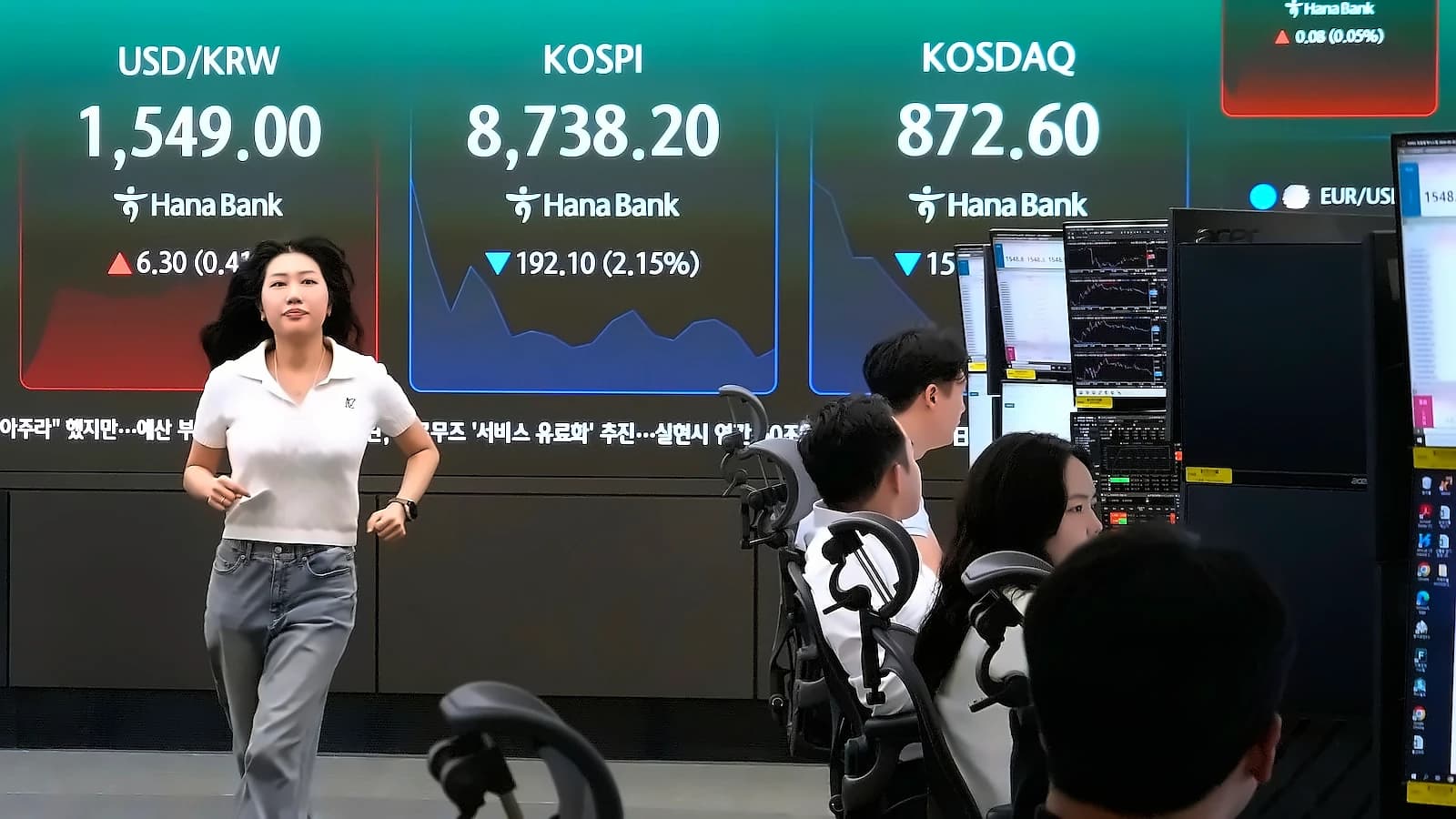
South Korea's financial authorities convened an emergency meeting on the evening of July 29 after the KOSPI lost ₹864.5 trillion in value across two trading sessions. According to Bloomberg, Finance Minister Koo Yun-cheol hosted the session, which started at 6 pm local time, with Bank of Korea Governor Shin Hyun-song joining him. FSC Chairman Lee Eog-weon and Financial Supervisory Service Governor Lee Chan-jin also participated in the emergency meeting. The session came as South Korea's KOSPI closed at 5,663.24, down 5.98% on Wednesday, triggering a market-wide circuit breaker for a second straight day. Korea Exchange halted trading in both markets on each day, marking the first time circuit breakers hit both sessions on consecutive days. Lawmakers had questioned senior officials repeatedly in parliament on July 29, tracing part of the selloff to single-stock leveraged products launched in May that they argued had magnified price swings and concentrated speculative trading in a small group of blue-chip stocks.
South Korean AI memory chip giant SK Hynix delivered what analysts considered disappointing Q2 results, despite strong year-over-year growth. According to reports from Reuters, the company reported record Q2 operating profit of ₹60.5 trillion won and revenue of ₹79.3 trillion won, representing growth of more than six-fold and 257% respectively from the previous year. However, the operating profit fell short of the ₹64 trillion won expected by analysts, delivering exactly the type of outcome that would normally weigh on AI-linked stocks. As Gary Tan, portfolio manager at Allspring Global Investments, noted to Reuters, "SK Hynix delivered strong results, but in today's AI market, strong is no longer enough." The earnings update came as SK Hynix shares tumbled 9.61% following the disappointing results, reflecting immediate market reaction to the miss against expectations. Investors were looking for additional catalysts, particularly around long-term agreements and shareholder returns, to support a memory sector that has become the epicentre of the AI trade.
Asian stocks experienced a severe selloff on Wednesday, extending the vicious bearish trend as investor anxiety about AI valuations and returns on massive spending rattled markets ahead of crucial earnings from major tech firms. According to The Times of India, South Korea's KOSPI plunged 6% to close at 5,663.24, its lowest level since early April, after falling more than 8% during intraday trading before recovering some losses. Samsung Electronics also lost 4.8%, adding to pressure on the index. The rout comes as investors fret about whether the massive capital expenditure in AI will deliver returns, particularly after Alphabet and Tesla spooked markets last week with negative cash flow reports. Sean Teo, sales trader at Saxo in Singapore, told Reuters that "this round of earnings would need to prove that the huge capital expenditure has paid off else we may see the market drag further."
Market analysts suggest that if SK Hynix and broader AI-linked names across Asia refuse to break lower on the earnings update, it could signal a potential tactical bear squeeze. According to the analysis from Investing.com India, markets that stop falling on bearish news often indicate something about positioning and sentiment. The setup comes amid thin pre-Fed liquidity and looming hyperscaler capex updates from Meta and Microsoft, creating conditions for a potential bear hunt. Normally, renewed Middle East tensions wouldn't be associated with Nikkei upside, but AI-related stocks have generally outperformed relative to cyclicals during such periods, suggesting the latest headlines need not scupper the setup. This represents a tactical long setup that goes completely against the prevailing bearish trend, making capital protection paramount.
For potential bullish scenarios, analysts suggest that if the price breaks above ₹62,683 and holds there, long positions could be established with tight stops beneath for protection, targeting ₹63,310 initially, followed by ₹64,250. Beyond that level, the June downtrend comes into play just above ₹65,000, marking the ultimate upside target. However, should the price break convincingly beneath ₹61,844, the bullish setup would be nullified, pointing instead to an extension of the prevailing bearish trend that may see further unwind towards support at ₹61,000. Given this is a tactical long setup that goes against the prevailing trend, traders should approach with caution, as blindly buying the dip is asking for trouble. The current market conditions suggest that any recovery attempt would face significant headwinds from the broader AI sector concerns and upcoming earnings from major tech companies.