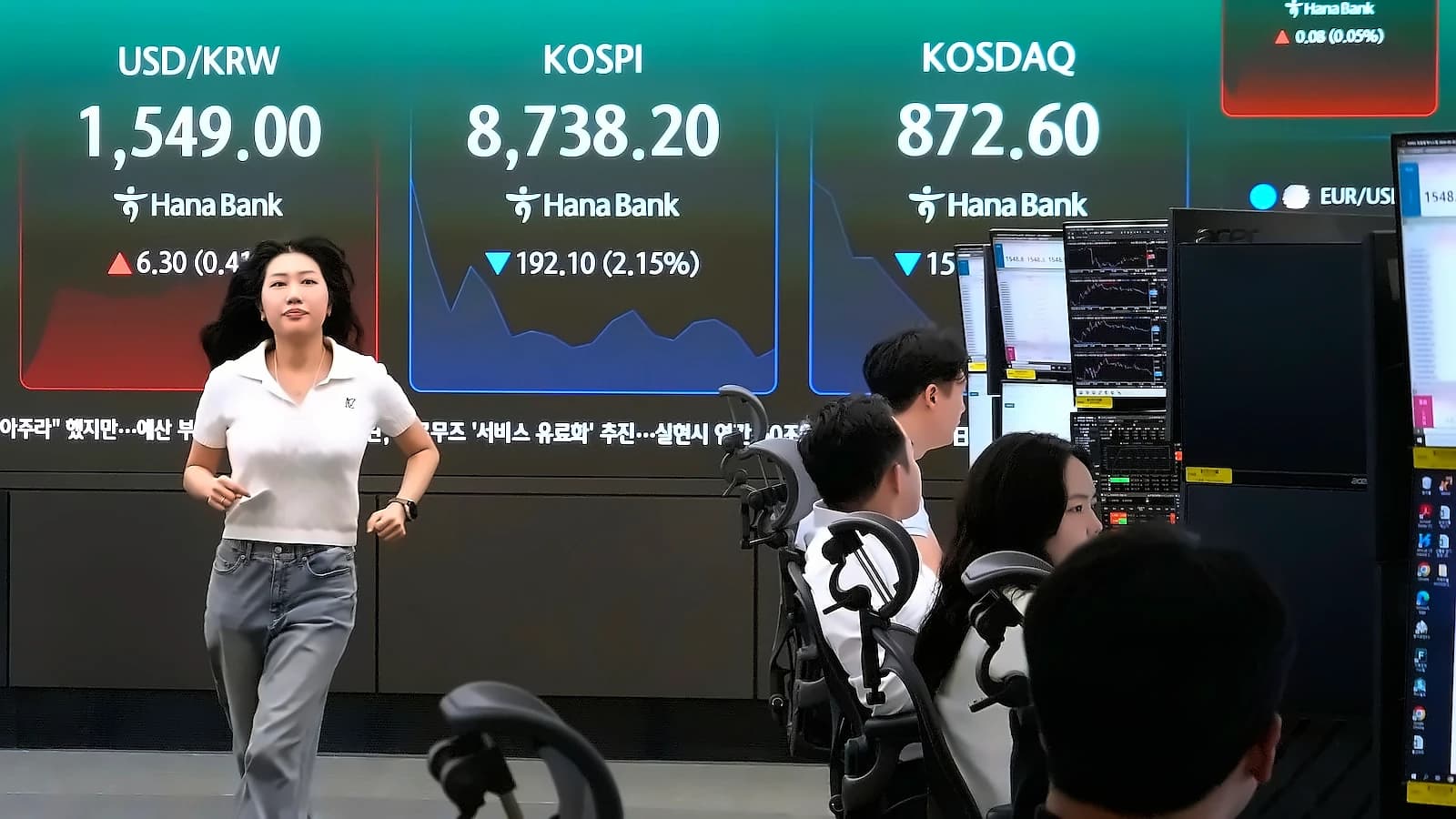
Asian markets showed signs of recovery on Monday following a crowded short unwind reversal in US technology stocks, with Nasdaq leading the rebound after last week's record selling in big tech. According to Investing.com India, the Magnificent Seven bounced meaningfully into the New York close, with buyers returning to names they were throwing overboard only days earlier. The KOSPI Index dropped 5.81% last week but is now positioned for a much cleaner opening, giving Korea's increasingly ambitious AI buildout fresh oxygen. Korea remains a higher-beta version of the global AI trade, with memory, industrial ambition and domestic positioning all magnifying the US move, making it the echo chamber of the AI boom where US capex optimism goes in at one end and memory names, leveraged products and domestic retail enthusiasm come out louder at the other.
Apple plunged by 6.1% on Wall Street on Thursday after the iPhone-maker raised prices on its MacBook and iPad by 25%, citing higher component costs including chips. The price increases show that consumers will have to fit some of the bill for these huge investments in AI, as technology giants have ploughed hundreds of billions into building AI infrastructure. The AI boom has led to a shortage of memory chips, with the chip shortage affecting multiple technology companies. U.S. semiconductor companies struggled in premarket trading, with Intel shedding just over 3%, Sandisk falling 4.74%, Arm losing 3.66% and Marvell dropping 3.29%. The Nasdaq Composite fell for a fourth straight session overnight, with the tech-heavy index dropping 0.46% as a 6% plunge in Apple overshadowed Micron's stronger-than-expected earnings. Stephen Innes of SPI Asset Management said Apple's price increases showed the cost of AI had started to filter down into consumer demand.
SoftBank Group Corp. lost 13.4% in Tokyo trading, following reports that OpenAI may delay its planned initial public offering until 2027, as reported by Business Standard. This development postpones potential gains for the company and highlights investor concerns about the timeline for AI investment returns. The technology giant's significant decline reflects broader market uncertainty about AI infrastructure costs and uncertain returns on AI investments. Andrew Jackson, an equity strategist at Ortus Advisors, said investor enthusiasm for SoftBank may also be capped by reports that OpenAI could delay its initial public offering until next year as it struggles to secure demand at a $1 trillion valuation.
In South Korea, Samsung Electronics lost 6.28% while SK Hynix fell 8.95%, according to latest trading data. The weakness also spilled into Asia's semiconductor sector, with South Korea's SK Hynix falling more than 8% and Samsung Electronics losing around 9%. Technology-focused investment holding company SK Square was down around 9.43%, while LG Electronics was 3.5% lower. Japan's Advantest declined nearly 10%, while Tokyo Electron was down 3.21%. Taiwan's TSMC fell 2.09%, while Hon Hai was 3.5% lower. Kioxia slumped 11.24%, narrowly holding the 90,000 yen mark intraday to close at 92,200 yen. The decline in Samsung, the country's biggest company, and chipmaker SK Hynix, which like Samsung is collaborating with Nvidia on artificial intelligence, highlights investor concerns about memory costs, capital expenditure requirements, and the durability of AI demand.
Second-quarter earnings season is the next real test for the AI boom, with AI infrastructure expected to contribute nearly 60% of S&P 500 EPS growth this quarter. According to Investing.com India, Micron and NVIDIA alone are expected to account for more than 40% of that contribution, while consensus expects the median S&P 500 company to grow earnings by roughly 9%. The S&P 500's roughly 21% gain over the past twelve months has been driven entirely by earnings rather than valuation expansion, giving the rally real muscle but also meaning earnings are now the engine, the gearbox and the spare tyre with very little room for the machine to cough. The market is beginning to ask a different question, moving from macro volatility back toward micro volatility as it wants a receipt for AI investments rather than applause for the size of the investment. For Korea, the answer matters more than almost anywhere else as its AI foundry aspiration cannot survive on the idea of semiconductor scarcity alone, with the investment having to become orders, the orders having to become earnings, and the earnings having to justify both the capital expenditure and the excitement now being built around it.