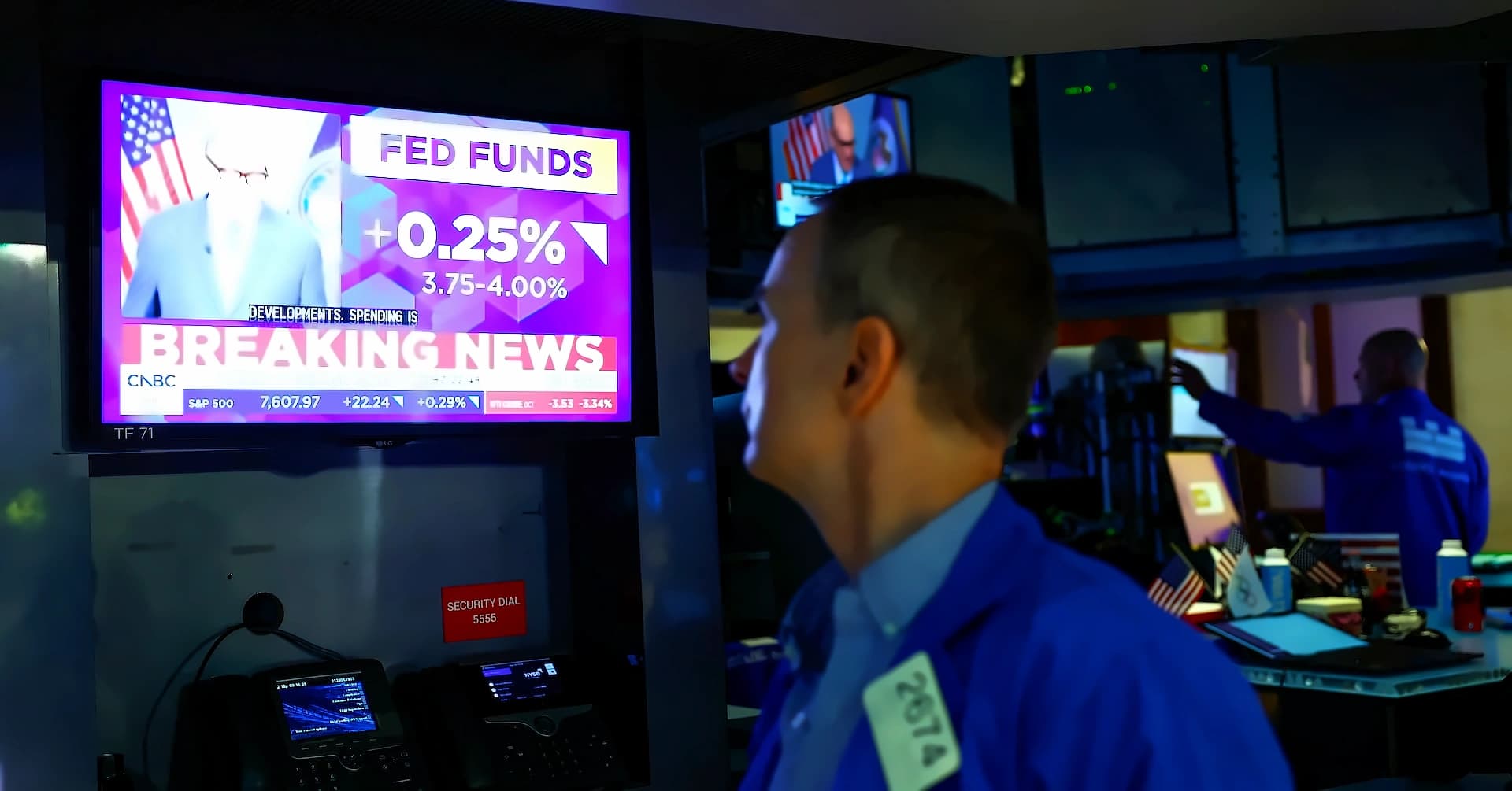
The Federal Reserve delivered its first rate hike in three years, raising the federal funds target range to 3.75%-4.00% with a 12-0 vote in favor, marking the first increase since July 2023. As per Goodreturns, Kevin Warsh-led FOMC cited inflation as the primary driver, with Warsh stating "The plain fact is that inflation is too high and has been for too long." Sixteen of the 18 officials submitting projections indicated a preference for further tightening this year, keeping the prospect of another increase firmly in focus. Markets subsequently priced the probability of another rate hike in October at around 55%, up from 42.5% last Friday and 7.2% a month ago. Treasury yields moved above 5%, creating a more challenging backdrop for non-yielding assets and prompting gold and silver to reverse their gains shortly after the Fed announcement.
US stocks ended a volatile week on Friday with mixed results as the Dow Jones crashed by 1,068.24 points or 2.03% for the week, while the Nasdaq posted weekly gains of 504.04 points or 1.94%, emerging as the top performer. According to Goodreturns, on September 18th, the Dow Jones dipped by 95.40 points or 0.2% to end at 51,682.64, while the Nasdaq Composite zoomed by over 104 points or 0.4% to close at 26,522.54 and S&P 500 index surged by 13 points or 0.2% to end at 7,650.50. Trading Economics data explained that persistent uncertainty over Middle Eastern oil supplies drove fuel and natural gas prices higher, with the threat of energy-driven inflation affecting underlying consumer prices. Credit-sensitive sectors fell, with banks and asset managers posting losses, as Bank of America lost 0.8% and Goldman Sachs fell 1%. Investing.com analysis reveals that the Dow has lost ground for three weeks running, down nearly 3.5% from its August 28 close, while the Nasdaq 100 is slightly higher over the same period, with the divergence largely occurring after the Fed meeting on September 16th.
The divergence between the Dow and Nasdaq reflects a clear sector rotation as investors adjust their holdings in response to the Fed's more hawkish policy stance. As per Investing.com, over the last three weeks, the economically sensitive industrials sector fell 4.2%, and financial stocks, sensitive to rising interest rates and a flattening yield curve, fell 3.9%. Technology rose 2.1% over the same time frame, with the Dow's price-weighted construction being over 25% weighted toward financial stocks, while the Nasdaq 100 holds none. Industrials account for 16% of the Dow but only 3% of the Nasdaq, while technology stocks are nearly 60% of the Nasdaq but only a fifth of the Dow. The 10-year Treasury yield touched its highest level since 2007, with parts of the market carrying cyclicality and refinancing exposure absorbing the damage. Technology shares rallied on the rate hike, in part because AI infrastructure commitments are contracted years forward and largely indifferent to a quarter-point move in the policy rate.
AI and memory stocks led the market rally, with Intel (INTC) rising 7.67% to $108.8 and Micron (MU) gaining 5.5% to $977.5. According to TradingKey, Lip-Bu Tan stated that with the rapid expansion of AI agent deployments, CPU demand has far exceeded Intel's current supply capabilities, currently meeting only about 50% of the demand from frontier customers. He noted that CEOs from several major tech companies have called him directly to request more CPU shipments, saying, "I have to apologize because our capacity cannot keep up." Citi noted that as AI transitions from mere training and inference phases into an era of "continuous learning," demand for HBM, server DDR5, and enterprise solid-state drives (eSSDs) will experience explosive growth simultaneously starting in 2027. The firm forecasts that global memory capital expenditures will jump 46.5% year-over-year to $80.4 billion in 2027, though long lead times for capacity buildout will struggle to fill the supply-demand gap.
Berkshire Hathaway said Warren Buffett will step down as chairman to become chairman emeritus, nine months after handing the CEO role to Greg Abel, with shares of the company down 0.4%. Xenon Pharmaceuticals tumbled over 27% after it temporarily paused enrolment in tests for its experimental drug for major and bipolar depression following reports of side effects. AI hyperscalers were mostly lower amid their debt issuance spree to fund capital expenditures, with Meta shedding 2.4% and Oracle losing 2%. Cryptocurrency-linked stocks Coinbase, Strategy and Robinhood surged as bitcoin prices jumped, providing additional market support. As per Goodreturns, Federal Reserve tightening has historically brought near-term volatility, but equities tended to often recover after early drawdowns, with slow hiking cycles producing milder market declines and stronger economic outcomes than fast cycles. A resilient labor market and firm coincident indicators support a gradual Fed approach, with volatility potentially creating opportunities for disciplined investors.