The Dow Jones Industrial Average surged to a record high on Tuesday, gaining 537 points or 1.03% to close at 52,747.32, as investors rotated out of technology stocks into old economy names. According to CNBC TV18, the Dow was led higher by three major stocks - Sherwin-Williams, Coca-Cola, and Boeing, all of whom reacted to their respective quarterly results. Sherwin-Williams reported better-than-expected results, sending the stock up over 8%, while Coca-Cola delivered an earnings beat and raised its full-year guidance. Boeing reported better-than-expected cash flow numbers in the second quarter, with the stock gaining 5%. These three stocks comprise nearly 8% of the Dow Jones index, making their performance particularly significant for the index's overall gains. The S&P 500 also gained 0.21% to end at 7,428.78, demonstrating the broad-based nature of the market's gains.
The S&P 500 closed higher on Tuesday, gaining 0.2% to end at 7,428.78, as reported by The Economic Times. The benchmark index was boosted by gains in Boeing and Coca-Cola, which helped offset tumbling chip stocks ahead of quarterly reports from major technology companies. The tech-heavy Nasdaq 100 Index dropped 0.2% after briefly dropping 9.3% below its record set last month, extending losses in what analysts describe as "bear market" territory. According to CNBC TV18, the Philadelphia Semiconductor Index fell 4.5% after plunging as much as 6.5%, with the VanEck Semiconductor ETF (SMH) down 3.45%, closing in red for the fourth consecutive day. Oil prices rose significantly, with Brent crude falling 4.4% to settle at $82.08 per barrel after hitting a two-month high of $102 last week. The divergence in S&P 500 and Nasdaq 100 moves "reflects rotation" away from chipmakers, said First New York portfolio manager Vikram Rai, noting that "the Nasdaq 100 'can't go up if semiconductors and memory don't go up."
Semiconductor stocks continued to sell-off worldwide, with Micron Technologies dropping 8.9% and being the heaviest weight on the S&P 500 after more than tripling for the year following gangbuster growth. As per Business Standard, Advanced Micro Devices fell 8.1% and Applied Materials declined 7.8%, helping to keep the market in check. The losses for chip stocks were even worse earlier in the day in other markets worldwide, with South Korea's Kospi index falling 10.8% as sharp drops for SK Hynix and Samsung Electronics dragged the index down. In South Korea, SK Hynix slid more than 10% after the chip giant missed analysts' estimates despite posting record quarterly profit and revenue. Mainland China's tech-heavy ChiNext 300 index lost 1.83% while the Hang Seng China Semiconductor Chips Index fell more than 5%, with Japan's computer memory manufacturer Kioxia down 10% and Tokyo Electron falling 8.5%.
The S&P 500 healthcare and consumer staples indexes each rallied, while declining chipmakers kept the tech index in negative territory, as reported by The Economic Times. Consumer staples companies rose the most in 15 months after Coca-Cola beat estimates, while Coca-Cola rallied after the beverage company raised its annual revenue and profit forecasts, according to CNBC TV18. Boeing jumped after the airplane maker generated positive free cash flow as its turnaround plans gained momentum. Sherwin-Williams rallied 8.3%, and Illinois Tool Works rose 3.6% after both also reported stronger profits for the latest quarter than analysts expected, according to AP. Stock prices generally follow the trend of corporate profits over the long term, and expectations are high for this most recent round of reports with the U.S. stock market still near its all-time high. Global markets have been volatile this month as investors worry that Alphabet, Microsoft, Amazon and other technology heavyweights may be overspending on AI data centers as they race to dominate the emerging technology landscape.
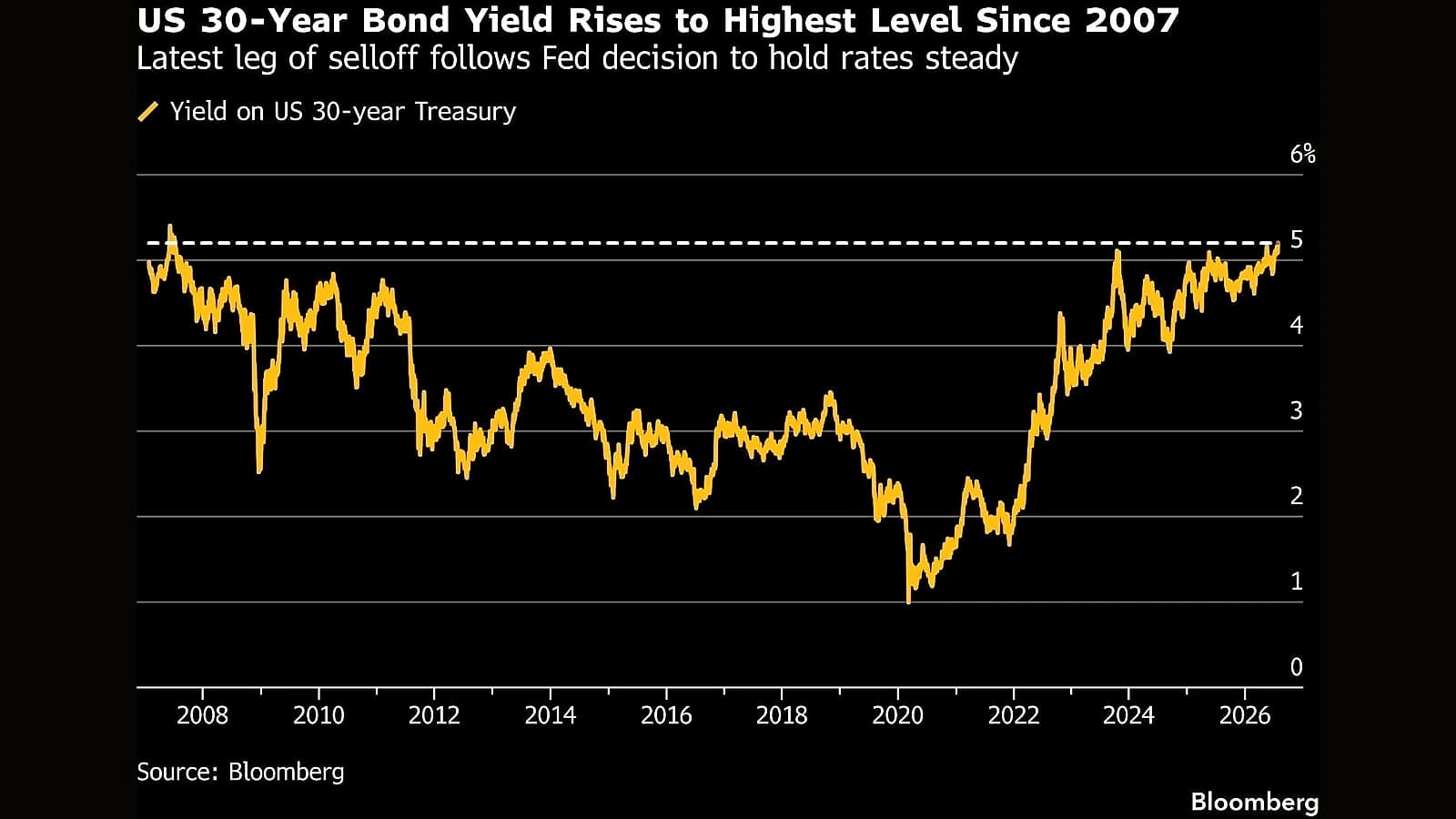
The Federal Reserve meets this Wednesday amid rising inflation driven by the US war with Iran and new global tariffs, with traders seeing a 31.5% probability of a surprise 25 basis points rate hike, down from more than 36% a day before, according to CME Group data. According to Reuters, analysts at BofA Global Research expect the Fed to hold rates steady with dissents from two committee members but see "strategic incentives" for Chairman Kevin Warsh to hike as it would differentiate him from former Chair Jerome Powell. Analysts at JPMorgan Chase & Co. said the probability of a rate hike is likely less than the roughly 30% chance currently priced, as "inflation, while elevated, does not appear to at-risk of an upside explosion." They assign a 50% chance to a "hawkish hold," as the central bank will want to stay vigilant even though recent energy prices suggest disinflation may be ahead. Lower oil prices helped to ease Treasury yields in the bond market, with the yield on the 10-year Treasury falling to 4.60% from 4.65% late Monday. A weaker-than-expected reading on confidence among U.S. consumers also weighed on yields, with fewer consumers saying they feel good about current business conditions according to the latest Conference Board survey.