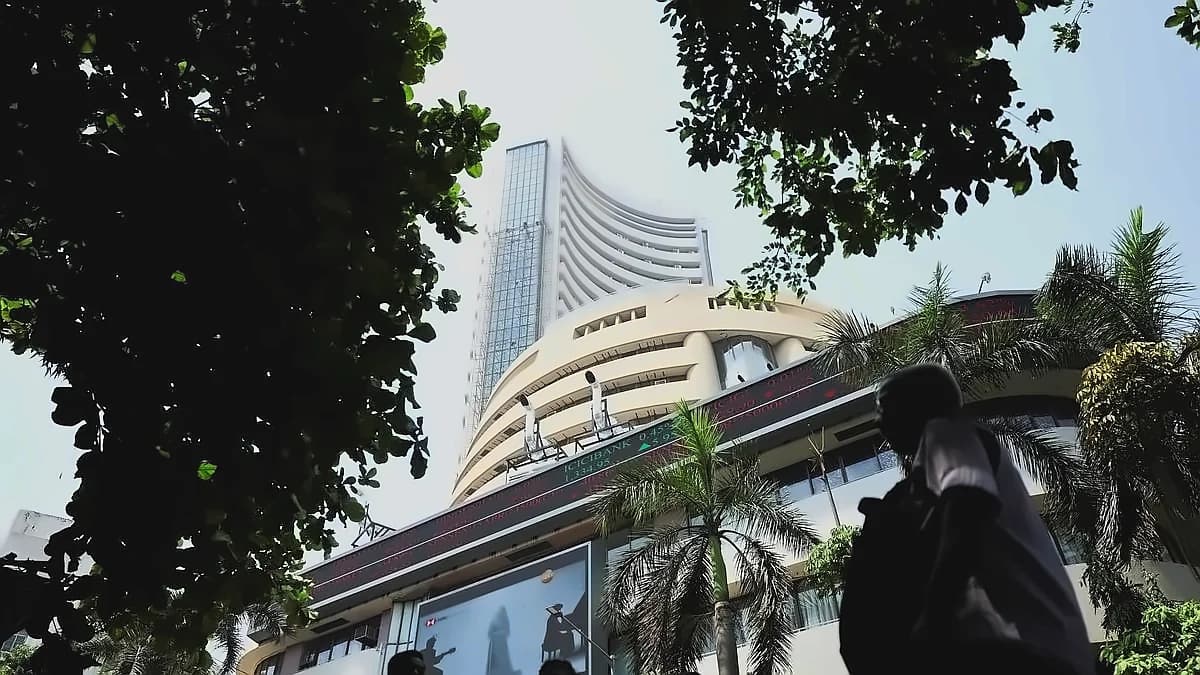
Indian stocks experienced severe declines on Thursday, with the NSE Nifty 50 falling 0.74%, or 180.10 points, to close at 23,997.55, while the BSE Sensex declined 0.75%, or 582.86 points, to end at 76,913.50. According to The Hindu BusinessLine, both indices opened gap-down and hit intraday lows before staging a recovery. The Nifty 50 touched an intraday low of 23,796 before staging a 291-point recovery in the second half to close just below the 24,000 mark. Investors lost around ₹6 lakh crore in a single day due to the sharp market decline. Despite the daily decline, Indian markets saw their best April performance in 28 months after March had seen the biggest foreign fund exit in history. The rupee hit a fresh record closing low, depreciating 6 paise to breach the 95-per-dollar mark, touching an intraday low of 95.322. In the latest session, the rupee edged higher against the dollar, hovering at 94.8400 compared with its previous close of 94.8800, though it touched an all-time low of 95.3450 during the session.
Most sectoral indices ended lower apart from IT and pharma, which advanced marginally. As reported by The Hindu BusinessLine, Nifty Metal, PSU Banks, Realty, and FMCG were the steepest losers, each declining between 1% and 2%. Larsen & Toubro (down 2.03%), ICICI Bank (down 1.09%) and HDFC Bank (down 0.98%) dragged the indices lower. The broader market also faced pressure with the BSE 150 MidCap Index slipping 1.01% and the BSE 250 SmallCap Index dropping 0.50%. The rupee's dramatic movement was attributed to surging oil prices amid swirling rumours of fresh Pentagon strikes against Iran, which created significant market uncertainty. Brent crude oil prices spiked to multi-year highs, crossing $110 per barrel and WTI approaching the $105–106 zone amid escalating US-Iran tensions and fears of supply disruptions through the Strait of Hormuz. Comments from Donald Trump rejecting Iran's nuclear proposal, alongside reports of the US considering fresh military options, deepened risk aversion across global markets. India VIX rose over 4.5% to 18.23, indicating rising market volatility and investor nervousness.
The Reserve Bank of India intervened aggressively to support the rupee, as reported by The Economic Times. Anil Bhansali, head of treasury at Finrex Treasury Advisors, explained that the RBI stepped in as the rupee weakened, allowing the currency to trade in the 95.10/$ to 95.35/$ range for much of the session before coming in with heavy dollar sales in the final hour. The central bank's intervention helped prevent the rupee from ending the day beyond the psychologically significant 95/$ mark. This proactive approach demonstrates the RBI's commitment to maintaining currency stability amid external pressures. The currency weakness was attributed to FII outflows, rising crude prices, and a hawkish US Federal Reserve maintaining its firm policy stance. Higher US bond yields, with the 10-year yield hovering around 4.4%, are making US assets more attractive, increasing the risk of capital outflows from emerging markets like India.
According to The Hindu BusinessLine, markets will remain closed on Friday for Maharashtra Day. Technically, Nifty's immediate support lies at the 23,800 level, with resistance at 24,334 and 24,600. Ajit Mishra, SVP Research at Religare Broking, noted that "A decisive move below 23,800 could trigger further downside towards the 23,500 level...On the upside, the 24,400–24,800 zone is likely to act as a strong resistance." The near-term trajectory will hinge on how crude prices and the US-Iran situation evolve over the extended weekend. Gaurav Garg of Lemonn Markets Desk noted that "FII outflows and higher crude prices continued to weigh on market sentiment." Foreign institutional investors remained net sellers while domestic institutional investors offered partial support, limiting the downside. Markets are expected to remain volatile in the near term, with crude oil prices, currency movement, global interest rate expectations, and foreign fund flows likely to dictate the direction.