Indian benchmark indices ended lower on September 8, with the Sensex closing down 555 points (0.73%) at 75,577.58 and the Nifty falling 144 points (0.61%) to 23,635.10. According to latest reports, the Nifty 50 has delivered a 6.04% return over the last 3 years, significantly underperforming both mid-cap and small-cap segments. The Nifty Midcap 150 returned 14.60% and the Nifty Smallcap 250 returned 14.42% during the same period. However, this headline performance masks a more nuanced picture when examining individual stock contributions, with only 10 out of 50 Nifty 50 stocks having delivered negative returns over the 3-year period.
Market experts attribute the divergence to a combination of index composition, earnings momentum, liquidity flows and global headwinds. Pravesh Gour, senior technical analyst at Swastika Investmart, explained that the divergence is less about weak fundamentals and more about where liquidity and earnings momentum are concentrated. "Nifty is heavily dependent on a handful of large-cap sectors, particularly banks, Reliance, IT and FMCG, and these stocks have not delivered the same price momentum as several mid- and small-cap companies," Gour said. The broader market has been driven by sectors such as defence, railways, capital goods, power, renewable energy and electronics, where investors have been betting on stronger structural growth and higher capital expenditure.
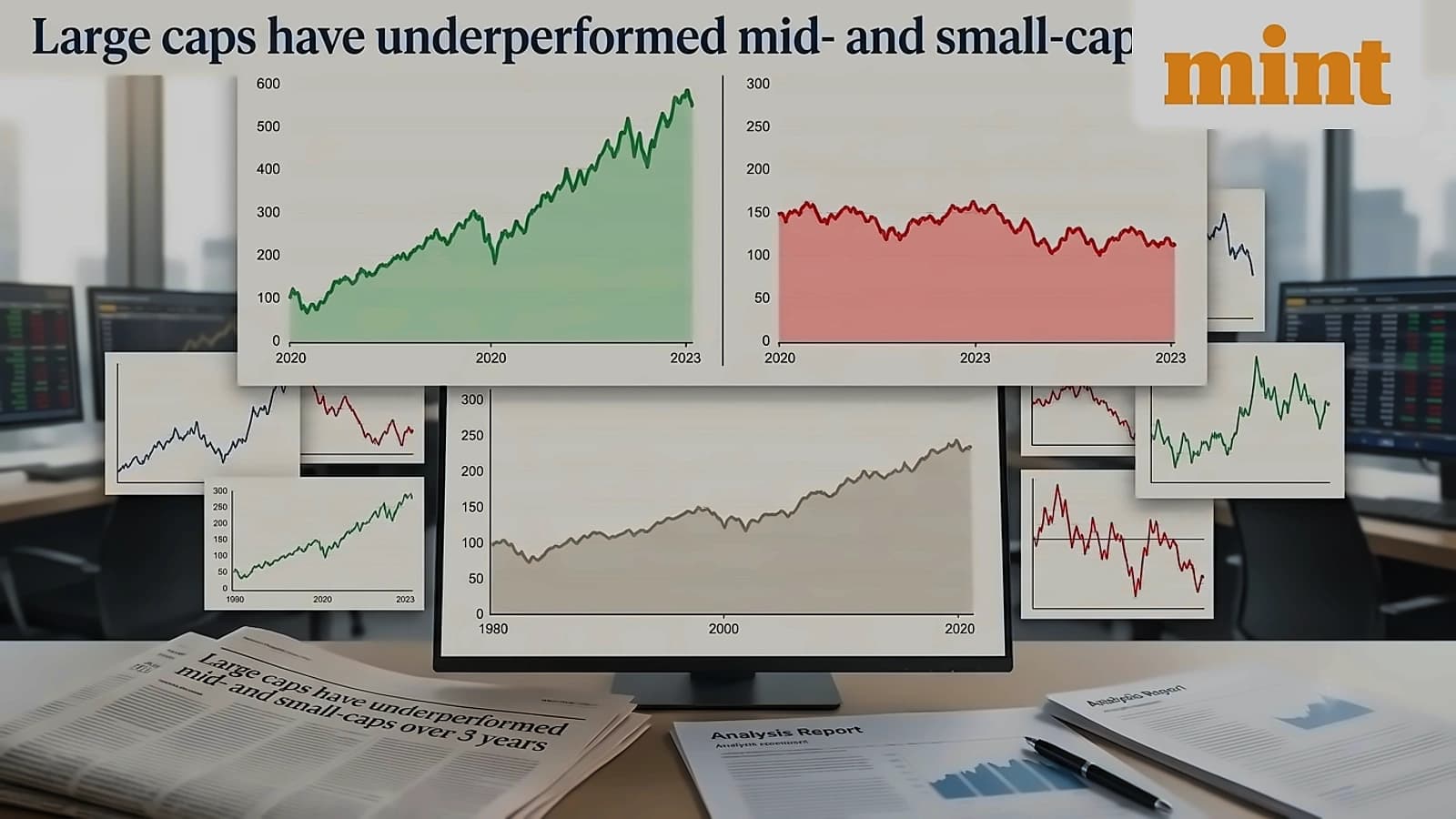
The divergence has been significantly driven by institutional participation patterns and earnings momentum across different market segments. Foreign investors have largely remained net sellers in Indian equities in 2026, with total FII ownership touching 17-year low levels. According to latest shareholding data, 37 out of 50 Nifty 50 stocks witnessed FII selling in Q1 FY27, while only 13 stocks saw FII buying. In contrast, mid-cap and small-cap indices saw FIIs add stakes in over 41 stocks each in Q1 FY27. HDFC AMC's Q1FY27 report shows mid-cap and small-cap categories witnessed 26% and 34% YoY profitability growth, significantly outpacing large-cap earnings growth of 20% YoY. JP Morgan's quarterly earnings preview highlighted that excluding energy stocks, NIFTY midcap 100 and small-cap grew 42% and 39% YoY respectively, with 58% of MSCI India companies beating analyst expectations versus 24% missing targets.
According to latest market data, Nifty Media emerged as the top sectoral performer, gaining 1.32%, while Nifty Private Bank and Nifty Financial Services witnessed the sharpest decline. The Nifty Oil & Gas index fell 0.87%, Private Banks declined 0.80%, and Infrastructure lost 0.59%. Market breadth remained weak with 270 stocks from the Nifty 500 universe ending the session in the red, though the Nifty Midcap 100 and Nifty Smallcap 100 outperformed and managed to close in positive territory. The Advance-Decline ratio was tilted in favour of declines, highlighting the selective nature of today's market weakness.
The broader market displayed relative resilience despite benchmark weakness. As reported by market sources, the Nifty Midcap 150 gained 0.11% even as the benchmarks declined, while the Smallcap 100 slipped 0.12%. In the mid-cap segment, top gainers included GE Vernova TD (+8.99%), Kalyan Jeweller (+4.09%), and Laurus Labs (+3.53%). Among the top losers, New India Assur declined 11.42% to ₹204.79 and United Brewerie fell 3.33% to ₹1,248.00. This data reinforces the pattern of concentrated weakness rather than broad-based underperformance across the large-cap universe.
Current market valuations reveal significant differences across market segments that explain the divergence in performance. The NIFTY50 trades at a 19x price-to-earnings ratio, while NIFTY Smallcap 100 provides a more promising picture with a PEG ratio of 0.9x after Q1 FY27 earnings. NIFTY Midcap 100's PEG ratio stands at 1.15x, indicating fair valuation. The NIFTY Smallcap 100 has rallied 13% in 2026 YTD, significantly outperforming the NIFTY50's -10.2% decline. Technical analysis suggests the 23,770-23,800 zone acts as an immediate hurdle for the index, with the RSI entering a bearish crossover and the Daily RSI on the verge of slipping below the 40 mark. A sustained move above 23,800 would be required to ease immediate downside pressure.