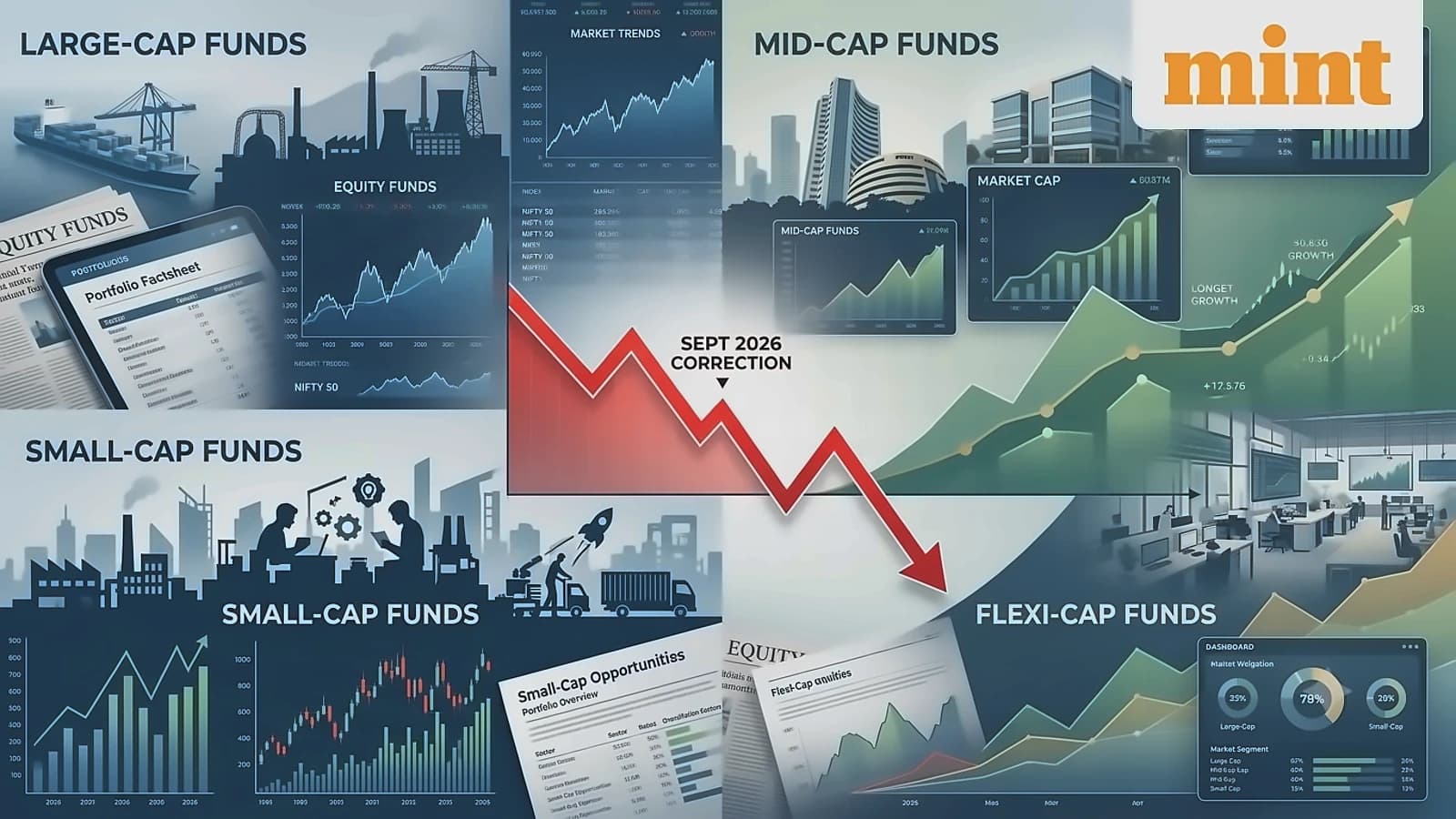
The Indian stock market has witnessed a dramatic shift in market capitalization distribution over the past six years, with large-cap stocks losing significant ground while smaller companies gain substantial market share. According to The Economic Times, the Nifty's share of total market capitalization fell 3.3 percentage points in Q1 to a multi-year low of 40.5% in June, down from 44.9% in March 2025 and 58.8% in March 2020. This represents a continued decline from the 58.8% share held in March 2020, highlighting the sustained trend of smaller companies gaining prominence in the market. The Nifty Next 50's share declined to 15.7% from 16.4% in March 2025 and 18% in 2024, while the Nifty Midcap 150 accounted for 21.4% of total market capitalization from 19% in 2025 and 14.9% in 2020. Most notably, the Nifty Smallcap 250's share rose to a multi-year high of 10.7% from 9.8% in March 2025 and 5.7% in 2020, while the Nifty Microcap 250 accounted for 4.4% of total market capitalization from 3.6% in 2025 and 1.5% in 2020, underscoring the increasing weight of smaller stocks in the broader market.
Despite losing market share, large-cap stocks have demonstrated superior alpha generation capabilities, with 52% of Nifty 50 stocks hitting their 52-week highs between January and June 2026, compared to 31% in the Nifty Midcap 100 and 27% in the Nifty Smallcap 250. According to Mint analysis, this performance divergence reflects the dynamics of domestic institutional flows into equities, with domestic investors continuing to drive the market while foreign investors remain net sellers. As Spark Asset Management's P. Krishnan explains, small- and mid-caps fell sharply in the early phase of the Iran war, creating a buying opportunity that domestic funds capitalised on aggressively, with their limited liquidity and relatively low foreign portfolio investment holdings making them particularly sensitive to domestic inflows. The Nifty 50 is down 9% year-to-date, while the Nifty Midcap 100 and Nifty Smallcap 250 have gained nearly 2% and 5.4% respectively, highlighting the current market leadership of smaller companies.

Foreign institutional investors have demonstrated sustained conviction in select small-cap stocks, with 11 stocks delivering at least 100% returns over six months led by Sterlite Technologies's remarkable 451% surge to ₹518 from ₹94. According to The Economic Times, FII ownership in Sterlite Technologies increased from 10.93% in December 2025 to 18.22% in June 2026, representing a cumulative increase of 7.29 percentage points across two quarters. Other notable performers include Dee Development with a 234% rally to ₹687, MTAR Technologies gaining 126% to ₹6,044 with FII ownership more than doubling to 24.79%, and Acutaas Chemicals advancing 113% to ₹3,615 while FII holdings increased from 16.67% to 21.61%. The parallel rise in share prices and foreign institutional ownership signals growing conviction in select companies rather than an indiscriminate bet on the broader smallcap universe.
Axis Direct's Rajesh Palviya suggests a selective shift towards large-cap stocks following the recent surge in mid and small caps, warning that these segments show stretched valuations after their recent rally. The Nifty 50 trades near its long-term average of 18x forward earnings, offering better comfort compared to the Nifty's current PE ratio of 21, which smart money typically views as attractive below 20. According to Axis Direct's latest July 2026 Monthly Top Picks report, the firm has revised their base-case December 2026 Nifty target to 27,220 (valuing the index at 19.5x December 2027 earnings), with a bull-case target of 28,615 (20.5x) driven by strong private capex revival and policy continuity. The small-cap rally has been led by Corcept Therapeutics (CORT), the largest company with a market value of $10.0 billion and 19.7% gains over the last month, but concerns remain about valuations with CORT trading at 211.0 times trailing earnings despite revenue growth of only 12.2%.
Q1FY27 earnings mark a gradual but mixed corporate revival, with the Nifty poised to return to double-digit growth via an estimated 11.2% YoY PAT expansion. However, near-term fundamentals remain soft with Q1FY27 profitability likely to stay under pressure from cautious global spending, wage hikes, and rising AI-related investments. As reported by Axis Direct, this drove a sharp 9% downgrade to the sector's FY27 Nifty EPS estimates post-Q4. The market is undergoing a healthy recalibration with the Nifty 50 correcting to trade near its historical average of 18x forward earnings, and its valuation premium over emerging markets has cooled to a more attractive ~50%. Strong earnings momentum is visible in domestic-facing sectors such as BFSI, Telecom, Utilities and Pharma, while IT Services face pressure from cautious global demand and Cement sector is squeezed by high fuel and freight costs. Consensus estimates now build in mid-teen earnings growth for the Nifty in FY27/28, with mid- and small-cap earnings expected to grow somewhat faster.