India's economy demonstrated remarkable resilience in the April-June quarter, with GDP growth slowing slightly to 7.1% according to most economists, as reported by NDTV. This growth was supported by GST rate cuts announced last year and income tax reductions that continued to support household disposable income and demand, helping cushion the impact of rising inflation. However, the growth was primarily driven by subdued private investment, with economists expecting this recent pickup to be temporary. Aastha Gudwani, India Chief Economist at Barclays, expressed amazement at the economy's resilience, stating that "we must keep in mind how resilient it has been in an unpredictable environment." Rishi Shah, Economic Advisory Services Leader at Grant Thornton Bharat LLP, added that "we're going through a very tough test, but we're doing very well at it."
The Indian stock market benchmark indices, Sensex and Nifty 50, are expected to open muted on Friday, 28 August, amid mixed global cues. According to Mint, Gift Nifty was trading at around 24,254, indicating a subdued start for the Indian benchmark index, with the futures trading at a discount of nearly 28 points from the Nifty futures' previous close. The domestic equity indices ended lower in the previous session, with the Nifty closing below 24,100 level and struggling to maintain levels above 24,000. As per Motilal Oswal Financial Services, "Indian equities are likely to remain range-bound amid a lacklustre market environment, as softer crude prices provide limited relief against weak global cues and selective selling. Near-term market direction is likely to remain dependent on global risk sentiment, while selective opportunities should continue to emerge across sectors."
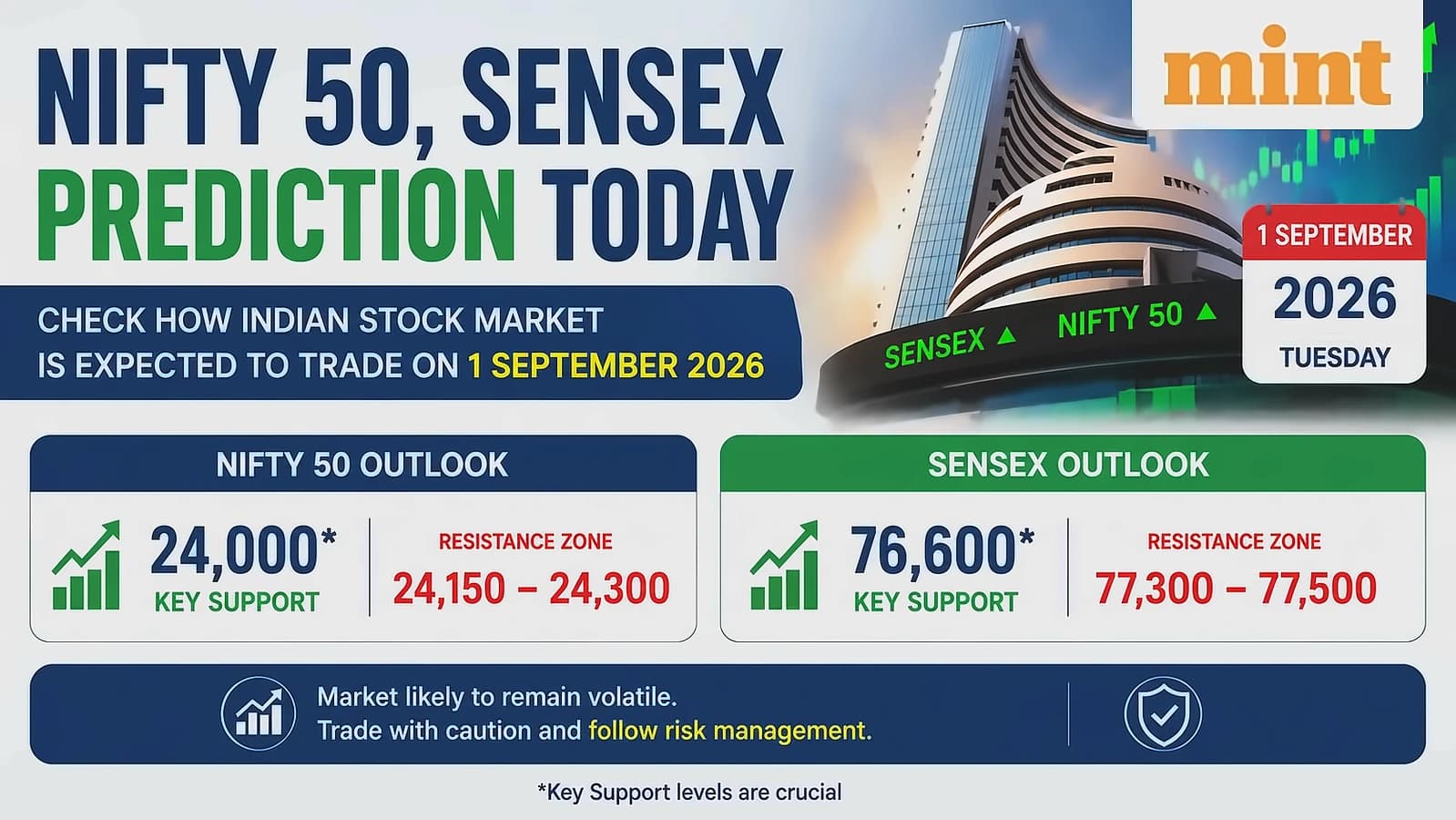
On Monday, the Indian stock market showed resilience with Nifty 50 recovering 86 points from intraday lows to settle at 24,080.40, down 95.25 points or 0.39%. According to Mint, the index remained under pressure throughout much of the session and briefly slipped below the 24,000 mark, touching a low of 23,993, resulting in a lower low on the daily chart. With Monday being the final trading session of August, the Nifty ended the month down 1.24%, bringing an end to the two-month winning run seen in June and July. The closing level was close to where the index had settled on August 19. Bank Nifty moved by more than 600 points during the Closing Auction Session, while the Nifty Midcap 100 recorded a swing of around 550 points, making final price discovery more difficult for traders to interpret. The late recovery resulted in the formation of a hammer candle on the daily chart, keeping the possibility of a short-term rebound open.
According to NDTV, public capital expenditure remains a strong pillar supporting India's current growth story, with Gudwani noting that "what's working out well is phenomenal heavy lifting by public capex." However, she cautioned that "we cannot expect an economy of this size to grow at rates which are concentrated in certain sectors," drawing comparisons with economies such as Taiwan where growth can be more concentrated. The next important factor will be private investment picking up, as the economy awaits a broader revival in this area. Gudwani expects India's gross value added (GVA) growth for the April-June quarter to come in at around 7.7%, which would represent a strong pace of expansion but would be marginally slower than the 7.9% GVA growth recorded in the January-March quarter. Despite the moderation expected in growth, Gudwani did not view the current trajectory as either a conventional cyclical slowdown or a cause for concern, with the challenge being less about headline growth rate and more about ensuring broad-based and sustainable expansion.
According to Motilal Oswal Financial Services, the Sensex formed a bearish candle on the daily chart and is now trading below its short-term moving averages, indicating weak momentum at higher levels. Technical analysts note that as long as the index remains below 77,000, further weakness could drag it towards 76,700 and 76,500, while immediate resistance is seen at 77,300 and 77,500. For the Nifty 50, HDFC Securities' analysts warn that a sustained move below the 24,000 mark could trigger further weakness, with the index nearing a potential breakdown below 24,075 level. On the downside, immediate support is identified in the 24,050–24,000 range, followed by a stronger support zone at 23,850–23,800. As per Moneycontrol, the Nifty is gradually narrowing down its consolidation range into a tight band, indicating a squeeze in volatility, with a decisive breakout from either side likely to provide directional cues. India's broader small-and mid-caps rose 0.5% each, supported by earnings, lower crude prices and sustained domestic inflows, providing some relief to the overall market sentiment.

Traders are awaiting Warsh's upcoming speech at the central bank's annual symposium in Jackson Hole, Wyoming. As reported by Mint, although the event is not linked to a formal policy meeting, investors will closely monitor his remarks for clues about the future direction of interest rates. According to CME's FedWatch Tool, Fed funds futures currently indicate around a 64% probability that the central bank will keep interest rates unchanged at its meeting next month. US Treasury yields rose ahead of the speech, with the yield on benchmark US 10-year notes rising 1.22 bps to 4.676%, while the 30-year bond yield rose 0.91 bp to 5.1941%. The US dollar was little changed after data showed weekly initial jobless claims fell for a second straight week, with the dollar index rising 0.02% to 99.14. US employment data will remain the most important trigger, with the August non-farm payrolls report scheduled for September 4, as noted by Religare Broking. The outcome could significantly influence expectations regarding the Federal Reserve's September policy decision, the US dollar, Treasury yields and emerging-market fund flows.