Indian stock indices are expected to open marginally higher on Tuesday following India's strong Q1 GDP growth data, though rising crude oil prices due to renewed West Asia tensions could keep any optimism in check. GIFT Nifty futures were at 24,178 points as of 7:59 am IST, indicating a positive start for the Nifty 50 after the benchmark index closed at a one-month low of 24,080.4 on Monday. The SENSEX ended 307 points or 0.4% lower at 76,957 and NIFTY50 index declined 95 points or 0.4% to close at 24,080 in the previous session. As per The Hindu BusinessLine, the 50-stock index lost 1.2% in August on West Asia jitters, with heavyweights HDFC Bank and Reliance Industries dragging the performance.
Crude oil prices surged to $91 per barrel following fresh escalation in West Asia tensions, providing significant boost to energy sector sentiment. Iran launched missiles overnight at two US air bases in Jordan in response to a US attack on Iran's Larak Island, with Brent crude futures lifted to $91 per barrel on the latest developments. This sharp increase in oil prices is expected to benefit energy-related stocks and could provide support to the broader market despite the cautious opening indicators. The Nikkei 225 declined 0.4%, China's Shanghai Composite declined 0.2%, Hong Kong's Hang Seng index dropped 1.43%, and South Korea's KOSPI index plunged 0.75%, reflecting broader weakness across Asian markets that is contributing to the subdued sentiment in Indian equities.
India's economy delivered a robust performance in the April-June quarter of 2026-27, with GDP growing 7.8%, significantly beating the RBI's projection of 7%. According to the Ministry of Statistics and Programme Implementation (MoSPI), real GDP at constant 2022-23 prices is estimated at ₹81.36 lakh crore in Q1 FY27, up from ₹75.46 lakh crore in the year-ago period. Nominal GDP at current prices grew 10.3% to ₹88.27 lakh crore from ₹80 lakh crore a year earlier. The upside surprise for Asia's third-largest economy came even as geopolitical tensions from the US-Israeli war on Iran continued to rattle global markets. Prime Minister Narendra Modi called the 7.8% GDP growth a herculean feat, while the ministry noted that "Indian economy has sustained growth momentum despite global headwinds." The stronger-than-expected growth comes after the Reserve Bank of India raised its GDP growth forecast for the full financial year to 6.7% from 6.6% earlier.
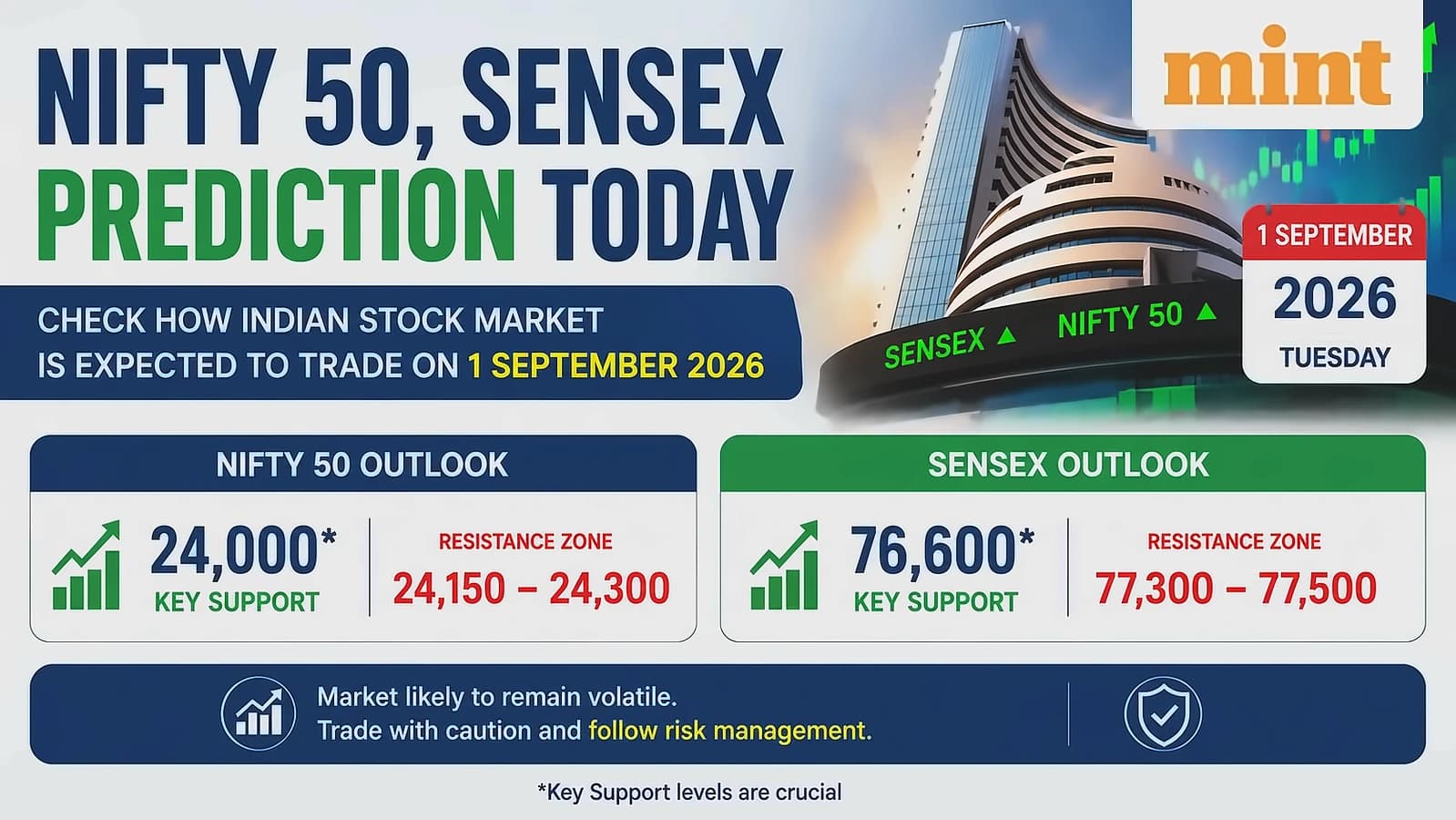
According to HDFC Securities Senior Technical Research Analyst Nagaraj Shetti, the Nifty 50 formed a small negative candle with a long lower shadow on the daily chart, indicating a bullish hammer-type formation. As reported by LiveMint, the 24,000 level remains a crucial support zone as it coincides with the recent swing low and the previous opening upside gap formed on July 29. Hariselvan Radhakrishnan, Founder & CEO of HST Wealth, noted that "the 24,000 level remains an important support despite continued external headwinds. The price action suggests that, although external headwinds continue to weigh on sentiment, the 24,000 level remains a key line of defence that market participants are not yet willing to concede." However, Angel One's Hitesh Rathi highlighted that the Nifty has breached a key upward-sloping trendline and the 10-column moving average on the Daily 0.1% × 3 and 0.25% × 3 Point & Figure charts, signalling a downside reversal. The Nifty is likely to remain in a consolidation phase with the 24,000-23,950 zone emerging as a crucial support area and 24,170-24,200 acting as the immediate resistance band, according to technical analysts.
Foreign Institutional Investors (FIIs) were net sellers of ₹7,986 crore on Monday, as per provisional data, while Domestic Institutional Investors (DIIs) bought ₹4,588.88 crore, indicating continued domestic support for the markets. Key corporate actions include results from Leap India and Milky Mist Dairy, along with Annual General Meetings (AGMs) for major firms like SBI Cards and KPIT Technologies. Notable corporate developments include Sun Pharma's agreement to extend Most Favoured Nation (MFN) pricing to state Medicaid programs and commitments to MFN pricing for future innovative medicine launches. ONGC's new trading unit is expected to begin operations "end of this year", initially handling the group's own crude and product requirements. The new price of Compressed Natural Gas (CNG) will be ₹88 per kg in and around Mumbai, effective from midnight on September 1, due to significant increase in input gas prices linked to international indices. Stocks to watch include ITC's IT unit buying a 22.1% stake in Happiest Minds Technologies for ₹1,330 crore, and Oil and Natural Gas Corp's plans to invest ₹1 lakh crore over five years to explore deepwater and ultra-deep water fields.
According to Kotak Securities' Head of Equity Research Shrikant Chouhan, the Nifty could potentially rebound towards 24,200–24,300 if the key support levels hold. As reported by LiveMint, on the downside, selling pressure could intensify below 24,000 on the Nifty 50, which could drag the index towards 23,850–23,800. Similarly, Angel One's Rathi expects the immediate resistance zone at 24,150–24,200, followed by a stronger hurdle at 24,300–24,360. For the Sensex, Chouhan expects the index could move up to 77,300–77,500 if the Sensex holds above 76,600, while Rathi identified 58,200–58,300 as immediate resistance for Bank Nifty. The market volatility gauge, India VIX, spiked nearly 5% to 11.18 points during intraday trading, reflecting heightened uncertainty. However, momentum indicators and oscillators are pointing towards a lack of clear directional bias, with the daily RSI moving in a sideways range over the last 14 trading sessions indicating the absence of strong bullish or bearish bias.