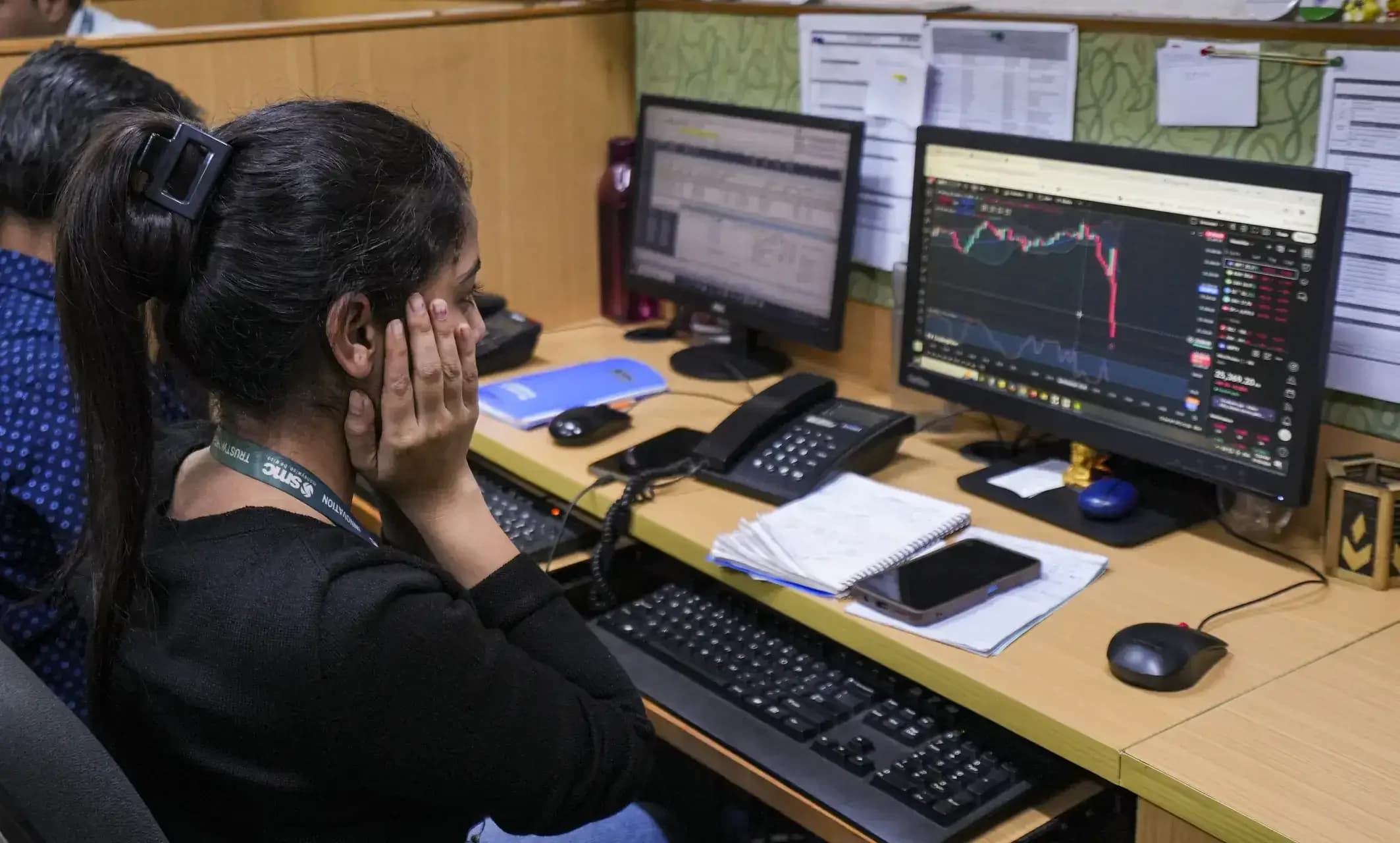
The Indian stock market is experiencing significant headwinds with GIFT Nifty futures trading at 23,069, indicating a weak opening below Wednesday's closing level of 23,214.95. According to Choice Equity Broking's Hitesh Tailor, markets are expected to open on a mildly negative note amid global uncertainty. The Nifty 50 closed 27.15 points lower at 23,214.95 on June 10 after profit booking emerged near higher levels, with the index touching an intraday high of 23,425.35 but failing to hold gains. The formation of a gravestone doji-like candlestick pattern indicates rejection at higher levels and reflects cautious sentiment among traders, with immediate support placed between 23,000 and 23,050 and resistance expected near 23,450 to 23,500. On Thursday, the market saw sharp swings before ending lower with Sensex dropping more than 151 points to close at 73,832 and Nifty declining over 53 points to end at 23,162. According to The Economic Times, the recovery proved fleeting due to an increasingly fragile global backdrop, with Nifty Midcap 100 and Nifty Smallcap 100 indices falling around 0.6% and 0.5% respectively.
Fresh US strikes on Iran and rising geopolitical tensions are creating significant market pressure. The Iran war, now in its fourth month, has become a key concern for global investors due to its impact on energy prices and inflation. US President Donald Trump warned of more attacks if a peace agreement was not reached, pushing Brent crude prices up 1.1% to $94 per barrel. As India remains the world's third-largest oil importer and consumer, higher energy costs can increase inflation and affect economic growth. The rising tensions have pushed broader Asian equities down 0.4% as investors moved away from riskier assets, with the cautious mood coming after the United States launched fresh strikes against multiple targets in Iran on Wednesday. According to The Economic Times, the expected ECB rate hike has further heightened concerns around liquidity tightening and its potential impact on emerging market flows.
Foreign portfolio investors (FPIs) continued their selling streak, pulling out ₹2,124.98 crore worth of Indian equities on Wednesday, marking their ninth consecutive session of selling. According to market data, FPIs have withdrawn a record $30.4 billion from Indian equities so far in 2026. However, domestic institutional investors provided crucial support, with DIIs buying Indian equities worth ₹3,124 crore on June 10, helping absorb foreign selling pressure. This divergence highlights the ongoing challenge of foreign capital outflows offsetting domestic institutional support. As per The Economic Times, IT stocks also lagged amid concerns that stronger US inflation could delay interest rate cuts and keep global financial conditions tight.
The banking sector faced pressure with Bank Nifty falling 94.20 points to close at 55,100.30, declining 0.17% despite touching an intraday high of 55,555.85. The formation of a gravestone doji pattern in Bank Nifty shows rejection from higher levels and reflects short-term indecisiveness, with immediate support placed between 54,500 and 54,600 and resistance around 55,500 to 55,600. Despite challenges, India continues to demonstrate strong fundamentals with the Reserve Bank of India cutting India's GDP growth projection for FY27 to 6.6% from 6.9%, providing a stable foundation for corporate earnings. The RBI's pivot toward eased monetary conditions and relaxed banking regulations is beginning to catalyse a genuine domestic credit cycle. According to The Economic Times, Banking and pharma stocks attracted buying interest, supported by resilient earnings, favourable RBI measures, and a shift toward defensive sectors.
Technical analysis reveals mixed signals with the Nifty 50 continuing to trade below its key moving averages, which are trending downward. The daily RSI remains below the 40 mark and is in a declining mode, reflecting underlying weakness, as per SBI Securities. The index has tested the 61.8% Fibonacci retracement level of its previous up move three times in the last four trading sessions, highlighting its importance as crucial support. The zone of 23050–23000 is expected to act as a crucial support for the index, with a decisive breach below 23000 potentially dragging the index towards 22850, followed by 22700 levels in the short term. On the upside, immediate resistance is placed in the 23300–23330 zone. Market breadth showed 1,013 stocks witnessed advances, 2,255 saw declines while 94 stocks remained unchanged out of 3,362 stocks that traded on NSE on June 11. Despite current challenges, experts suggest selective opportunities exist for patient investors, with the current market dip presenting opportunities for those willing to look beyond short-term volatility.