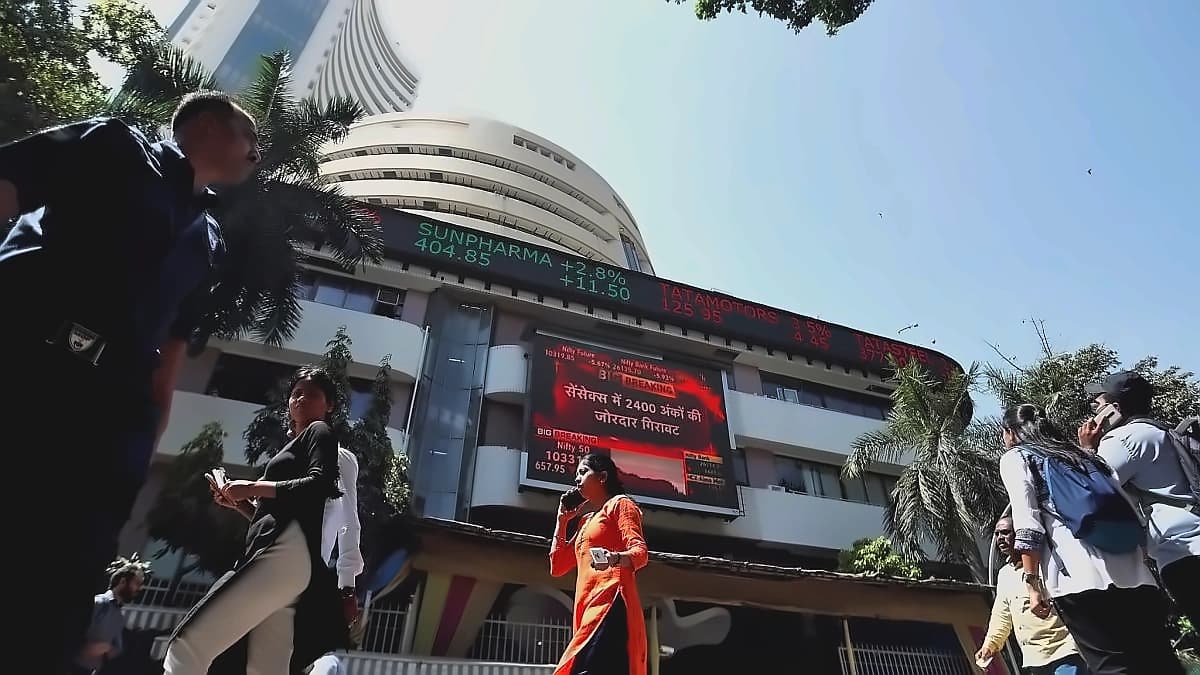
Indian markets opened sharply lower on Monday, June 8, with the Nifty 50 falling 173.95 points (0.74%) to 23,190.45 and the Sensex declining 596.85 points (0.80%) to 73,636.95 at 10:30 IST. The weakness was broad-based, with the BSE 150 MidCap Index declining 0.85% and the BSE 250 SmallCap Index shedding 0.91%. Market breadth remained weak with 1,431 shares rising and 2,416 shares falling on the BSE, while 229 shares remained unchanged. The NSE's India VIX jumped 7.64% to 17, indicating heightened volatility expectations among market participants. This follows Friday's session where the Sensex declined 116.67 points (0.16%) to close at 74,243.34 and the Nifty 50 fell 49.85 points (0.21%) to settle at 23,366.70.
The escalation of the West Asia war into a 100-day conflict has triggered severe market corrections, with the combined market capitalisation of BSE-listed stocks collapsing by ₹4.5 lakh crore as the Nifty index slid roughly 7%. According to The Economic Times, this represents a ₹4.5 lakh crore wipeout over the past 100 days, exposing the domestic market to severe global crosswinds. The sell-off coincides with systematic downgrades to India's corporate earnings cycle, with analysts trimming CY26 MSCI India profit forecasts to 13% from 16% since the West Asia war began. Foreign institutional investors (FIIs) have dumped a record $28 billion year-to-date (YTD), with the sell-off intensifying dramatically over the past two weeks, with nearly $4 billion in outflows driven by passive regional liquidations.
The market correction has been broad-based across sectors, with oil and gas stocks hammered down roughly 9.4% as a sector. Major energy companies witnessed significant declines, with Bharat Petroleum Corporation off 23.5% and Indian Oil Corporation falling 26.2%. Nifty Bank is down 9.97% since the conflict began, with private banks still down over 8%, while Nifty IT is down 5.2%, squeezed by the Nasdaq rout. However, pharma and healthcare have outperformed sharply, with Nifty Pharma up 5.6% over the period and Nifty Healthcare gaining 3.6%. Small and mid-cap indices like Nifty Smallcap 100, Nifty Smallcap 250 and Nifty Midcap 100 have held firm or gained, reflecting a domestic growth narrative that has partially decoupled from global tech. Among sectoral indices, Nifty Realty and Nifty Metal emerged as the biggest laggards, reflecting concerns over economic uncertainty and global growth prospects, while defensive segments attracted buying interest.
The NSE's Nifty Realty index fell 1.54% to 757.05, extending the sector's decline after gaining 0.82% in the past two trading sessions. Major realty stocks witnessed significant selling pressure, with Anant Raj declining 3.24%, DLF falling 2.43%, Godrej Properties dropping 2.36%, Lodha Developers down 1.91%, Brigade Enterprises declining 1.54%, Prestige Estates Projects falling 1.51%, Sobha dropping 1.39%, Aditya Birla Real Estate down 1.28%, Oberoi Realty declining 0.9%, and Phoenix Mills falling 0.36%. The sector's weakness reflects broader market uncertainty and investor caution amid ongoing geopolitical tensions. In contrast, defensive sectors like Nifty Pharma and Nifty Healthcare outperformed the broader market, attracting investor interest amid heightened uncertainty.
Market sentiment remained subdued as Iran reportedly launched missiles at Israel, marking the first major flare-up since a fragile ceasefire came into effect in April. The development followed Israeli airstrikes on Beirut's southern suburbs, which Tehran viewed as a breach of the ceasefire agreement. Market participants are closely monitoring these developments, as any further escalation could impact global risk appetite and energy prices. Brent crude for August 2026 settlement rose $4.19 or 4.50% to $97.28 a barrel, reflecting heightened geopolitical risks. U.S. President Donald Trump expressed optimism that a breakthrough could be achieved over the weekend, while Iran's Foreign Minister indicated that talks aimed at ending the conflict had produced no tangible progress. Separately, Israel launched fresh attacks on Lebanon over the weekend despite a ceasefire, raising concerns over regional stability and the smooth flow of oil shipments through the strategically important Strait of Hormuz.
Despite the current challenges, market experts see potential for selective opportunities. Dr VK Vijayakumar from Geojit Investments noted that the tech-led sell-off in global benchmarks may offer an unexpected structural silver lining for Indian equities via capital reallocation. He emphasized that "the sell-off in the US on Friday was a tech-led sell-off. This can trigger a rotation from AI trade to non-AI trade, which can be beneficial for India." Fund managers suggest that "close to one-third of the mid-cap space is priced below its five-year average valuation levels, whereas nearly half of the small-cap space is trading below its own five-year average valuation levels." The Reserve Bank of India (RBI) and the government have rolled out structural measures to build a forex buffer, including exempting interest and capital gains from FPI investments in government securities from taxation, which has helped the Indian rupee strengthen to around 94.94 from its historic low of 96.96. Technically, Nifty 50 ended at its lowest level in eight weeks, maintaining a weak structure with lower highs and lower lows, where the immediate support zone is placed between 23,000 and 23,100.