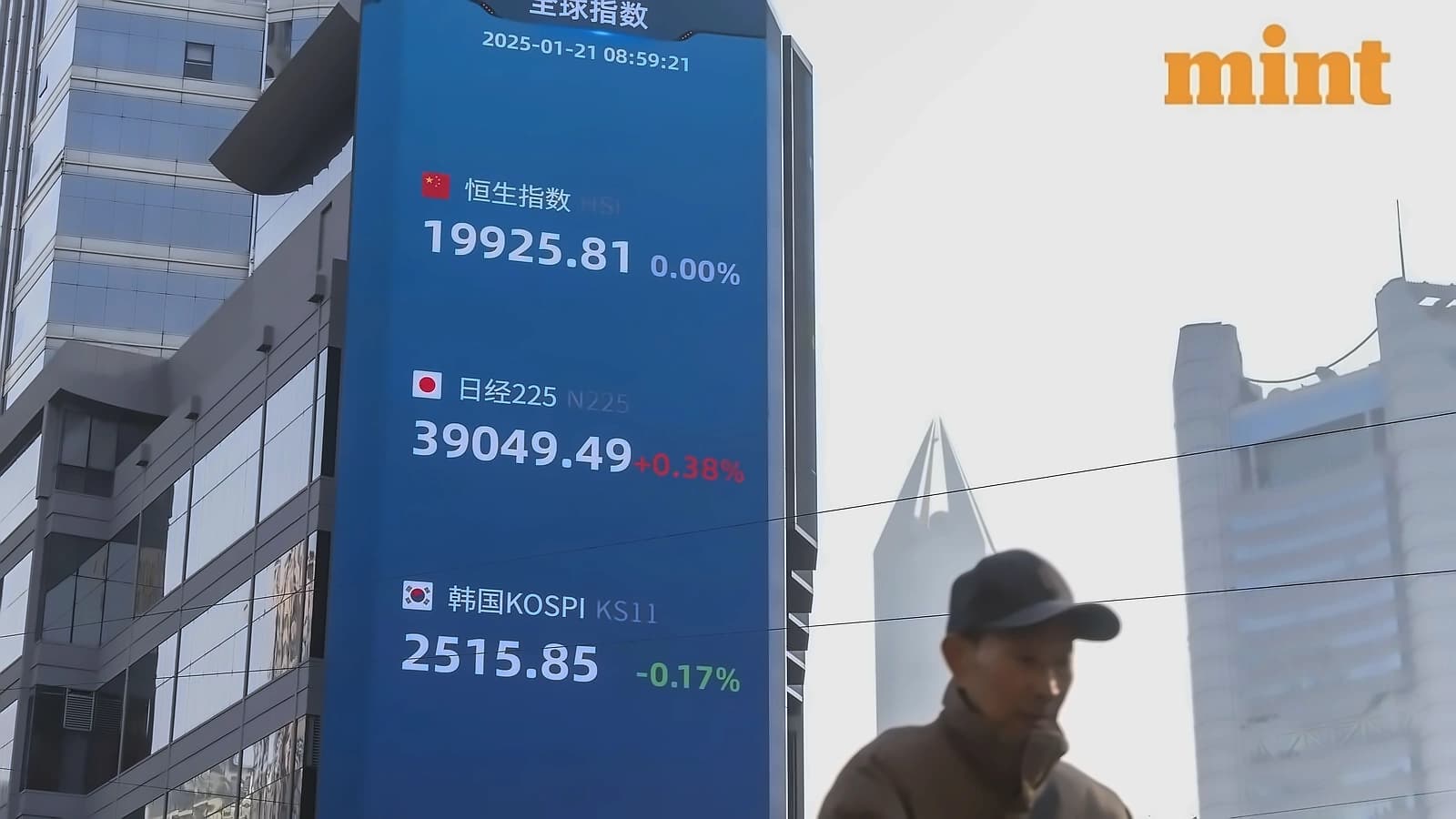
Indian markets are set to open higher on Friday, tracking gains in other Asian markets as GIFT Nifty futures surged more than 250 points to 23,455, indicating a strong gap-up opening. This represents a significant improvement from earlier sessions when GIFT Nifty had been trading at 23,180.50 as of 10:53 p.m. IST on Tuesday, indicating a gap-down opening. The positive signal comes after Indian markets ended lower in a volatile session on Thursday, with the Sensex declining 151 points and the Nifty slipping below the 23,200 mark. Other Asian stock markets rallied sharply, with MSCI's broadest index of Asia-Pacific shares outside Japan jumping 3.2 percent, led by a 7.4 percent surge in South Korea's KOSPI. Japan's Nikkei advanced 2.7 percent, while China's CSI300 and Hong Kong's Hang Seng gained around 1 percent and 1.3 percent, respectively. Wall Street also witnessed its strongest rally in over two months overnight, with the Dow Jones Industrial Average rising 930 points (1.86 percent), the S&P 500 gaining 1.75 percent, and the Nasdaq Composite surging 2.54 percent.
Iran and Israel said on Monday they had halted attacks on each other after an appeal from US President Donald Trump, though Tehran warned it would resume hostilities if Israel continued to hit Hezbollah in Lebanon. As reported by Livemint, Tehran had warned of retaliation after Israel struck Beirut's southern suburbs without warning earlier Sunday in defiance of the ceasefire agreement. The escalation has dampened hopes of an end to the wider US-Iran war and contributed to the global market selloff. Latest media reports showed that Iran launched around 10 ballistic missiles at Iran, with explosions witnessed in Iran's capital city of Tehran and other cities like Tabriz and Isfahan on Monday. After Iran's retaliation over the weekend, the Israel Defence Forces (IDF) attacked the central and western regions of Iran on Monday morning, even after US President Donald Trump reportedly told Israeli Prime Minister Benjamin Netanyahu to "hold off" on a retaliatory attack. Iranian authorities have also threatened to block another key maritime trade corridor, the Bab Al-Mandab, which connects the Red Sea with the Gulf of Aden. However, US President Donald Trump has vowed for a retaliation to Iran shooting down an American while it was patrolling the Strait of Hormuz overnight, indicating continued tensions despite the truce. Trump said on Thursday the United States and Iran could sign a peace deal as soon as this weekend that would reopen the Strait of Hormuz to shipping, though Iran said it had not reached a final decision on an agreement.
Crude oil prices surged significantly after the latest round of attacks in West Asia, with Brent crude dropping to around $89.40 per barrel after falling nearly 3 percent overnight. WTI crude slipped to about $86.70 per barrel, representing a sharp decline from earlier levels. Oil prices have now fallen to their lowest levels in two months as investors reduced geopolitical risk premiums following signs of progress in negotiations. According to The Economic Times, Pankaj Pandey from ICICI Direct noted that if crude oil prices remain elevated, Indian companies may be compelled to implement further price increases in the coming months. US-based WTI crude oil futures were also trading 3.57% higher at $93.76 per barrel on Monday, India time, compared to $90.54 per barrel at the previous commodity market close. The conflict has entered its 15th week since its beginning on February 28, with investors becoming increasingly cautious about frequent escalations over the weekend. Brent crude prices rebounded sharply after declining in the previous two sessions, rising over 3% to $95.5 a barrel on Monday. The ongoing conflict has led to the closure of the Strait of Hormuz, a key shipping route that accounts for roughly a fifth of global oil trade, raising fears that elevated crude prices could persist for longer. However, crude oil benchmark Brent trading at around $91 a barrel, about 3% lower, after slipping below $90 in intraday trade, indicating some easing in oil price pressures.
Global markets showed mixed signals with Indian equity benchmarks ending lower in a volatile session on Thursday, with the Sensex declining 151 points and the Nifty slipping below the 23,200 mark amid broad-based selling pressure. However, the positive global sentiment has now translated into strong opening signals for Indian markets. The US stock market plunged as the Nasdaq fell over 2% due to the tumbling chip stocks, following Friday's sharp selloff where the Nasdaq 100 Index plunged 4.8% and the S&P 500 dropped 2.6%. The Philadelphia Semiconductor Index slumped 10% as investors turned cautious on technology valuations, with chipmakers among the biggest losers globally, including Samsung Electronics falling as much as 11%. MSCI's broad gauge of Asian equities declined 3.4% as technology stocks led losses across the region, with the broader MSCI Asia ex-Japan index tumbling 2.7%, while South Korea's KOSPI fell 4.8% and Japan's Nikkei lost 3.8%. On the upside, 23,380-23,400 zone is expected to act as a key hurdle for the benchmark equity index, with the Nifty finding support near the 23,100 level. For Bank Nifty, the key hurdle remains the 55,800-56,000 zone, with a breakout above this range opening the path toward 56,500-56,800 levels.

The easing geopolitical tensions have provided relief to foreign investors, though foreign portfolio investors remained net sellers for a twelfth consecutive session on June 11, though the pace of outflows moderated to ₹1,987 crore. According to The Hindu BusinessLine, the Nifty and Sensex have fallen 8 per cent and 9.2 per cent, respectively, since the Iran conflict began in late February, as higher oil prices stoked concerns over inflation, economic slowdown and corporate profitability in the world's third-largest crude importer. Domestic institutional investors continued to provide support, purchasing equities worth ₹4,224 crore and extending their buying streak to 18 straight sessions. "While a formal agreement is still pending, market participants will closely watch whether the easing geopolitical backdrop can trigger a meaningful turnaround in foreign portfolio flows," said R Ponmudi, chief executive officer at Enrich Money. The conflict had threatened to wreck Washington's efforts to reach an agreement with Tehran to end their more than three-month-old war, with the most direct confrontation between Iran and Israel since April threatening to wreck Washington's efforts to reach an agreement with Tehran to end their more than three-month-old war.