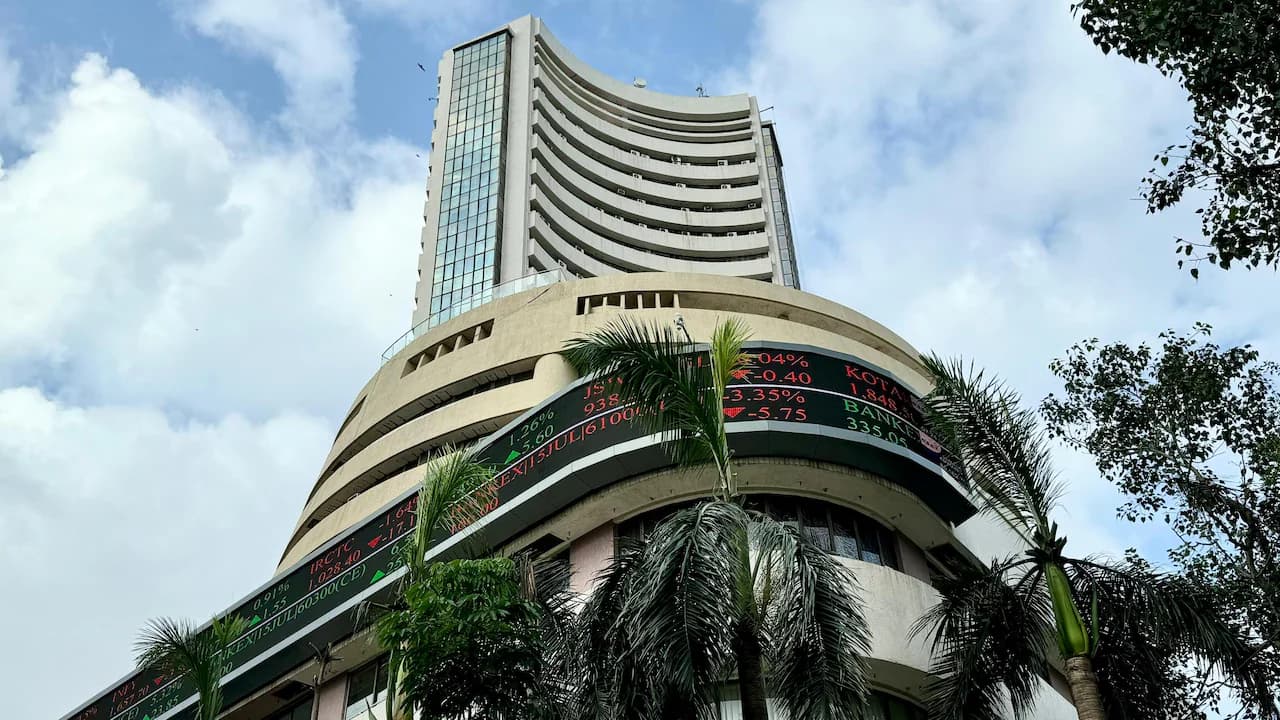
Indian stock markets experienced a significant downturn on Wednesday morning, with Sensex and Nifty falling around 1% as escalating US-Iran tensions and soaring oil prices spooked investors. After opening, Sensex dropped over 750 points to fall below 76,200 while Nifty 50 plunged over 200 points to slip below 23,800 level. The sharp decline erased nearly ₹5 lakh crore from the total market capitalisation of BSE within minutes from opening, dragging it down to ₹488 lakh crore. Infosys shares plunged nearly 3% to lead losses on Sensex, while TCS, HCLTech, IndiGo and M&M shares dropped nearly 2% each. HDFC Bank, NTPC, Tech Mahindra, Asian Paints, Bajaj Finance, Bharat Electronics (BEL), ITC and UltraTech Cement shares meanwhile fell over 1% each, with only Sun Pharma and Adani Ports shares remaining in green with marginal gains. India VIX, which measures volatility in the stock market, sharply jumped more than 3% to 11.86 in the morning session.
BSE share price dropped over 4% to an intraday low on Wednesday, September 2 as investors weighed concerns over lower participation following the introduction of the Closing Auction Session. The stock came under pressure after BSE management acknowledged that the newly introduced CAS has resulted in lower participation from high-frequency trading firms, proprietary traders and retail investors. As reported by ET Now, BSE management told Zee Business that "CAS has led to lower participations from HFT, proprietary accounts, retail traders. CAS participation needs to pick up." The decline reflects heightened volatility under the new CAS mechanism, with traders reducing activity amid expiry-day volatility that has prompted several market participants to scale back derivatives activity, particularly during the final half-hour of trading.
The Closing Auction Session (CAS) was implemented in Indian markets from August 3, 2026 as a separate 20-minute session from 3:15 pm to 3:35 pm, where buy and sell orders are matched to establish a single official closing price. As reported by ET Now, the mechanism came into effect following the Securities and Exchange Board of India's decision to introduce a closing auction session in Indian equity markets. The CAS is a call auction mechanism designed to determine the closing price of stocks in the cash segment that have active derivative contracts, with the aim of improving transparency and fairness in closing-price discovery. Equity derivatives turnover on NSE and BSE fell to multi-month lows in August, with analysts attributing the decline to heightened volatility under the new mechanism. Rajesh Palviya, head of research at Axis Securities, noted that "The decline in derivatives volumes is largely a result of the behavioural changes triggered by CAS."
According to Jefferies, the introduction of CAS adversely impacted equity options turnover and contracts in August, which is negative for companies like BSE and Groww. The industry's August 2026 index options premium Average Daily Turnover (ADTO) of ₹539 billion was the lowest since February 2025, with options ADTO falling 20% month-on-month led by uncertainty around CAS. Other derivative products such as index futures and stock F&O also witnessed a decline in August. BSE's August 2026 ADTO of ₹187 billion was down 26% month-on-month due to CAS and an additional expiry in the base, with its P/N ratio increasing to 12.2bps in August vs 10.9bps last month. Jefferies highlighted that the key challenge with CAS has been the uncertainty on expiry day, forcing option writers to stay away from the market, noting that "Sebi has introduced the CAS from August 2026, replacing the volume weighted average price (VWAP). This has resulted in volatility at the end of the trading day, as auction pools are currently shallow (1 per cent of cash ADTO)."
According to ACE Equity data, BSE shares have declined over 7% in the past three sessions and have tumbled 15% since the CAS came into effect on August 3. The 15% decline has eroded BSE's market capitalisation by ₹20,231.05 crore, with the stock down 30% from its 52-week high of ₹4,446.80 touched on May 27, 2026. Harish Jujarey from Prithvi Finmart noted that BSE has remained under pressure and has corrected nearly 30% from its all-time high, with the stock trading below all key moving averages. The next important support for the stock is now seen in the ₹3,100 - ₹3,000 zone, with the RSI near oversold levels of 30 showing slight positive divergence. "The ₹3,100 - ₹3,000 zone will therefore be crucial to watch. If the stock manages to hold this zone, we could see a recovery towards ₹3,500 - ₹3,550 levels. However, a decisive break below ₹3,000 could lead to further weakness and a deeper correction," he added.
Another factor weighing on BSE shares is the renewed focus on how NSE shares could trade following its proposed public-market debut, as reported by ET Now. BSE management clarified that, under the current framework, an exchange cannot list its own shares on its platform, but indicated that NSE could first list its shares on BSE and subsequently seek to have the shares permitted for trading on NSE. The distinction between listing and permitted-to-trade is significant, as while listing makes an exchange the primary platform for a company's securities, permitted-to-trade status allows shares listed on another recognised exchange to be bought and sold without the company being listed there. NSE already has more than 200 companies whose shares are permitted to trade on its platform despite not being listed there, highlighting this distinction. PTI reported that NSE may not be required to take Sebi approval for allowing its own shares to trade on the platform as far as it lists its shares on another exchange, potentially under the existing permitted-to-trade framework.