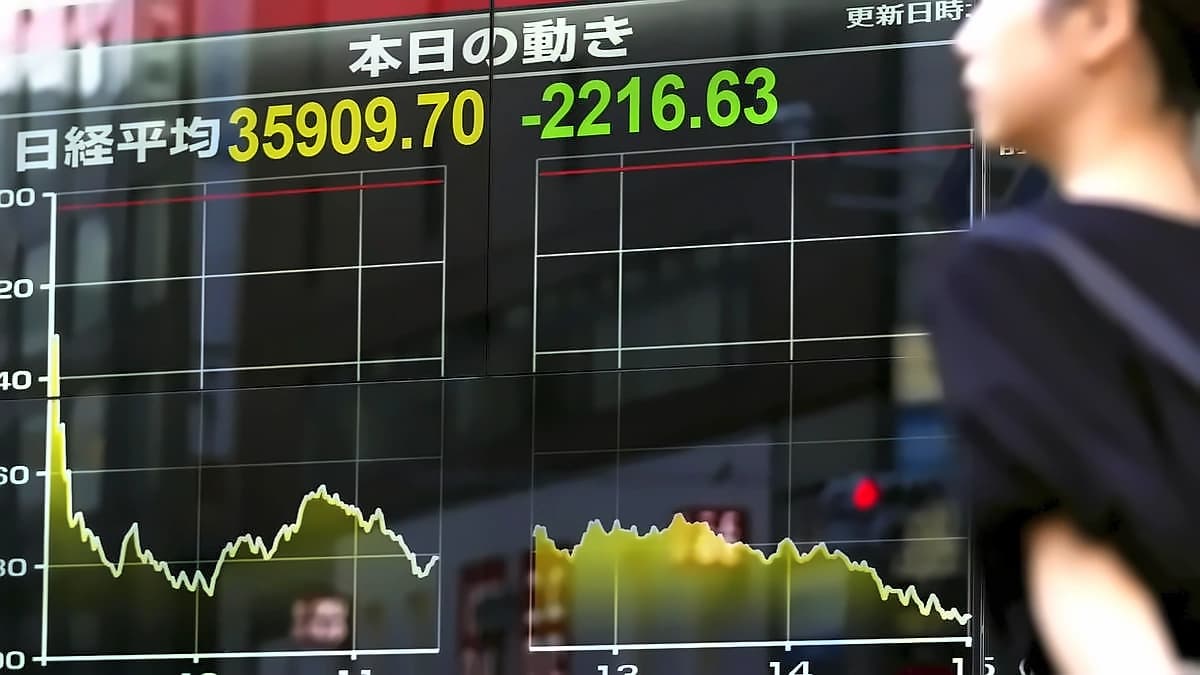
Asian stocks showed mixed movement on Tuesday, August 11, with US equity-index futures also edging lower overall. According to reports from CNBC TV18, the Kospi fell 1.09% in intraday trading, while Hang Seng futures rose 0.55%. Japan's stock market remained closed for Mountain Day, a national holiday observed on the second Monday of August. The defensive rotation away from AI stocks toward banking sector investments drove significant gains in regional financial markets, with Japan's Nikkei posting its highest close in nearly four weeks on Monday, rising 2.08% to 66,970.22. Meanwhile, US markets edged down from record highs, with the S&P 500 slipping 0.1% from its record set on Friday, while the Dow Jones Industrial Average dipped 60 points and the Nasdaq composite fell 0.3%.
Asian bank stocks staged one of their strongest rallies in decades as investors moved away from the volatile AI trade in search of safer bets. As reported by CNBC TV18, the MSCI Asia Pacific Financials Index climbed 8.6% in July, recording its best-ever monthly outperformance against the technology gauge. This marked the best monthly outperformance against the broader regional index since October 1998, when Japan launched a massive bank rescue package following the Asian financial crisis. Hong Kong's financial stocks posted their strongest month in almost four years, while Japanese banks doubled the gains of the benchmark Topix this year.
Japan's technology sector led the market gains with chip-related stocks providing significant support to the Nikkei's strong performance. According to Reuters, Advantest and Tokyo Electron rose 6.43% and 4.13% respectively, while Fujikura climbed 7.62% after the fiber-optic cable maker raised its annual net profit forecast on Friday. Ibiden, a supplier to AI bellwether Nvidia, rose 4.03%, benefiting from the broader AI sector rally. The technology gains were supported by easing bets for a U.S. Federal Reserve rate hike, as data showed the U.S. economy unexpectedly shed jobs last month, dampening expectations for rate increases at the September meeting.
Singapore's equity market has shown extreme concentration in 2026, with three local banks and Singapore Exchange (SGX) contributing 95.2% of the Straits Times Index's 1,025-point rally year-to-date, while the remaining 26 component stocks added just 50 index points between them, according to DBS. The concentration has become more pronounced since the US-Iran conflict began on February 28, with the 26 stocks outside the banks and SGX collectively subtracting 184 index points over that period. This contrasts sharply with last year's more balanced rally when four financial stocks contributed 62.3% of the index's 850-point gain.
Brent crude rose 5% to $87.72 after swinging between $72 and $102 last month as hopes rose and fell that the United States and Iran could reach an agreement allowing oil tankers to freely exit the Middle East. The rise pushed the 10-year Treasury yield up to 4.70% from 4.65% late Friday, up from 3.97% before the war with Iran. The Japanese yen weakened 1% on Monday, wiping out roughly half its recent intervention-led rally, though it steadied slightly to trade at about 159.17 per dollar in early Tuesday trading. The offshore yuan held largely steady at 6.7456 per dollar.