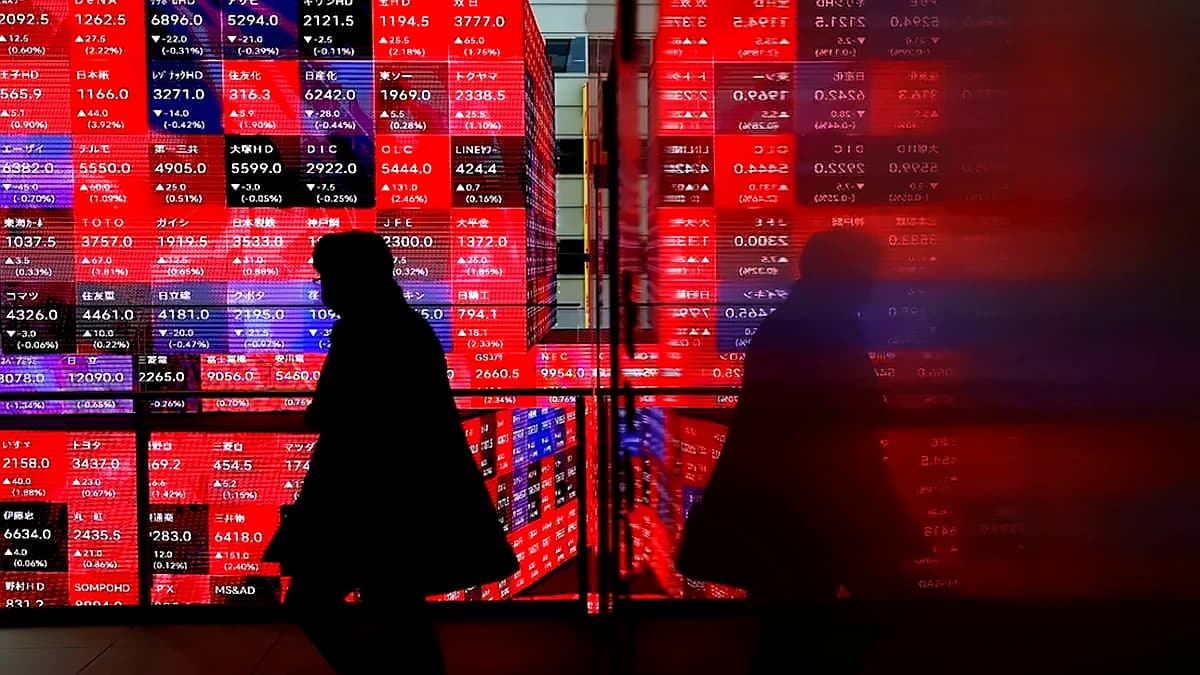
Asian stock markets traded lower on Tuesday as renewed fighting in the Middle East unsettled investors and pushed oil prices above $91 a barrel. According to Bloomberg, Japan's Nikkei 225 fell 0.49%, South Korea's Kospi declined 0.42% and Australia's S&P/ASX 200 slipped 0.31%. The weaker start followed fresh military exchanges between the US and Iran after a period of relative calm, with American forces striking an island in the Strait of Hormuz while Iran responded with attacks targeting the United Arab Emirates and Jordan. Oil prices extended their advance in early Asian trading, with Brent crude rising above $91 a barrel as the latest escalation raised concerns about energy supplies and shipping through the key waterway. US stock futures were little changed after Wall Street ended Monday lower, although the major benchmarks still recorded monthly gains in August.
South Korean shares fell sharply on Monday as hawkish comments from Federal Reserve Chair Kevin Warsh raised expectations of a possible US rate hike as early as next month. According to The Economic Times, the benchmark KOSPI dropped 2.46%, falling 167.29 points to 6,621.59 by 0104 GMT. Foreign investors were net sellers of shares worth 347.2 billion won ($252 million), adding to pressure on the market. Largecap technology stocks led the decline, with Samsung Electronics falling 2.72% and SK Hynix dropping 3.27%. Among other major stocks, Hyundai Motor slipped 0.50% while Kia gained 0.31%, while LG Energy Solution declined 0.54%. Of the 908 stocks traded on the South Korean exchange, 133 advanced and 746 declined, reflecting broad-based selling pressure across the market.
Oil prices climbed significantly as fresh fighting flared up in the Strait of Hormuz, highlighting risks to Middle East crude flows after months of relative calm. According to Bloomberg, Brent for November gained toward $90 a barrel, while West Texas Intermediate was near $85 following the US military's strike on Iranian rocket launchers preparing to send mines into the waterway on Sunday. The attack by the US was the first military action against Iran in more than a month, as President Donald Trump has switched to a campaign to drive Iran to the negotiating table by squeezing its economy. Brent futures climbed 2.8% to $90.60 a barrel after US forces struck two of Iran's launchers on its island of Larak on Sunday. President Trump later posted that Kharg Island, Iran's main oil terminal, was being "blown to smithereens," though there was no confirmation of this from the military. Iran attacked American forces in Jordan, and missiles have been intercepted, with Fox News reporting that there has been no significant damage so far. Chris Weston, head of research at Pepperstone Group Ltd, noted that "the direct attack on Iranian launch sites does little to advance talks, and neither will Iran firing back at Jordan," but added that there seems little appetite to push crude materially higher.
The resulting risk to inflation kept bond markets on edge after Federal Reserve Chair Kevin Warsh emphasised on Friday the central bank had work to do to control inflation. Markets reacted by lifting the probability of a September rate increase to 60%, shoving short-term Treasury yields sharply higher and flattening the curve. According to Business Standard, Michael Feroli, chief US economist at JPMorgan, said "We continue to expect that a hike won't come until December, though agree that the September meeting is live." He noted that Warsh's speech suggested a chair more willing to translate his concern about inflation into policy tightening. Key to the chance of an early hike will be the outcome of Friday's August payrolls report and consumer price data due on September 11. Analysts are forecasting a bounce of 58,000 in jobs, following July's shock drop of 23,000, with unemployment holding at 4.1%. It would probably need a much weaker outcome to greatly lessen the risk of a September rate move. As Investing.com explains, Warsh turned up at Jackson Hole and quietly changed the locks, with the market's starting point shifting from asking what the economy would need to do to force the Fed back into tightening to increasingly asking what the economy has to do to keep the Fed from tightening.
Despite Monday's decline, the Korean won strengthened against the dollar, with the Korean won strengthening 0.16% to 1,377.3 per dollar on the onshore settlement platform, compared with 1,379.5 at the previous close. In offshore trading, the won was quoted at 1,376.6 per dollar, while its one-month non-deliverable forward contract stood at 1,376.1. South Korean government bond yields also moved higher, with the most liquid three-year Treasury bond yield rising 3.7 basis points to 3.835%, while the benchmark 10-year yield climbed 2 basis points to 4.294%. September futures on three-year Treasury bonds fell 0.09 point to 103.25. In a significant development, South Korean President Lee Jae Myung tapped a career technocrat as finance minister in a surprise cabinet reshuffle over the weekend, apparently aimed at stemming a slide in support. Despite Monday's decline, the KOSPI remains up 57.13% so far this year, with the won having strengthened 4.5% against the dollar over the same period.