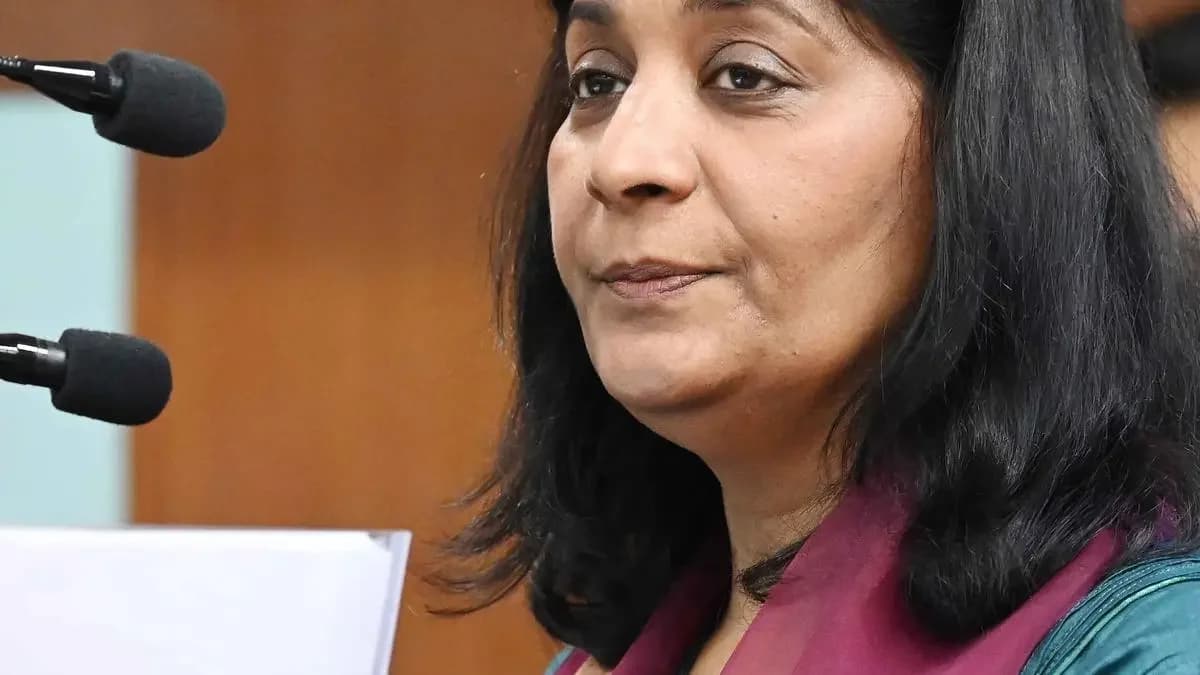
Reserve Bank of India's Deputy Governor Poonam Gupta outlined India's path to high-income status by 2047, emphasizing that achieving this goal will depend less on national-level macro policies alone and more on how effectively states craft and execute growth strategies tailored to their local strengths. According to reports from The Hindu BusinessLine and ANI, Gupta spoke at the Columbia Indian Economy Summit 2026 on Monday, arguing that sustaining or exceeding recent growth trajectories requires extending our growth frameworks at the subnational levels with policy priorities differing sharply between above-median and below-median states. She stressed that India's Viksit Bharat vision by 2047 will be built not just on national policy reforms but on a mosaic of state-led strategies that complement each other while addressing local challenges. As reported by The Economic Times, Gupta described this projection as part of a 'simple thought experiment' where the central bank calculated each state's average annual growth in per capita gross state domestic product (GSDP) over the past decade and extended the same pace for the next two decades.
Gupta projected that if the growth patterns of the past two decades are sustained, the average state per capita income could approach high-income thresholds by 2046-47. According to The Economic Times, she noted that below-median states are projected to contribute substantially to this expansion, reinforcing the broad-based nature of India's growth story. The RBI Deputy Governor calculated that India's per capita income is projected to grow by 4 times in USD terms by 2046-47, with the expansion expected to be broad-based across both richer and poorer states. This signals a shift from the earlier era of sharp income divergence toward a more inclusive and balanced development trajectory, with the pace of income divergence having weakened considerably over successive decades. Gupta observed that the growth gap between richer and poorer states has narrowed over successive decades, with the attrition of divergence attributed to better performance of relatively lower-income states such as Odisha, Assam, and Uttar Pradesh during the past decade.
For above-median states, Gupta identified key focus areas including innovation and scale, planned urbanisation, attracting global and domestic talent, expanding market share both domestically and internationally, and actively taking part in shaping national frameworks on trade, FDI, and finance. According to The Hindu BusinessLine and ANI, these states are expected to drive India's competitiveness in technology, capital markets and global supply chains. In contrast, below-median states need to prioritise unlocking productivity in agriculture and reimagining the sector; building skills; integrating more in the national and international labour markets, complementing more advanced states, particularly in labour-intensive activities. Gupta called for holistic assessments, richer dialogues, greater awareness, specific actions across states, alongside learning from each other, to fully leverage their existing strengths and building new comparative advantages. As reported by The Economic Times, she noted that India's growth story consists of broad-based prosperity, with every state recording a significant increase in per capita gross state domestic product over the past two decades, though the pace of income growth has varied significantly across states.
Gupta highlighted India's remarkable economic transformation over the past four decades, with average real GDP growth rising from 5.7% in the 1980s to 6.6% in the 2010s and reaching 7.7% in the most recent four-year period excluding pandemic years. According to The Economic Times, per capita income has risen nearly tenfold from about US$ 274 in 1981 to around US$ 2700 in 2024, with the acceleration being even more pronounced in per capita income terms. She noted that while it took over two decades for per capita income to double initially, it has expanded by almost fivefold in the subsequent two decades, indicating a clear structural shift in growth momentum. Gupta emphasized that India has 'attained a virtuous cycle of accelerated growth and macroeconomic stability', supported by lower inflation, manageable current account deficits, stronger bank balance sheets and improved fiscal quality. She concluded that achieving higher prosperity by 2047 would require differentiated strategies for states depending on their stage of development.
The speech pointed to encouraging signs of convergence in welfare outcomes, with Gupta observing that convergence has been faster and more decisive across a wide set of welfare and development indicators: per capita consumption expenditure, literacy, nutrition, access to basic services, financial inclusion and a range of health and gender outcomes. According to The Economic Times, she noted that multiple other dimensions of socio-economic wellbeing have been converging, citing health, education, sanitation, access to electricity, clean cooking fuel, drinking water and financial inclusion. A particularly striking example is the percentage of women in India with access to a bank account, which has jumped to around 80% during 2019-21 from 14% in 2005-06. However, she pointed out that convergence has not been universal, with interstate convergence appearing limited for some structural variables including the share of agriculture in state economies, productivity growth, capital formation, FDI inflows, and bank credit growth. Gupta concluded that prosperity is both India's ambition and destiny, but the central question has shifted from whether India will prosper to how quickly, how broadly, and how equitably that prosperity is shared.