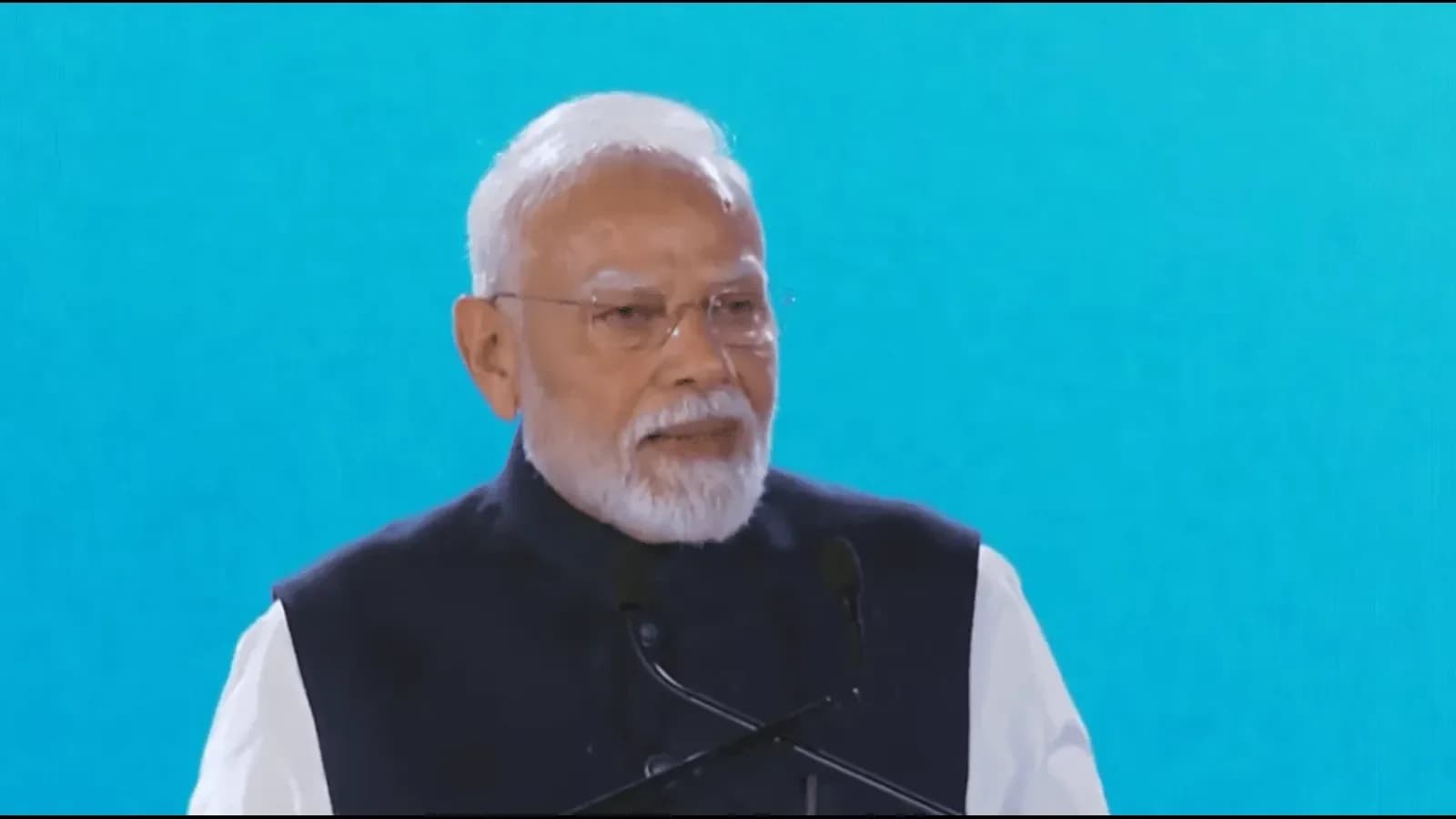
Prime Minister Narendra Modi addressed the Bloomberg New Economy Forum in New Delhi on Tuesday, emphasizing India's commitment to 'grow with the world, and for the world' rather than at anyone's cost. According to reports from Business Standard, Modi stated that India does not seek to grow at the expense of other countries but wants to advance a model where technology, innovation and economic strength empower others rather than remain instruments of control or competition. 'In this world full of uncertainties, India inspires reliability and stability,' Modi said, pitching India as a reliable economic partner amid geopolitical tensions and growing competition over critical technologies and resources. Modi emphasized that India seeks to expand its global economic influence through shared prosperity, with the country's approach centered on 'power to empower' rather than measuring strength by who has the power. Speaking about the Forum, Modi said 'Today, India stands at a defining moment in its journey. India is no longer just a destination for investment; it is a trusted partner in shaping the global future'. Modi's comments come amid India and much of the Global South facing challenges to their food and energy security, the threat of sanctions and supply-chain disruptions, including those involving critical minerals.
India recorded 7.8% growth in the April-June quarter and its current account deficit declined to 0.61% of GDP last year, as reported by Business Standard. The Prime Minister highlighted the country's economic resilience and reform momentum, citing key policy changes including the Goods and Services Tax, Insolvency and Bankruptcy Code, and consolidation of 29 labour laws into four labour codes. Modi emphasized that 'this growth is taking place on a strong foundation' with strong macroeconomic fundamentals, noting that 'India's economic growth is taking place on a strong foundation amidst global uncertainty' and citing the country's latest GDP expansion at 7.8% in Q1 FY27. He also cited foreign-exchange reserves exceeding USD 700 billion as evidence of the country's financial stability, with Modi stating that 'this year, in the April to June quarter, India's economic growth was 7.8%' and that 'the growth is taking place on a strong foundation' with drastic reduction in India's current account deficit from over 4% 12-13 years back to about half a percent now. Modi said 'India's reform express continues to move ahead at high speed. For us, reforms are not a compulsion. Reforms are our conviction'.
Addressing the forum, Modi said technology, data, knowledge and innovation had emerged as sources of power, emphasizing the need to ensure that the benefits of technological progress reach a wider section of society. The Prime Minister stated that 'will technology advance only a few people or create new opportunities for millions? Will knowledge remain the strength of a select few or enhance everyone's capabilities?' and introduced the concept of 'power to empower' rather than power to control. Modi said the approach called for a shift in thinking, prioritizing empowerment over control, cooperation over competition and helping others succeed over individual success. He noted that 'this seeds a new thinking — Moving beyond power to control, we need power to enable. Moving beyond power to compete, we need power to collaborate. And moving beyond power to succeed, we need power to help others succeed'. Modi emphasized that 'the idea of using knowledge, money and power for a larger purpose was not new to India', adding that 'the true value of power lies in its purpose' and that 'our thousands of years of tradition have taught us this'. Speaking about India's belief in inclusive technology, Modi said 'today, technology is power. Data is power. Knowledge is power. Innovation is power. But the real question is not who possesses power. Rather, the question is how that power is being used'.
India's digital ecosystem demonstrates remarkable scale and democratization, with more than 500 million YouTube users and more than 500 million Instagram users, according to Business Standard reports. The country hosts more than 2,000 global capability centres serving companies worldwide and has shared its digital capabilities extensively, including digital payments, digital identity and vaccine manufacturing. During the Covid pandemic, India supplied vaccines to more than 100 countries, showcasing its vaccine manufacturing capabilities. Modi highlighted India's more than 80,000 registered newspapers and publications, more than 1,000 satellite television channels, and nearly 800 languages, emphasizing how 'in our country, people openly debate different issues, and citizens discuss diverse viewpoints'. He noted that 'in the present era, one factor that has played a major role in enabling this is digital power' and that 'digital power has enabled the democratisation of information and ideas'. Modi detailed how his government, in the last 12 years, had placed great emphasis on making mobile data affordable, which has helped students, young people and small shopkeepers in smaller towns and villages, terming it 'power to empower'.
India's startup ecosystem has grown to more than 250,000 startups, with nearly half based in small cities and towns, as reported by Business Standard. The Prime Minister highlighted India's energy transition success, noting that renewable energy capacity increased from around 75 gigawatts in 2014 to approximately 300 gigawatts. Modi emphasized that India's technology is helping lift 250 million people out of poverty through direct benefit transfers and that democratising access to technology would help new ideas emerge. He highlighted India's expanding startup ecosystem and clean-energy capacity as examples of how domestic capabilities could support inclusive growth. Modi said 'India believes that competition is important, but compassion is equally important. Innovation is essential, but its benefits must also be widely shared. National strength is necessary, but we must also contribute solutions to global challenges'.
Addressing global disruptions, Modi noted that supply chains, critical minerals, energy, payment systems and technology are increasingly becoming tools of pressure and dominance. According to Business Standard, he stated that 'things that once connected the world are now being turned into weapons' and that 'the routes created by globalisation over past decades have, in many cases, become chokepoints'. The Bloomberg New Economy Forum, hosted in India for the first time, brings together more than 500 public- and private-sector leaders under the theme 'A World in Play: Defining the New Levers of Power' to examine the changing geopolitical landscape and collaborate on a roadmap towards future prosperity. Modi warned that 'they are all becoming tools for coercion and for exerting pressure' and emphasized that reliable partners and resilient economic systems are more important in the current global environment. Modi had spoken of the importance of trust among countries at the Group of Seven (G7) meeting in France, with US President Donald Trump sitting next to him, saying 'many countries were facing challenges related to ageing populations' and that 'the world needed more trust among countries'.