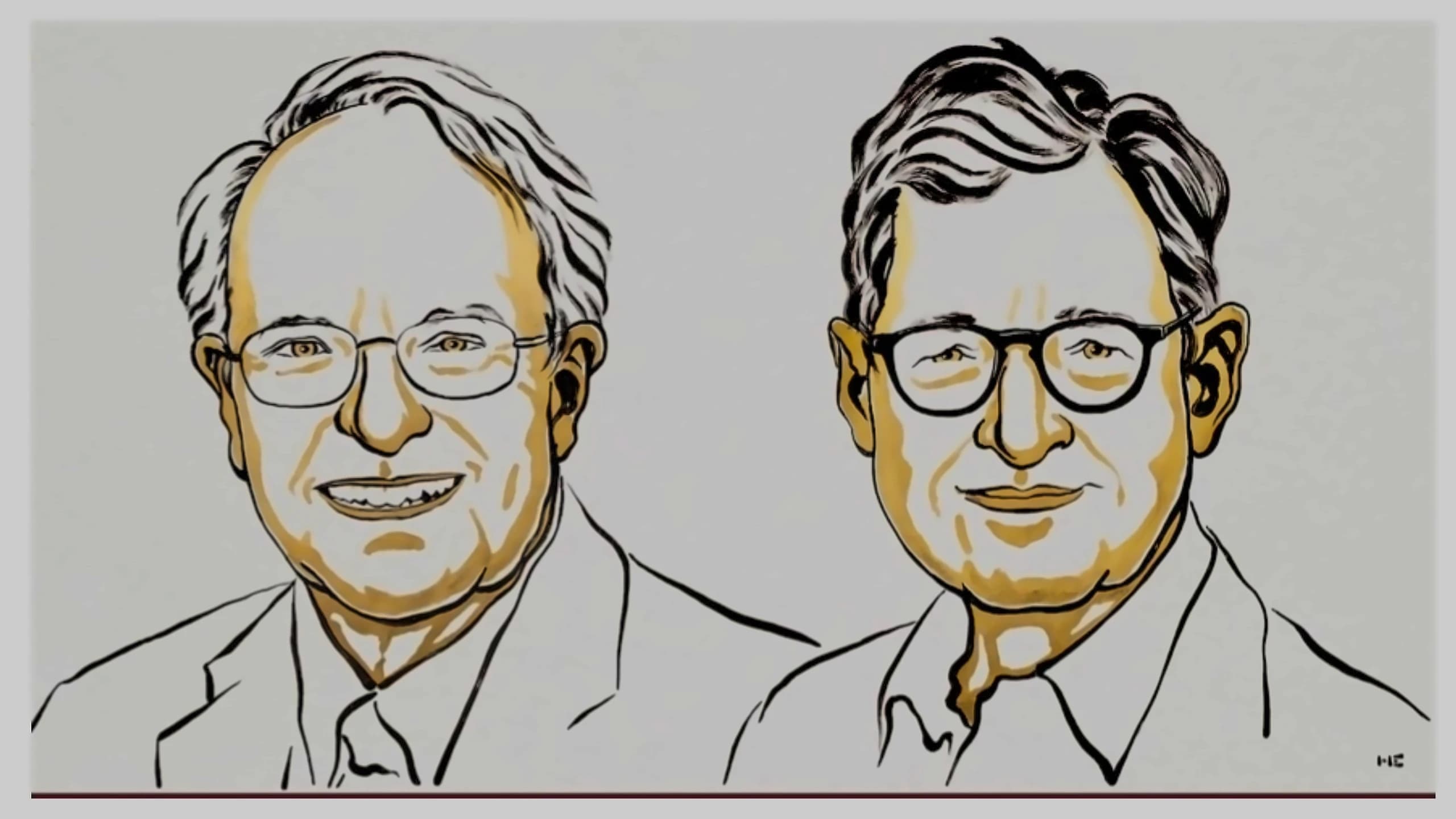
The 2026 Nobel Prize in Economics has been awarded to Robert E Hall and Michael Woodford for their groundbreaking research that fundamentally transformed economic policymaking. According to reports from Business Standard, the Royal Swedish Academy of Sciences awarded them the prize 'for microeconomic foundations of macroeconomic stabilisation'. Their research has generated a paradigm shift in stabilisation policy, resulting in New Keynesian models that explain and quantify how stabilisation policy affects business cycles and are now used by central banks and finance ministries worldwide. As the Nobel committee explained, economic outcomes are the result of millions of decisions made at the microlevel by households and businesses, moving policymakers away from studying the economy from a macro perspective like a bird's eye view. Hall and Woodford will share the ₹1.2 crore ($1.2 million) award, with Hall affiliated with Stanford University in California and Woodford with Columbia University in New York. As reported by the academy, 'The laureates have helped us smooth out the economy's peaks and troughs'. The jury specifically noted that 'On the basis of these models, well-timed fiscal and monetary policy measures can reduce the economy's peaks and troughs'. The timing of the award is particularly significant, as it recognizes work that emerged during the 1970s oil crisis, a period that fundamentally disrupted traditional economic models and created what economists termed 'stagflation' - a situation where low economic growth and high unemployment existed alongside high inflation.
The oil crisis of the 1970s fundamentally disrupted traditional economic models and created what economists termed 'stagflation' - a situation where low economic growth and high unemployment existed alongside high inflation. As reported by Business Standard, earlier models had assumed that high unemployment was generally associated with low inflation, but the oil crisis challenged this relationship. Economist Robert Lucas, who won the Economics Nobel in 1995, argued that the problem was the assumption that relationships between economic variables would remain stable even when government policies changed, leading economists to focus on microfoundations - understanding the overall economy through individual household and business decisions. Lucas's criticism gained traction, but building models with microfoundations proved more challenging than initially thought. According to the academy, 'Ever since John Maynard Keynes formulated his economic theories almost a century ago, stabilisation policies had long let officials boost economic growth when needed. But during the oil shocks in the 1970s, the Keynesian models that governed when and how action should be taken no longer worked'. The oil-price shock itself was never really reversed; prices settled at a new, permanently higher level, challenging the assumption that shocks are temporary and that normal equilibrium can be restored. This has broader implications for current macroeconomic theory, as what if the new normal is not a stable higher price — but erratic, with an upward trend?
Robert E Hall's research fundamentally changed how economists understand household consumption behavior. According to Business Standard, Hall's central idea was that if households are optimistic about their future income, they will consume more than if they are pessimistic. In a landmark article published in 1978, Hall argued that if households make spending decisions based on all available information, changes in their consumption cannot be reliably predicted because people will change their spending decisions when they receive new information about their future income. Hall presented his results in what was described as a 'eureka moment' for research, turning the traditional approach on its head by testing the hypothesis that consumption changes cannot be predicted rather than searching for predictive indicators. His most sceptical colleagues were convinced, as the insight that there was now a natural benchmark proved as important as demonstrating the accuracy of the theory. In a 1982 paper with economist Fredric Mishkin, Hall found that around 80% of households made spending decisions based on their expectations for the future 'while the rest lived hand to mouth', as reported by the Nobel committee. The fundamental aspect of Hall's work is that 'Households are forward-looking when making decisions about spending or saving', meaning the way governments and central banks communicate their policies can influence people's views of the future when making such decisions. Hall's research on consumption and household behaviour highlighted the importance of expected lifetime income in shaping spending decisions. Rather than looking only at the money available to them today, households consider what they are likely to earn and spend over time, helping explain why a temporary increase in income does not always translate into higher consumption if families expect financial uncertainty ahead.
Michael Woodford developed a complete New Keynesian macroeconomic model in 2003, incorporating insights from Hall's research and other economists' work. As reported by Business Standard, Woodford's framework addresses three critical areas: interest rates influence spending (with central banks using the concept of natural interest rates to determine optimal policy levels), businesses cannot always change prices instantly (creating sticky prices that affect inflation and growth), and expectations influence inflation (with central bank credibility, transparency and communication being crucial factors). His model uses the concept of output gap to help policymakers understand whether demand is too high or too low relative to economic capacity. Woodford's book from 2003 presents a complete New Keynesian macro model built upon microfoundations, serving as a prototype for all subsequent New Keynesian models and functioning as a laboratory for policymakers to understand the impact of different policy measures. According to economist Ivan Werning from the Massachusetts Institute of Technology, the prize recognizes research that 'pushes our understanding of macroeconomics from the bottom up, from families and firms making decisions over time, while looking ahead'. Woodford spoke to the committee by phone on October 12 from New York, saying: 'It's a tremendous honour; it's a surprise'. Businesses do not necessarily change their prices as soon as economic conditions shift. Existing contracts, administrative costs and the practical difficulties of frequent price revisions can delay adjustments, while companies may base their pricing decisions on what they expect inflation, consumer demand and monetary policy to look like in the months ahead. These decisions have wider consequences, as when prices and wages adjust at different speeds, changes in interest rates can affect economic output, employment and inflation in ways that may take time to become visible.
The research by Hall and Woodford has fundamentally changed how policymakers respond to economic shocks, moving beyond historical relationships between inflation, unemployment and growth. According to Business Standard, their work helps policymakers examine how households and businesses make decisions and how expectations about the future influence the economy. These New Keynesian economic models are now widely used by central banks and governments to respond to economic challenges, including the pandemic and recent energy crises. The models can be refined and adapted to each country's circumstances, with the Swedish central bank having its own New Keynesian model adapted to Swedish conditions. The implications extend to how central banks communicate their policies, as changing interest rates is only one part of monetary policy. How households, businesses and investors interpret those decisions also matters, with central banks using forward guidance to communicate their expectations for the future direction of monetary policy. By signalling how borrowing costs may evolve, they aim to influence decisions on spending, saving and investment before an actual rate change takes place. If households and businesses expect interest rates to remain high, they may delay borrowing, purchases and investment. On the other hand, credible signals that rates could fall may encourage some spending and investment even before borrowing costs decline. However, forward guidance does not guarantee a particular response. Its effectiveness depends on whether people trust the central bank's signals and on the economic circumstances they face. A household worried about job security, for example, may remain reluctant to spend even if it expects interest rates to fall. John Hassler, chair of the prize committee, said: 'The laureates' work has provided us with a stable theoretical foundation for the models that are now used by central banks and governments around the world'.