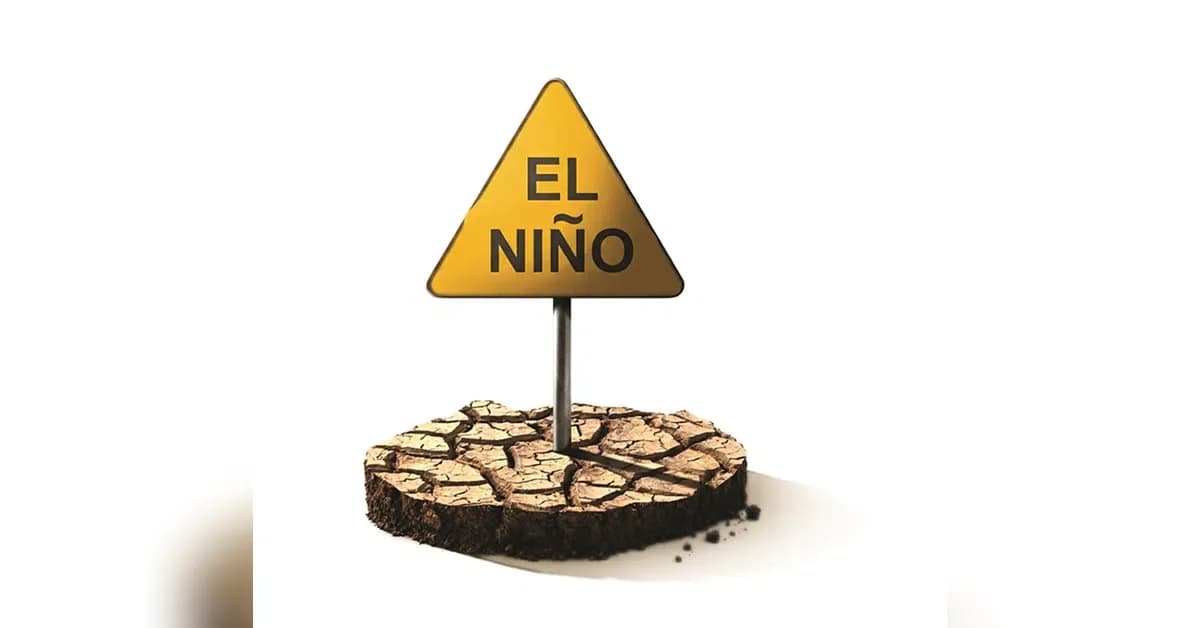
India is facing one of its strongest El Niño events in decades, with the overall rainfall deficit from June 1-23 touching 43%, representing a significant escalation from the earlier 41% June rainfall deficit that had threatened the kharif crop season. According to The Hindu BusinessLine, weak monsoon conditions are likely to persist until July 2, which could impact the kharif harvest, particularly crops requiring more water, namely paddy and maize. The monsoon reached Kerala on June 4, 2026, three days later than its normal onset date of June 1 and more than a week after the IMD's projected arrival date of May 26, 2026, marking a weak start to the season amid El Niño concerns. The IMD had earlier projected seasonal rainfall at 94% of the long-period average, but Skymet is now reviewing its forecast due to the strengthening El Niño conditions. India Meteorological Department on Wednesday said that monsoon rainfall across the country during June 1-24 was 42% lower than normal with only 21% of the geographical areas receiving average rainfall, as per The Hindu BusinessLine.
The Central government has identified 315 districts across the country that are likely to be impacted by low monsoon this year, with 111 districts classified as 'most vulnerable' due to having less than 25% irrigation coverage. As per The Hindu BusinessLine, Maharashtra accounts for 22 of these 111 most vulnerable districts, while 10 districts in Chhattisgarh are also included in this category. Agriculture Minister Shivraj Singh Chouhan announced that special drives would ensure full crop insurance coverage, easier loan availability, adequate seeds for replanting, maximum utilisation of available water resources and fertiliser availability in the most vulnerable districts. The ministry has mapped 315 districts across Madhya Pradesh, Maharashtra, Tamil Nadu, Gujarat, Uttar Pradesh, Rajasthan, Karnataka, Bihar, Jharkhand, Telangana, Andhra Pradesh and Odisha as likely to receive below-normal rainfall. Another 76 districts fall under the medium-priority category with irrigation coverage between 25 and 50 per cent, while 128 districts have been classified as low priority owing to relatively better irrigation facilities.
The Indian government's assessment of districts vulnerable to El Niño impact is based on historical analysis by the Indian Council of Agricultural Research (ICAR) of crop losses during previous El Niño years of 2002, 2004 and 2009. According to The Hindu BusinessLine, ICAR has identified 77 districts in paddy, 65 in maize, 36 each in sorghum and millet as particularly susceptible to rainfall shocks associated with El Niño conditions. The rainfall deficit was 19% in 2002, 13% in 2004 and 23% in 2009, with kharif season foodgrains production dropping by over 22% in 2002 and 12% each in 2004 and 2009. However, a former agriculture secretary noted that the current year's situation is not comparable with these previous three years as there has been a major expansion of area under assured irrigation, mainly through groundwater. ICAR's Hyderabad-based Central Research Institute for Dryland Agriculture (CRIDA) has started holding meetings with agriculture departments of States to sensitise stakeholders, with first round of meetings held with major rice growers including Bihar, Karnataka, Telangana, Andhra Pradesh, Maharashtra, Rajasthan, Assam, Punjab, Gujarat, Uttar Pradesh and West Bengal.

The farm ministry is urging farmers in rain-fed areas with limited irrigation to shift to less water-intensive crops such as pulses, oilseeds and millets as authorities prepare for a potentially weak monsoon that could weigh on agricultural output. According to Business Standard, this push is part of a broader effort to prepare for the 2026 monsoon planting season after rainfall since June 1 has run 42% below normal, prompting New Delhi to step up coordination with states to safeguard farm output and rural incomes. District-level contingency plans will guide crop choices, water management and emergency responses if rainfall remains deficient, with most affected districts spread across 12 states including Madhya Pradesh, Maharashtra, Gujarat, Uttar Pradesh, Karnataka and Andhra Pradesh. Several of these districts are among India's largest producers of soybean, sugar, cotton, peanuts, corn and rice, making the shift particularly critical for national agricultural output. According to ICAR's standard operating procedures for 2026, Krishi Vigyan Kendras will recommend applying life-saving irrigation, foliar nutrient applications, and prioritization of catch crops in case of crop failures.
Highlighting the government's agricultural support initiatives, Agriculture Minister Shivraj Singh Chouhan emphasized that the ministry has set up an El Nino Monitoring Cell and a Crop Weather Watch Group for real-time tracking and advisory. According to The Hindu BusinessLine, the 731 Krishi Vigyan Kendras (KVKs) have been asked to step up farmer outreach, with timely advisories to be disseminated via SMS, WhatsApp, call centres and other media. The Minister stated that there is a gap in rainfall, we need to suggest alternative crops to farmers, we will not let farm fields remain empty, with seed and fertiliser availability being adequate for the season. Reservoir levels are currently above last year's level, though declining, with states directed to use water judiciously and clean ponds, streams, farm ponds and check dams under the VB-GRAM G programme to preserve water for irrigation contingencies. The ministry has called for extensive enrolment under crop insurance schemes and Kisan Credit Cards in the identified states. The Indian Council of Agricultural Research (ICAR) has prepared comprehensive guidelines for the States to work with farmers at different stages of the monsoon season based on rainfall deficit and sowing pattern. The Centre has fixed a production target of 176.16 million tonnes of foodgrains which include 123.15 mt of rice, 31.04 mt of maize, 13.56 mt of nut cereals and 8.4 mt of pulses in the current Kharif season.