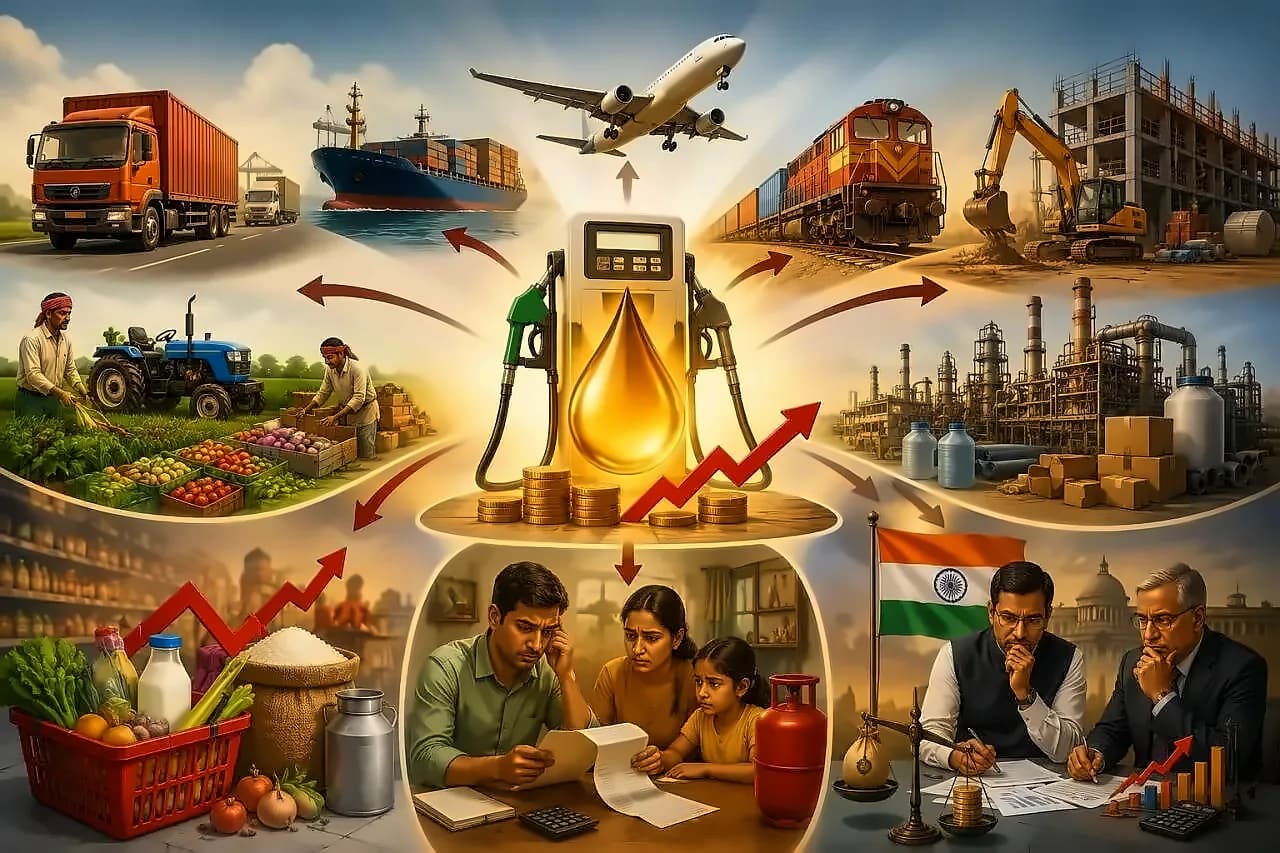
India's wholesale price index-based inflation rate surged to 8.3% in April compared to 3.9% in the previous month, primarily driven by higher fuel prices, according to reports from Business Standard. The retail inflation rate for April stood at 3.48%, as reported by CABhagyashreeThakkar, showing a more modest consumer impact. The consumer price index-based inflation rate remained modest at 3.5% for April, primarily because of limited passthrough of higher oil prices to consumers. Economists expect the retail inflation rate to inch towards 4% following the fuel price increases. The current oil price shock is having stagflationary effects, reducing growth rates while increasing inflation rates simultaneously. Fuel and power costs have soared by 24.71%, showing significant upstream cost pressures according to the latest data. Recent reports indicate that companies' fuel, transport, raw materials and production costs are rising rapidly, creating immediate pressure on businesses that will eventually impact consumers through higher prices for groceries, milk, delivery charges, cab fares, and daily use items.
The wholesale inflation jump to 8.3% represents a 42-month high, indicating significant pressure building at the producer level, as reported by CABhagyashreeThakkar. Packaging, metals, chemicals and logistics are getting expensive, creating a broad-based inflationary pressure across multiple sectors. While the common person may not feel the full impact immediately because companies usually absorb costs for some time, these costs can eventually start showing up in everyday bills. This producer-level inflation suggests that inflationary pressures are building beneath the surface, with the wholesale price index showing what is happening at the producer level. The ongoing Middle East crisis is keeping Brent crude prices high, with projections averaging $96 a barrel in 2026 and $79 in 2027, creating sustained pressure on India's import-dependent economy. Recent analysis confirms that companies' costs are rising rapidly, with businesses facing significant increases in fuel, transport, raw materials and production expenses that will eventually translate into higher prices for consumers.
India faces a double blow as net FDI drops significantly, creating structural economic challenges alongside high oil prices. Net FDI has fallen dramatically from $38.6 billion in FY2022 to an estimated $1 billion in FY2025, while gross FDI inflows remain strong at about $90.8 billion by January 2026. This downward trend reflects foreign companies sending more profits home and Indian firms investing more abroad. Net FDI fell to just $0.5 billion in January 2026, indicating a deeper change in how India finances itself externally. The combination of falling net FDI and high energy prices creates an unstable environment, with geopolitical risks often deterring FDI in emerging markets and global policy uncertainty lowering chances of FDI increases.
The Reserve Bank of India faces significant challenges in the coming months as monsoon this year is expected to be below normal, which could lead to a significant increase in food and fuel prices affecting inflation expectations, as reported by Business Standard. The Monetary Policy Committee (MPC) needs to be extremely alert to these developments. Inflation rates in many parts of the developed world are running well above target, with potential rate increases in developed economies that could further affect capital flows and pressure the currency. The Reserve Bank of Australia raised the policy rate earlier this month for a third consecutive time, while the US inflation rate is running close to double the target. If inflation goes above the Reserve Bank of India's target, the central bank may face tough choices between fighting inflation and supporting growth.
India's economic strength faces significant challenges from global energy markets and changing investment trends. The Asian Development Bank projects GDP growth around 6.9% for FY2026 and 7.3% for FY2027, though these forecasts assume external pressures can be managed. However, analysts have different views on India's economic trajectory. The OECD expects higher inflation (5.1% for FY27) and slower GDP growth (6.1%), while Morgan Stanley predicts 6.7% growth for FY2027 but warns of risks to economic stability. Goldman Sachs forecasts strong 6.9% growth in 2026. This wide range of predictions shows the uncertainty in India's economic path, with the country's view as a powerful growth driver facing challenges from global energy markets and changing international investment trends. Recent analysis emphasizes that inflation is hitting consumers gradually but consistently, making it important for individuals to adopt financially smart practices including avoiding unnecessary shopping, controlling credit card bills, and maintaining savings that can help beat inflation.