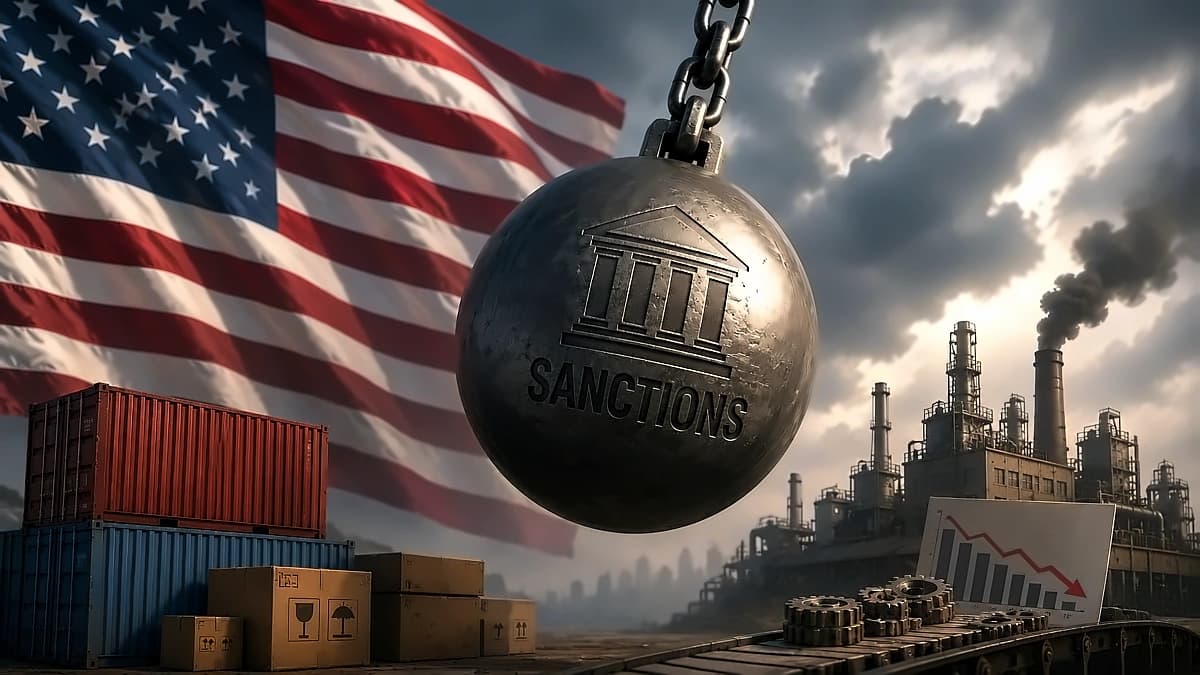
Iran's parliament has advanced a plan to charge ships for using the Strait of Hormuz, adding fresh pressure on oil markets just hours before Washington unveils new sanctions on Tehran. According to Financial Times, Iran's National Security and Foreign Policy Commission backed a draft law on Sunday that would require ships from countries that may use Hormuz to pay Tehran for the services it provides. The proposal follows weeks of Iranian rhetoric, with Mohsen Rezaei, secretary of Iran's Supreme National Security Council, warning that Tehran would treat cooperating countries as enemies. US Treasury Secretary Scott Bessent set the stage for Monday's sanctions announcement in a Financial Times op-ed, declaring 'At dawn begins an economic D-Day — the single greatest financial offensive ever marshalled against an adversary.'
India's direct economic exposure to Iran has sharply declined in recent years, with Indian exports to Iran falling from $3.5 billion in FY2019 to $1.2 billion in FY2026, according to data by Global Trade Research Initiative (GTRI). Imports have fallen even more dramatically, from $13.5 billion to less than $375 million, after India largely stopped importing Iranian crude. However, India bought Iranian crude worth $707 million in April and May under a temporary US waiver, but halted these imports from June. Rice remains particularly important, with India exporting $383.11 million worth of rice to Iran in the first half of 2026, while tea exports stood at $14.34 million. As reported by Reuters, these shipments have traditionally relied heavily on Dubai for payments and logistics, creating potential disruption risks.

A serious impact could come if the economic warfare further disrupts oil flows through the Strait of Hormuz, a key route for global energy supplies. A Hormuz disruption could sharply raise India's oil-import bill, according to GTRI Founder Ajay Srivastava, who noted it could push up crude prices, freight rates and marine insurance costs. For India, which imports most of its crude oil, this could add pressure on inflation and the rupee. The UAE's decision to suspend trade and financial transactions with Iran has added another problem for Indian businesses, with companies now exploring routes through countries such as Turkey to avoid disruption. The impact could be especially significant for the basmati rice industry in northern India, where India ships around 5-6 million tonnes of basmati rice overseas each year, of which close to 1 million tonnes go to Iran.
The Iran crisis intersects with US pressure on Russia, with the US Senate passing the Lindsey O. Graham Sanctioning Russia and Iran Act of 2026 by an 86-11 vote, which could allow President Trump to impose tariffs of up to 100 per cent on goods from major buyers of Russian oil and gas. India's imports of Russian crude rose to a record 2.58 million barrels per day in June, supported by tighter supplies from West Asia and lower prices offered by Moscow as demand from China weakened. Indian refiners have altered their crude procurement mix, raising imports from Russia and turning increasingly to non-traditional suppliers such as Venezuela, Brazil and Angola to cushion supply disruption risks. The legislation still needs to clear the US House and become law before such powers can be used.
Bessent's Monday press conference should detail specific targets and potential scope of the sanctions campaign. Bessent argues that maximum economic pressure lowers the odds of military escalation rather than raising them, suggesting that traders may be misreading the campaign's true purpose. However, the standoff may stay rhetorical or become a real test for oil supply and the bond market. Elevated oil prices compound the problem, with energy costs feeding directly into inflation, which leaves the Federal Reserve less room to cut rates. The focus shifts to Kevin Warsh's first major speech as Fed Chair at Jackson Hole next week, where his stance could make Bessent's challenge even harder by injecting more volatility into an already febrile bond market. Indian debt markets are shut on Wednesday for a local holiday, adding to the week's volatility as markets navigate global sanctions uncertainty.