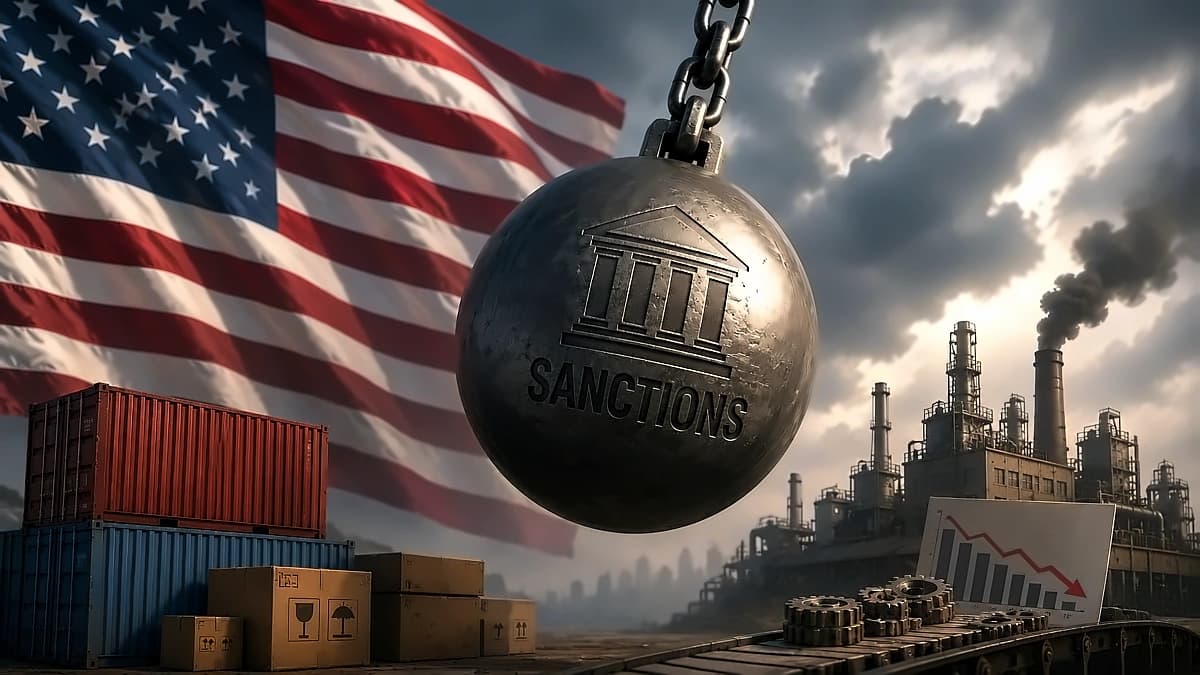
The 'Operation Economic Outcast' campaign has significantly expanded beyond its initial targets, now covering five critical sectors under Executive Order 13902. According to Treasury Secretary Scott Bessent, the campaign targets digital assets, technology, gold, aviation and shipping sectors, with Washington warning that "no one is above the reach of US sanctions." The distinction between primary and secondary sanctions is crucial - primary sanctions bar Iran-related transactions involving US persons, while secondary sanctions reach non-US parties for business conducted entirely elsewhere, using access to the American financial system as leverage. Treasury teams are approaching foreign counterparts with defined timelines to shut down Iran-related activity, though specific deadlines have not been disclosed. As per Bloomberg, the campaign targets nearly 60 entities in the first wave, with Treasury mapping "every node, every facilitator, and every network" Iran uses to move oil and evade sanctions, stating the campaign "will gather force with every day that follows."
Indian refiners including Reliance Industries, Indian Oil Corporation, Bharat Petroleum Corporation, and Hindustan Petroleum Corporation face significant exposure to US sanctions on Iran. According to Ruchit Thakur, Market Analyst at VT Markets, these companies could experience higher crude procurement, freight and insurance costs if Iranian supply becomes less accessible. The impact will depend on whether Washington moves from warnings to secondary sanctions implementation. The 'Operation Economic Outcast' campaign was announced by US Treasury Secretary Scott Bessent on Monday, August 24, targeting nearly 60 individuals, companies and vessels over Iran trade. Washington has also sanctioned four India-based firms over their alleged link with Iran's petroleum and petrochemical trade, including Portease Partners LLP, Sadashiva Overseas Ltd, PP Softtech Pvt Ltd and Prakrutees Infra Impex India Pvt Ltd. Reports indicate that Indian refiners mostly stopped importing Iranian crude to avoid risking access to American markets and the financial system.
Indian exporters of rice, tea and pharmaceuticals face an immediate crisis as Dubai-based trade channels have been completely disrupted. According to Reuters, India exported $383.1 million worth of rice to Iran in the first half of 2026, with much of this trade traditionally routed through Dubai. The UAE's suspension of Iran-related trade and financial transactions has created a major problem for Indian exporters. Additionally, India imported $707 million worth of Iranian oil in the first half of 2026, with these shipments enabled by a US exemption granted during a ceasefire in the wider West Asia conflict. India-Iran trade has fallen dramatically, with bilateral trade declining by 72% from $17.03 billion in fiscal year 2018-19 to $4.77 billion in fiscal year 2019-20, and current exports limited mostly to humanitarian-exempt goods worth $1.63 billion in fiscal year 2025-26. The recent sanction threat by the United States, which includes the removal of any entity that facilitates money laundering on behalf of Iran from the US dollar system, could critically disrupt these exports.
The sanctions campaign has created significant disruptions in global maritime operations, with OFAC warning US and non-US parties about dealing with three Iranian bodies involved in managing passage through the Persian Gulf Strait Authority, the Persian Gulf Marine Insurance Company and the Hormuz Safe Marine Services Authority. The strait authority was created in 2026 to run Tehran's permit system for passing ships, with Iran's asserted jurisdiction over international shipping there being contested. OFAC warns that accepting insurance or other services, or even answering information demands in exchange for guarantees of safe passage, can create sanctions risk. Iran's security chief Mohsen Rezaei warned that if countries around Iran join the American economic campaign, "not a drop of oil will leave the Persian Gulf and the Strait of Hormuz." On Tuesday, Ebrahim Rezaei of parliament's national security committee called it "an official and operational warning" to any country cooperating with US secondary sanctions. The exposure goes well beyond paying tolls - OFAC says accepting insurance or other services, or even answering information demands in exchange for guarantees of safe passage, can create sanctions risk.
China emerges as a crucial player in the sanctions landscape, with Beijing accounting for roughly 90% of Iran's oil exports. China reported $9.96 billion in bilateral trade with Iran in 2025, excluding the roughly $31.2 billion in unreported Iranian crude oil exports to China that year. When asked about Chinese banks, Treasury Secretary Scott Bessent stated that "if they facilitate transactions and are part of the ecosystem that turns Iranian oil into money, into repression, they will be targeted." Responding to the development, China has said that it is illegal for its nationals to comply with any unilateral US sanctions, with the latest US measures not targeting major Chinese financial institutions despite China being Iran's most important oil customer. This reflects the potential diplomatic and economic costs of directly confronting Beijing, with Beijing answering on Tuesday that "China's cooperation with Iran is conducted within the framework of international law and should not be interfered with or disrupted."
The sanctions campaign arrives as Iran's economy faces severe pressure, with the rial hitting a record at about 205,000 to the dollar on Tuesday, roughly seven percent weaker than a few days earlier. Iran's minimum wage of about 166 million rials a month is now worth around $81, while typical earnings of 200-300 million rials come to about $98-$146. Food inflation stands at 128% year-on-year against general inflation of 88%, with the government's own remedy - raising the monthly food coupon to 12.3 million rials - losing seven percent of its value before anyone could spend it. Treasury Secretary Scott Bessent explained that "for decades, this regime has drawn strength from a calculus that regards Iranian retaliation as certain and American enforcement as negotiable. That era is over." The campaign targets nearly 60 entities in the first wave, with Treasury mapping "every node, every facilitator, and every network" Iran uses to move oil and evade sanctions. The 'Operation Economic Outcast' campaign was announced by US Treasury Secretary Scott Bessent on Monday, August 24, targeting nearly 60 individuals, companies and vessels over Iran trade, with the campaign "gathering force with every day that follows."