The Korea-U.S. Strategic Investment Corporation (KUIC) was officially launched on June 18, 2025, marking a significant milestone in bilateral economic cooperation. Established pursuant to the Special Act on the Operation and Management of Strategic Investments between the Republic of Korea and the U.S., which was passed by the National Assembly on March 12, 2025, the Corporation held its inaugural ceremony at its headquarters in Naseong-dong, Sejong City. The Ministry of Finance and Economy established the Korea-U.S. Strategic Investment Corporation Establishment Committee, composed of seven members including government and private-sector representatives, chaired by First Vice Minister Lee Hyoung Il, to oversee the establishment process. Over the past three months, the Committee deliberated on key matters including the Corporation's articles of incorporation, organizational structure, and staffing, before transferring responsibilities to the newly appointed President and CEO upon completion of registration.
Despite South Korea's historic launch of 24-hour won trading from July 6, MSCI CEO Henry Fernandez expressed skepticism about the country's ability to achieve developed market status. As reported by CNBC, Fernandez questioned whether the extended trading hours would create 'a large pool of liquidity with a tight bid-ask spread' during off-peak hours. 'If Korea wants to depend on a night shift of trading the won, so that we in London, we in New York can trade it, the question becomes, will that be a large pool of liquidity with a tight bid-ask spread? I have my doubts,' Fernandez told CNBC. The MSCI review this week disappointed hopes that South Korea would be placed in the Developed Markets watchlist, with the index provider citing rigid investor identification systems, restrictions on in-kind transfers and off-exchange transactions, and limits on investment products as key concerns. 'Investors have communicated that the underlying issues have not been fully resolved,' MSCI stated, maintaining the country in the emerging markets category.
South Korea is set to launch 24-hour trading in the Korean won from July 6, marking one of the country's most significant financial market reforms in decades. According to Reuters, the trial period began June 29 with the official rollout scheduled for July 6, allowing local banks to test the new system ahead of its full implementation. As reported by Bloomberg, the transition comes after 18 years of limited foreign exchange market access, with the country now removing control mechanisms that have operated for decades. The extended trading hours are expected to improve access for global investors, although they will also require financial institutions to maintain continuous market coverage through expanded staffing and overnight operations. The reform comes as South Korea seeks to strengthen its appeal among international investors and improve its chances of securing developed market status from global index provider MSCI. A freely accessible and continuously traded currency is considered an important factor in enhancing market accessibility, with the move aimed at eliminating the 'Korea Discount' - the tendency of Korean stocks to trade at considerable discounts relative to global peers due to currency restrictions.
The extended trading hours are expected to improve access for global investors, although they will also require financial institutions to maintain continuous market coverage through expanded staffing and overnight operations. As reported by Reuters, the reform comes as South Korea seeks to strengthen its appeal among international investors and improve its chances of securing developed market status from global index provider MSCI. A freely accessible and continuously traded currency is considered an important factor in enhancing market accessibility, with the move aimed at eliminating the 'Korea Discount' - the tendency of Korean stocks to trade at considerable discounts relative to global peers due to currency restrictions. To support the transition, authorities have introduced several measures aimed at ensuring sufficient market liquidity. As reported by Reuters, offshore investors will now be allowed to hold and settle transactions directly in Korean won through a new offshore settlement system, while additional safeguards such as overdraft facilities have also been introduced. Major lenders including Hana Bank, Woori Bank, Shinhan Bank and KB Kookmin Bank are expanding staffing both in South Korea and overseas, particularly in London, to ensure continuous trading coverage. According to Reuters, Hana Bank plans to add three staff to three shifts, Woori Bank will double its UK team to four, Shinhan Bank will add one person in London, and KB Kookmin Bank will add two staff members.
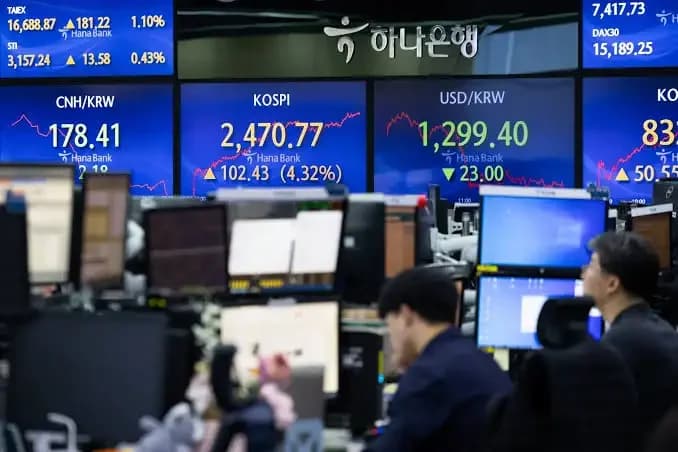
The transition faces challenges as the won has remained under pressure, trading near a 17-year low against the US dollar, making it vulnerable to heightened volatility during periods of thin overnight liquidity. According to Reuters, even modest trading volumes during off-peak hours could result in larger-than-usual price swings. The currency weakness is being driven by South Korea's booming equity market, with the benchmark KOSPI index doubling to all-time highs this year, prompting foreign investors to lock in profits and repatriate funds. As reported by Bloomberg, the record rise of the main index is pushing foreign funds to sell to lock in profits or rebalance portfolios, while South Korean investors continue actively investing in US stocks at an unprecedented pace. Ironically, the gains have reinforced won weakness as overseas funds engaged in record selling. 'Sometimes it gets intense all of a sudden, like the other day when orders flooded in after SpaceX went public,' said Hana Bank FX dealer Shin Jae-min, who works until 9 p.m. and noted that 'responding to such demand means no break even during some really odd hours.'
Despite these reforms, South Korea's efforts to gain developed market classification still face fundamental hurdles beyond trading hours. According to MSCI, the key issue holding back classification is 'the functioning of the equity markets' rather than the currency reforms. 'South Korea is one of the most developed markets on the planet,' MSCI CEO Henry Fernandez told CNBC, 'Economically, technologically, society-wise, et cetera. [But] our big focus is on the functioning of the equity markets, and in that respect, they exhibit a large number of attributes of emerging markets.' The problem extends beyond trading hours to questions about liquidity in the currency market, with Fernandez noting that 'you cannot buy the Korean won anywhere but in office hours, day trading hours in Seoul.' This makes rebalancing portfolios difficult for index fund managers invested in South Korean equities, as a third of the global money being managed on indexes is attributable to index funds. While MSCI acknowledged that 'reforms to the Korean system are clearly underway and enormous progress is being made,' the index provider maintained that the country's classification will remain unchanged until these underlying issues are fully resolved.