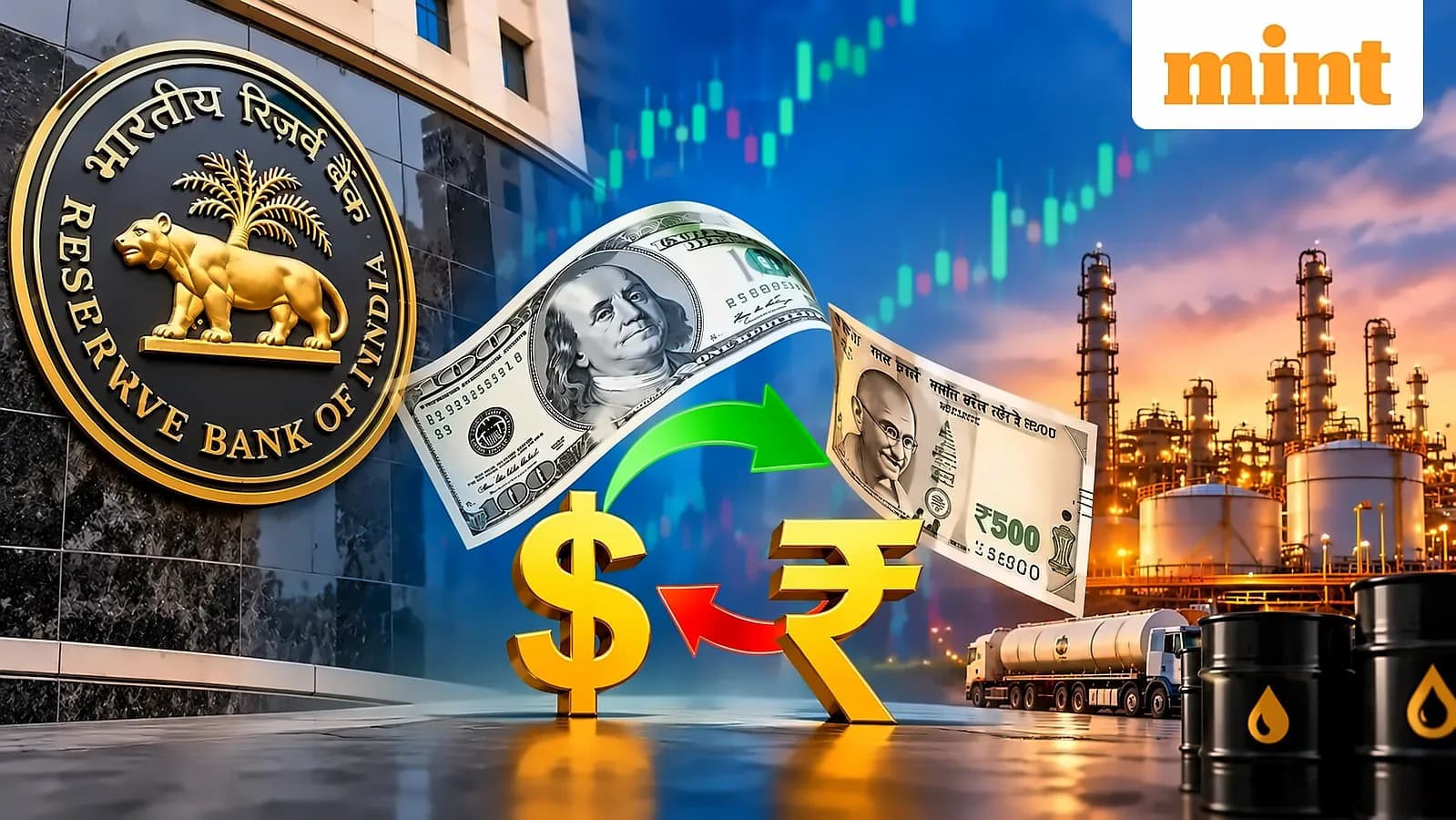
The Indian rupee posted its best weekly performance in 11 weeks, rising 0.83% for the week ended Friday, marking the fourth weekly gain in the last five weeks. According to The Economic Times, the currency ended largely unchanged at 94.32 per dollar after a choppy session on Friday, as weakness in regional currencies largely offset the unwinding of long dollar positions. The rupee had climbed to 94.21 early in the session as long dollar positions were unwound, but surrendered gains later as the dollar strengthened and index-rebalancing outflows hit the currency. This was also the best performance since the week ended April 3, demonstrating sustained momentum from recent RBI measures and favorable market conditions. As per De-Risk Forex Consultancy, "The recent RBI measures together with favorable oil prices on account of de-escalation of Middle East concerns kept the local unit in positive territory even after sizeable dollar strength today."
The Reserve Bank of India (RBI) has stepped up dollar purchases significantly to rebuild foreign exchange reserves and manage its large short dollar forward position, according to latest market reports. Market participants estimated the RBI's dollar purchases at around $1 billion-$2 billion on Thursday, after the central bank is believed to have absorbed $2 billion-$3 billion from the market on Wednesday. The Indian rupee strengthened for the fifth consecutive session, gaining 1.5% against the dollar to settle at 94.34 per dollar after touching an intraday high of 94.17 per dollar. The currency had opened weaker after the US Federal Reserve maintained a cautious stance on rate cuts, but recovered through the day as lower crude oil prices and sustained foreign inflows boosted sentiment. As per William Blair Investment Management, "RBI absorbing hedging cost to attract foreign currency deposits and support external borrowing with the concessional FX facility appear most effective in the near term to lend support to the rupee."
Robust foreign inflows into Indian government securities and a slump in oil prices since the RBI announced dollar-attracting measures have worked in favor of the local currency, according to market analysts. Over the past week overseas investors have pumped more than $2 billion into government bonds since the RBI removed capital gains tax for FPIs on domestic bonds. Government FII tax exemption would increase the foreign participation in bond markets and would also be incrementally positive for inclusion of Indian G-secs in global indices, according to Kunal Vora, Head of India Equity Research at BNP Paribas India. The biggest change came on June 5, when the government made investments in certain Indian government bonds tax-free for foreign portfolio investors (FPIs). Since then, foreign investors have poured about $1.7 billion into Indian government securities through the Fully Accessible Route (FAR), compared with just $229 million in the 10 trading sessions before the announcement. Elara Capital estimates that India could attract $80-85 billion in bond-related inflows if the country is included in the Bloomberg Global Bond Index and current policy measures continue to support foreign participation.
The Fed's latest policy meeting, the first under new Chair Kevin Warsh, revived expectations of further rate increases and drove the dollar index to a one-year high, challenging the rupee's upward momentum. According to The Economic Times, the resurgent dollar, an uptick in oil prices, and renewed U.S. rate-hike expectations on Friday provided headwinds to the local currency. Brent crude inched up after U.S. Vice President JD Vance withdrew from a planned meeting with Iranian negotiators on Friday to begin discussions on implementing the 14-point agreement. However, the recent RBI measures together with favorable oil prices on account of de-escalation of Middle East concerns kept the local unit in positive territory, as noted by Dhaval Shah from De-Risk Forex Consultancy. The report expects the US Federal Reserve to raise interest rates by a cumulative 75 basis points between September 2026 and January 2027 as it focuses on bringing inflation back to its 2% target. The US Dollar Index (DXY), currently at 100.85, has seen a strong rise above 100 after the Fed meeting outcome, with immediate resistance around 101 and potential for a fresh rally to 106 by the end of this year or in the first quarter of next year.
Market participants remain cautious ahead of the Federal Reserve's policy announcement, with the US central bank widely expected to hold rates steady within the 3.5% to 3.75% range. According to Elara Capital, FY27 could be a "tale of two halves" for the rupee, with the currency expected to remain stable and even strengthen modestly in the near term as India's external position improves. However, pressure could return in the second half of the fiscal year if the US Federal Reserve resumes raising interest rates. "This suggests the bias for rupee has changed and we continue with our previous forecast of 93.50," said Dhaval Shah from De-Risk Forex Consultancy. By September, analysts see scope for the currency to climb to the 93 levels against the US dollar, with currency analysts noting that if geopolitical tension between Russia and Ukraine ease and oil slips to steady levels, the Indian rupee may even jump to the 92-93 range. However, crude oil prices below $100 and the RBI's FCNR(B) swap window are likely to provide only short-term relief. The rupee can gain some ground and move to 93 or 92.50 in a best-case scenario in the next quarter, but once strong dollar and high US yields take center stage, the rupee can begin to lose ground again. "We can expect the rupee to weaken back towards 96-97 and even make fresh lows as we head into 2027," according to market analysis. The preferred path is for the rupee to strengthen towards 93-92.50 first, before weakening again towards 96, with broad expectations of a 94-96 range in the short term and 93/92.50-96 in the medium term.