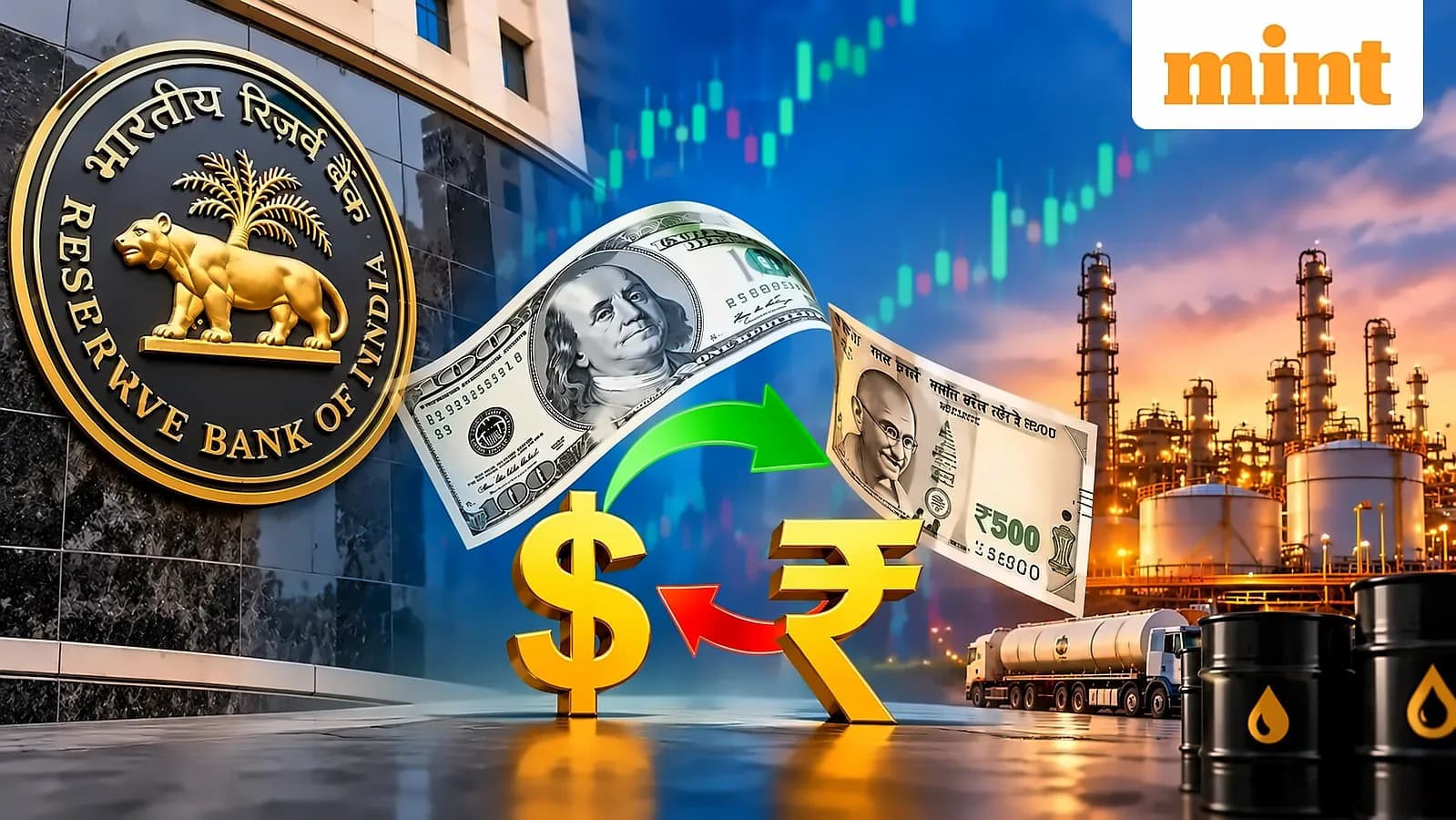
The Indian Rupee recorded its sharpest single-day gain in over 12 years, surging 1.6% to 93.10 against the US dollar on Thursday, marking the biggest single-day rise since September 2013. According to The Economic Times, the rupee gained 173 paise from its previous close of 94.83 per dollar, touching an intraday high of 92.83 per dollar. The currency opened at 93.54 per dollar and saw a volatile session, trading between 93.65 and 92.82, as oil companies and importers bought dollars, while banks and corporates sold the US currency. This dramatic recovery came after the Reserve Bank of India implemented its most aggressive forex intervention in over a decade, with the central bank's Wednesday night measures closing every escape route. The surge followed a series of steps by the central bank to restrict banks from onshore forward markets, prompting dollar unwinding by lenders.
The RBI's new rules have significantly impacted the banking sector, with Jefferies estimating ₹40-50 billion in losses for the sector, equivalent to ₹40-50 billion. As reported by The Hindu BusinessLine, foreign banks may absorb roughly 45% of derivative market losses, private banks 40%, and state-owned banks 15%. The losses, while manageable given the sector's pre-tax profit of ₹5.5 lakh crore in FY25, could affect medium to long-term trading activity in the rupee. Banks cannot make rupee derivative transactions with related parties, including their foreign trading entities, a rule particularly relevant for foreign banks. Former SBI Chairman Dinesh Khara noted that the kind of rupee volatility seen for the last couple of days was essentially the reason why moral suasion would not have worked, making the RBI's decisive step necessary. The aggressive intervention comes as the rupee hit a string of all-time lows on worries over spillovers from the Iran war, which has exacerbated pressure on a currency already struggling with concerns over India's current account and weak capital flows.
The RBI's new directive has significantly impacted the non-deliverable forward (NDF) market, with the gap between domestic and overseas NDF rates widening substantially. As reported by The Hindu BusinessLine, the offshore NDF market is large and often sets the tone for rupee pricing, with average daily offshore trading in the rupee across Singapore, the UK, the US and Hong Kong was about $149 billion in 2025, more than double the $72 billion traded onshore. A senior bank treasury official noted that "Rupee rose as expected in the spot market and the difference between the domestic rate and the one month overseas NDF rate is now 135 paise from about 35 paise on Friday." Banks are now paying NDF premiums to hedge their local dollar sales, as they cannot net off overseas trades with the domestic market. Treasury officials warn of significant mark-to-market losses as banks rush to comply with the stringent new rule. The new rules require banks to close contracts in open markets by removing leeway to sell to corporates or clients, potentially leading to higher rupee appreciation versus the flat performance seen on Monday. While banks were expecting to minimize their losses, the tighter rules may bring losses back to the original estimate or higher, depending on how spreads move. In the latest NDF market data, the largest notional trade is seen for April 7, with ₹1,218.20 million at a weighted average forward rate of 94.5581, across 240 trades, followed by another large build-up on April 13, with ₹946.00 million at 94.7127 across 100 trades.
The rebound in the rupee follows a series of decisive actions by the RBI aimed at tightening speculative positions in the currency market. In a circular dated March 27, 2026, the central bank capped banks' net open positions in the rupee at $100 million, with compliance required by April 10. On Wednesday, the RBI announced additional measures, stating that authorised dealers will not be allowed to offer non-deliverable derivative contracts involving the rupee to resident or non-resident users. The central bank also barred users from rebooking any foreign exchange derivative contract, whether deliverable or non-deliverable, once cancelled after the issuance of these instructions. These steps disrupted a massive $149 billion-a-day market, making it one of the most stringent crackdowns in over a decade. The central bank had earlier reduced the permissible net open position limits from 25% of capital to $100 million, before tightening norms further by restricting access to the NDF market for both resident and non-resident clients. According to The Hindu BusinessLine, the new rules take effect immediately and come just days after the RBI capped lenders' daily onshore currency positions at $100 million. The directive sent banks scrambling to unwind at least $30 billion of arbitrage trades, with people familiar with the matter estimating that between $4 billion and $10 billion have been unwound so far.
Despite the current recovery, underlying pressures persist with elevated crude oil prices, weak capital flows, and concerns over India's balance of payments continuing to weigh on sentiment. According to The Hindu BusinessLine, foreign institutional investors sold equities worth ₹8,331.15 crore on a net basis on Wednesday, with domestic equity markets also under pressure as Sensex tumbled 1,312.91 points or 1.80% to 71,821.41 and Nifty slumped 410.45 points or 1.81% to 22,383.40 in early trade. Since the beginning of the West Asia war on February 28, 2026, the rupee has depreciated over 4%. During the fiscal year ended March 2026, the currency has declined nearly 10% against the US dollar. VK Vijayakumar, Chief Investment Strategist at Geojit Investments Limited, noted that "the high crude price, the widening trade deficit, the fear of declining remittances and sustained FPI selling are acting cumulatively to put high pressure on the rupee." The stronger measures come with a side effect: they have driven up the cost of hedging exposure to Indian assets, according to Rajeev de Mello, global macro portfolio manager at Gama Asset Management. "When implied rates rise, foreign investors are compelled to sell their government bond holdings and unwind their hedges," he said. Weaker foreign demand for sovereign debt could drive up the cost of borrowing across the economy, with foreign investors already shunning local bonds, pushing up the benchmark yield to a two-year high.

The rupee's recovery was further supported by a weakening US Dollar in global markets, with the Bloomberg US dollar spot index trading down 0.03% as of latest reports. However, the USD/INR pair continues facing pressure from rising energy prices driven by Middle East conflict concerns. According to The Times of India, Brent crude traded 6.84% higher at $108.08 per barrel, with the dollar index rising 0.60% to 100.05. The rise followed US President Donald Trump's remarks that the US would hit Iran "extremely hard" within weeks, adding that military goals were nearly achieved and that the conflict was close to ending. As per The Times of India, for India, being a major oil importer, higher oil prices increase dollar demand, which directly puts pressure on the rupee. The overall picture for the rupee remains delicate, with rising oil prices, ongoing geopolitical tensions, and a strong dollar environment continuing to keep pressure on the currency. Bank shares declined, with the NSE's sector gauge falling as much as 2.9% to its lowest in almost a year, as the central bank's moves raised fears of mark-to-market losses on their foreign currency trades. In domestic equities, the Sensex ended 185.23 points higher at 73,319.55, while the Nifty gained 33.70 points to close at 22,713.10.