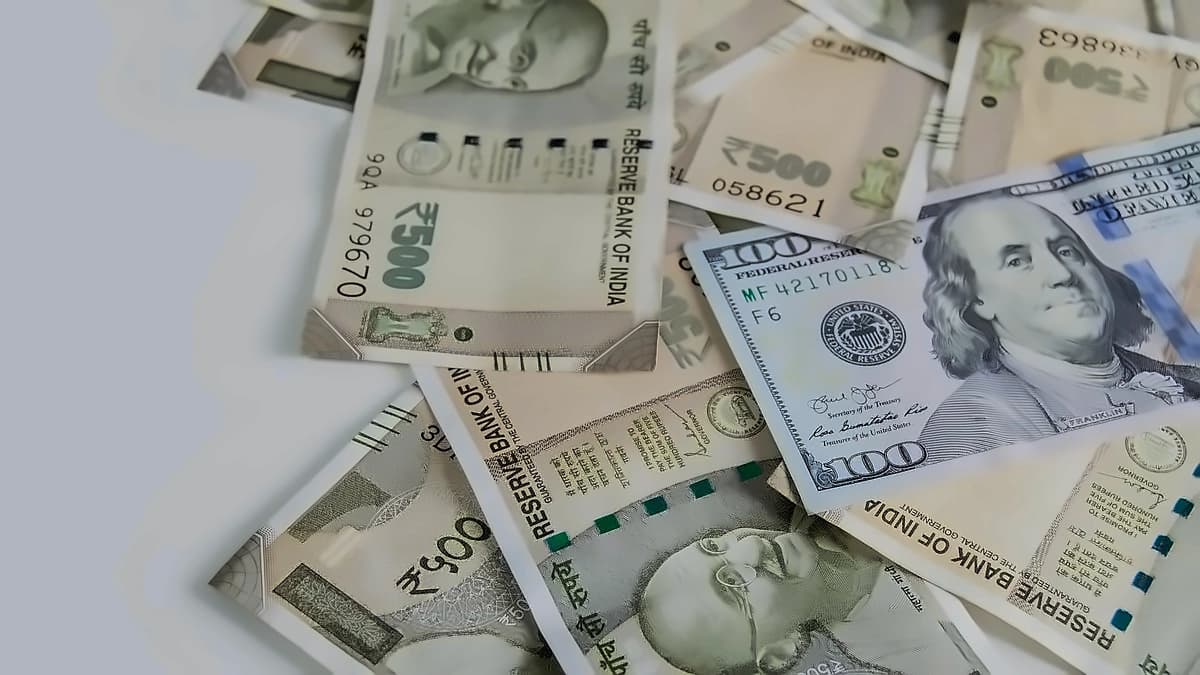
The Indian rupee fell to a record low of 95.73 per dollar in provisional trade on Thursday, continuing its losing streak that has seen new record lows every day. According to The Hindu, the currency settled at 95.73 (provisional), down 7 paise from its previous close, after experiencing significant volatility during the trading session. The rupee opened lower at 95.74 against the American currency and witnessed an intra-day high of 95.61 and an all-time intraday low of 95.96 before settling at current levels. As per Business Standard, the currency has fallen by over 6% this year and declined by more than 1% just this week. The rupee is treading dangerously close to the 96 mark against the US Dollar, representing a significant milestone in the currency's decline. As per CNBC TV18, the rupee has depreciated around 6% so far in 2026 and about 11% over the past twelve months, while foreign exchange reserves have fallen by roughly $38 billion from their February 2026 peak of $728.49 billion.
International oil prices continued to hold around the $100 per barrel mark that kept the rupee under pressure, with Brent crude quoted near the $106.16 per barrel level in futures trade, representing a 0.50% increase from previous levels. As reported by The Hindu, the West Asia crisis and the blockade of the Strait of Hormuz have disrupted crude petroleum imports into India, with the sharp rise in crude prices making fuel imports costlier. With India importing more than 80% of its energy requirements from the Middle East, the country faces significant pressure from geopolitical tensions. Experts widely anticipate a rise in local oil prices to control the country's fiscal deficit, with India needing to raise petrol and diesel prices to prevent oil companies from bleeding.
On May 13, the Indian government implemented a duty hike on import of precious metals, raising import tariffs on gold and silver to 15% from 6%. According to The Financial Express, this led to heavy investor selling in bullion markets, with MCX Gold and Silver futures both hitting their upper circuit in yesterday's trade. A rise in gold prices weighs negatively on the currency as it adds pressure on the country's current account deficit, as India is a net gold importer. As noted by Amit Pabari, Managing Director at CR Forex Advisors, "The timing is no coincidence. As tensions in West Asia continue to keep energy markets nervous, India's import bill has ballooned sharply."
Wholesale price inflation shot up to a 42-month high of 8.3% in April on the back of a spike in energy prices that followed the disruptions caused by the West Asia conflict, according to data released by the commerce and industry ministry. Wholesale price index (WPI) inflation was 3.88% in March, while it was 0.85% in April last year, representing a dramatic increase driven by an increase in prices of mineral oils, crude petroleum & natural gas, basic metals, other manufacturing and non-food articles. As per The Hindu, foreign institutional investors offloaded equities worth ₹4,703.15 crore on Wednesday (May 13, 2026), adding to the pressure on the rupee. The dollar index, which gauges the greenback's strength against a basket of six currencies, was trading at 98.51, down 0.01%, while foreign investors have withdrawn more than $22 billion from domestic markets this year, surpassing their last year's outflow of $18.9 billion.
Despite the rupee's weakness, Indian equity markets settled sharply higher for the second consecutive session, with the Sensex jumping 789.74 points to settle at 75,398.72 and the Nifty climbing 277 points to 23,689.60, as per The Hindu. However, the rupee is expected to trade with a negative bias amid inflation concerns and the strength of the US dollar in overseas markets. Indian policymakers are evaluating a comprehensive set of measures to stem dollar outflows and shore up the country's balance of payments. According to CNBC TV18, Option 1 involves tightening the Liberalised Remittance Scheme (LRS), where currently Indian residents can remit up to $250,000 abroad annually. Option 2 involves making Indian government securities more attractive through tax rationalisation, restoring the concessional 5% TDS rate on interest earned from Indian government bonds that expired in July 2023. Option 3 involves mobilising funds from the Indian diaspora through a special deposit scheme, though this faces challenges as US interest rates remain significantly higher than in 2013.