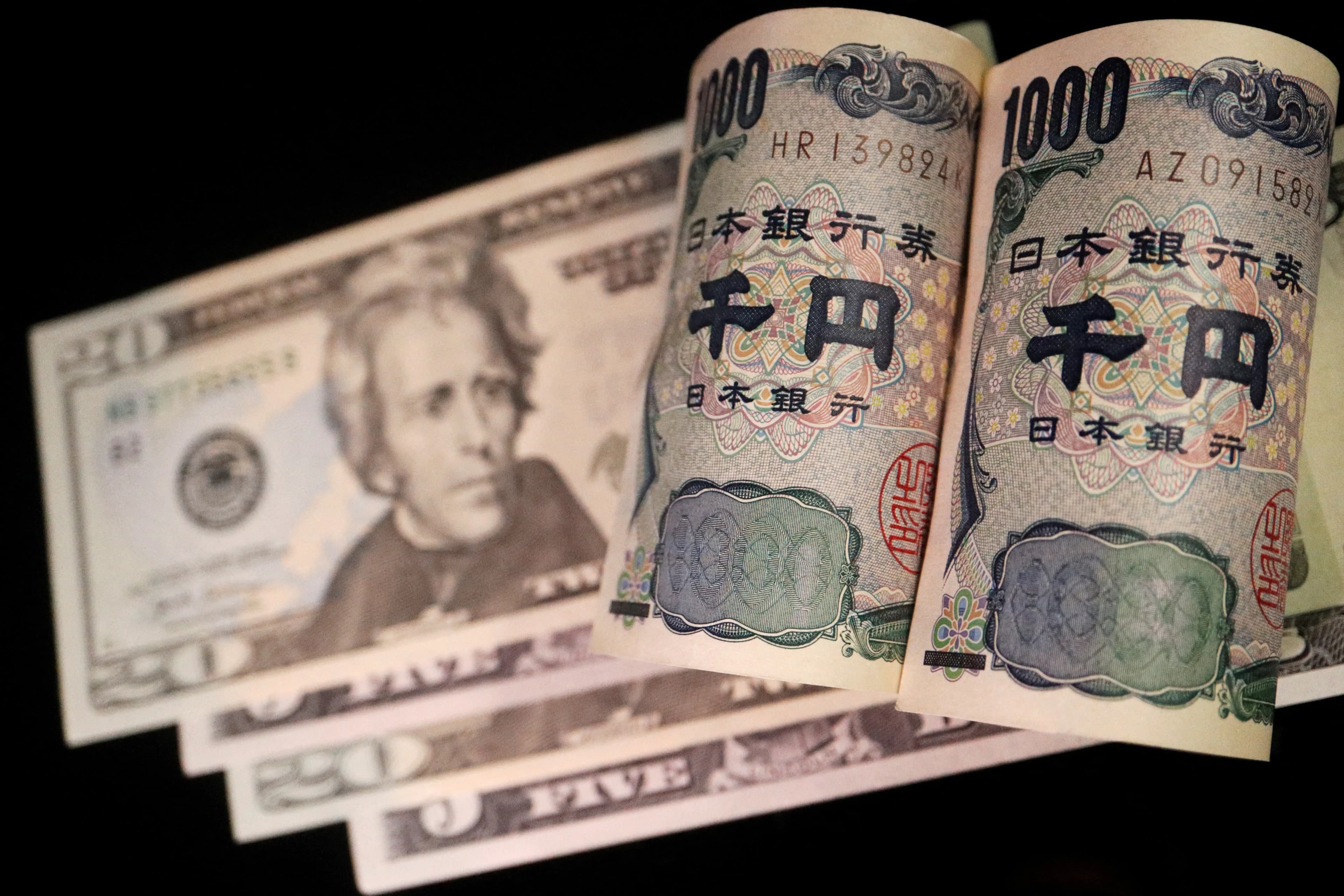
USD/JPY has broken beneath the critical 156.68 support level, a key technical threshold that attracted bids on each of its previous three tests, as the AI-driven selloff intensifies across global markets. According to Investing.com India, the currency pair has fallen 0.84%, broadly consistent with the collapse in US Treasury yields, with 2-year yield declines implying a 0.59% fall in USD/JPY and 10-year yield declines suggesting a 0.69% fall. The yen's strength adds another headwind for the Nikkei's internationally exposed companies, reducing the yen value of overseas earnings and compounding pressure from the broader global AI selloff. VXN, the Nasdaq 100's equivalent of the VIX, surged 4.30 points on Thursday, while MOVE, measuring implied volatility across the US Treasury curve, jumped 10.90 points to 106.84, indicating rising liquidation risks as technology losses amplify forced selling.
The Nikkei 225 has broken beneath its key 200-day moving average, marking the bottom of a broader support zone that includes the Liberation Day uptrend from April last year, horizontal support at 62,714, the September 14 low, and the moving average itself. As per Investing.com India, RSI (14) is showing building downside pressure but is not yet oversold, a message reinforced by MACD, which has staged a bearish crossover and turned negative. The index is sitting just beneath the 200-day moving average, with downside momentum building and increasing the risk of a further unwind towards 60,433, the July 29 swing low, followed by 60,000. Overhead resistance includes the 200-day moving average, followed by 62,714 and the Liberation Day uptrend currently around 63,300. With three of the Nikkei's four biggest constituents directly linked to the AI trade, the market remains on watch for signs of whether selling pressure could extend into European and US trade later Friday.

US 10-year Treasury yields hovered near a one-month low at 4.953%, after tumbling on Thursday when equities sold off on renewed concerns about the sustainability of the AI boom, pushing the dollar to a nearly three-week trough. As per ING analysts, "Whether yields stay below 5% is another question," adding they still expect the 10-year yield to snap back above 5% eventually, given inflation, fiscal deficit and AI trends. The moves in currency markets were driven by doubts over the AI spending boom even as Brent crude futures pushed above $114 per barrel, extending a 4% climb from the previous session after Houthi attacks in Saudi Arabia stoked concerns of further disruption to energy supplies from the region. "AI had become an increasingly two-way macro risk for the US dollar," analysts noted, with AI jitters favouring the yen while AI-related inflation concerns support oil prices.
Brent crude futures rose above $114 per barrel, extending a 4% climb from the previous session after Houthi attacks in Saudi Arabia stoked concerns of further disruption to energy supplies from the key exporting region. As per Reuters, this oil-driven inflation risk has increased fears that it could affect Fed policy, with Fed funds traders seeing only a small chance of a hike next week, and the next interest rate increase expected in December. The ongoing US war with Iran has heightened these concerns, with Chris Scicluna, head of economic research at Daiwa Capital Markets, noting that "AI is making people nervous, as is oil ... and as is France." The dollar had jumped last week after data showed that US consumer price inflation accelerated in September, but this move was soon overtaken by AI-related concerns and now faces additional pressure from elevated crude prices.
Data on Friday showed Japan's annual core consumer inflation reached 2.1% in September, topping the central bank's 2% target for the first time since December, a sign of broadening price pressure that bolsters the case for a near-term interest rate hike. According to The Economic Times, the majority of economists polled by Reuters expect a hold on Friday of next week, followed by a quarter-point hike at the following meeting in December. Overnight swaps, which track rate expectations, imply an 80% chance of a December BOJ hike, as reported by The Japan Times. The yen's strength ahead of the Bank of Japan's policy meeting next week reflects growing expectations for monetary policy tightening. Economists expect the Bank of Japan to consider an interest rate hike soon, with the next hike - to 1.5% - expected early next year, as the central bank grapples with rising inflation pressures.
Investors are currently preparing for upcoming central bank meetings next week, with the Federal Reserve seen on hold in October, followed by a hike in December. The European Central Bank is expected to hold its benchmark rate at 2.5% next week, though a hike is all but priced in before the year's end. Markets have priced a hold in Tokyo, with the next hike - to 1.5% - expected early next year. The European Central Bank lifted its deposit rate from 2.25% to 2.5% on September 10, its second hike this year, with ECB President Christine Lagarde noting that policymakers are not pre-committing to a rate path. The Canadian dollar firmed past C$1.40 against the greenback, up 0.1% to its strongest level in a month, while the Swiss franc was steady at 0.8199 per dollar, near its firmest level in a month. As per The Economic Times, "The risk-off environment takes pressure off the Fed to hike next week. But even given that, we'd not be loading up on duration here, at least not just yet."