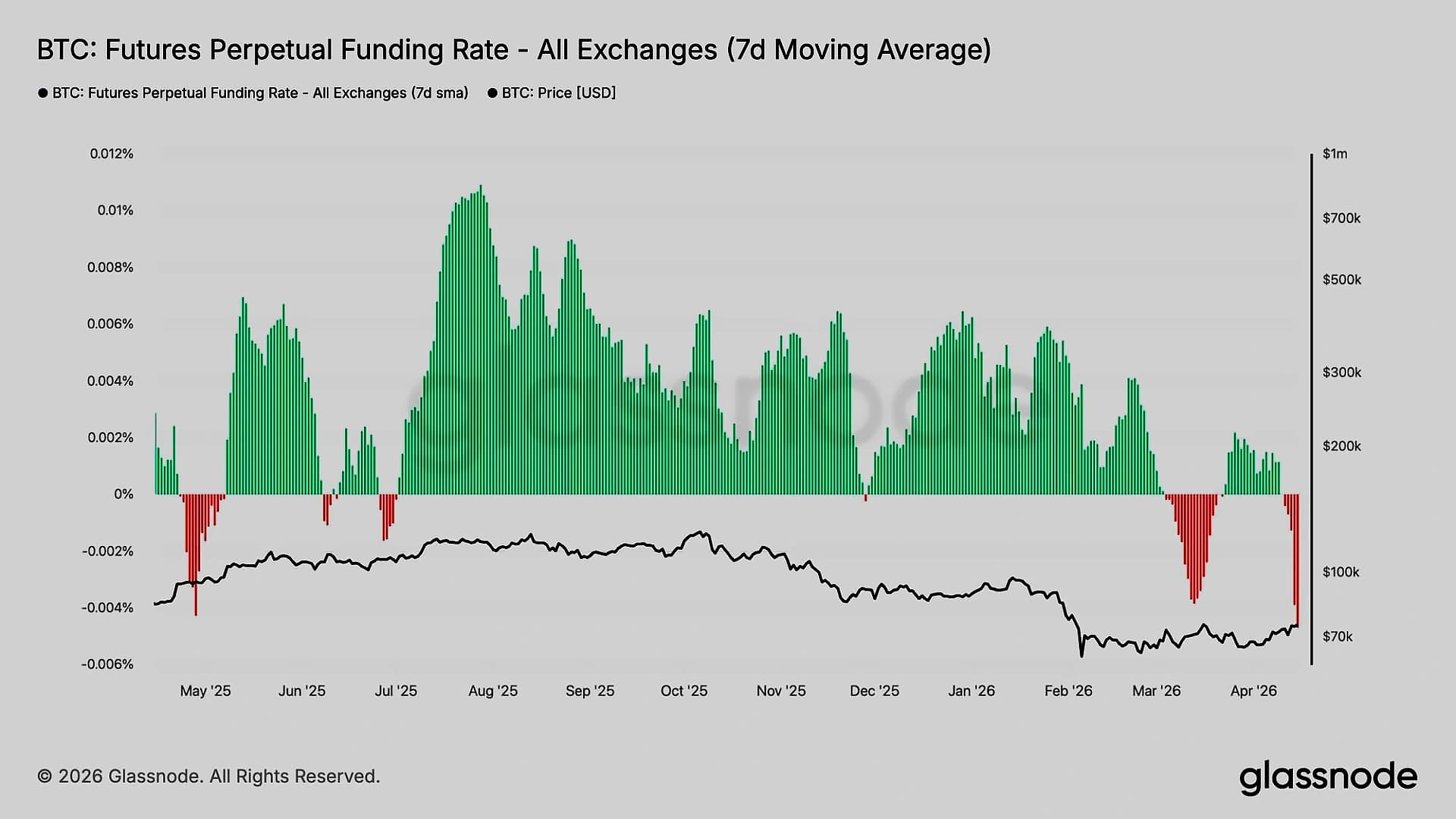
Bitcoin traders are becoming increasingly bearish with funding rates now at their most negative levels since 2023, according to Glassnode's 7-day moving average. The metric has slipped to the -0.004% to -0.005% range, representing the deepest red stretch in recent times. Short positions are dominating the market as traders bet on a greater fall. However, this extreme negativity has historically only come near local bottoms, with similar sentiment drops seen around March 2020, mid-2021, and during the FTX-led collapse in late 2022 - all well-known local market bottom phases. Despite the bearish sentiment, exchange reserves have now fallen to around 2.68 million BTC, down from above 3.0 million BTC in early 2025, with the decline accelerating since.
The U.S. government moved $606K in Bitcoin to Coinbase Prime on Thursday, April 16th, according to reports from AMBCrypto and Live Bitcoin News. This transfer was part of the 94,643 BTC seized from the 2016 Bitfinex hack, as confirmed by Arkham data. The seized funds, worth over $7 billion at current prices, have not been returned to Bitfinex nearly a year after the U.S. District Court for the District of Columbia ordered their return to the primary victim. However, the delay may be associated with complex legal proceedings related to unwinding such massive amounts.
Bitcoin bearish positions have been forcefully liquidated for $365 million since Monday, which has naturally eroded collateral on short positions. According to CoinGlass, Bitcoin futures aggregate liquidation history shows this significant outflow occurred during recent market volatility. Traders could have opted to sit tight rather than rush to add margin, anticipating that funding rates would adjust on their own. The negative funding rate reflects losses from bears rather than conviction, as perpetual contract funding rates are calculated every eight hours and temporary spikes to 20% are not particularly concerning for most traders. Under neutral conditions, the indicator should range between 5% and 10% to compensate for the cost of capital and exchange risks.
Despite the bearish sentiment, technical indicators suggest bullish momentum is building. At press time, Bitcoin was trading near $75K after recovering from the $66K-$68K range. The RSI was comfortably above its signal average of 56.17, indicating higher buying strength. The MACD was also firmly bullish, with the MACD line at 1,342.96 above the signal line at 753.51, and the histogram positive at 589.45. The confluence of fewer coins on exchanges, with exchange reserves declining steadily since early 2025, means fewer coins are available to sell in the market. If buying demand returns while reserves remain this low, the story could flip quickly, especially with short positioning already high.
Despite Bitcoin's recent rebound to around $75K, the broader cryptocurrency market remains in 'extreme fear' according to AMBCrypto. However, Bitcoin stayed relatively calm throughout the news cycle, with the cryptocurrency trading at $74,847 on CoinGecko, down just 0.13% in 24 hours. The seven-day performance still showed a 3.85% gain, with the market absorbing the transfer news without a sharp reaction in either direction. According to Ali Charts, most Bitcoin traders were leaning bullish that week, with a rally to $75,300 wiping out $80 million in short positions before the transfer news broke, clearing overhead resistance and shifting sentiment toward the long side. However, Cryptoquant data reveals that hourly Bitcoin exchange inflows hit 11,000 BTC on April 15th, 2026, the highest reading since late December 2025, with the mean Bitcoin exchange deposit reaching 2.25 BTC - the highest daily reading since July 2024.