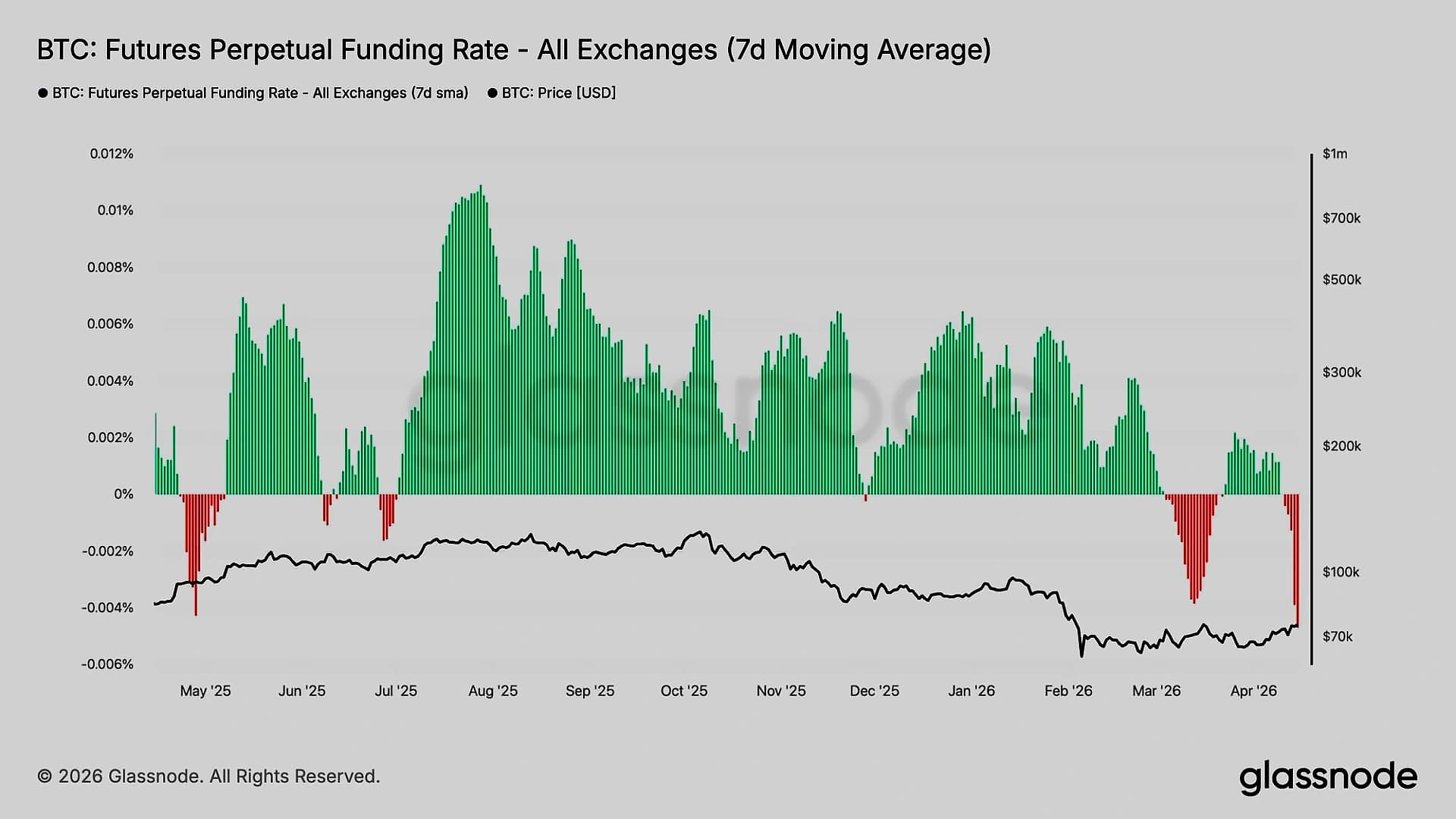
Bitcoin funding rates have turned most negative since 2023, with the metric slipping to the -0.004% to -0.005% range according to Glassnode's 7-day moving average. This represents a significant shift from the positive funding rates that had characterized the cryptocurrency market in recent periods. The negative funding rates indicate that traders are paying premiums to short Bitcoin, suggesting bearish sentiment among market participants. As reported by AMBCrypto, similar sentiment drops were observed around March 2020, mid-2021, and during the FTX-led collapse in late 2022 - all well-known local market bottom phases.
The negative funding rates are being interpreted as a potential market bottom signal for Bitcoin. As reported by market observers, this funding rate structure typically occurs when market participants are positioning defensively, often ahead of significant price reversals. The current negative funding environment suggests that traders are expecting Bitcoin prices to decline further, creating a self-reinforcing cycle of bearish sentiment. However, AMBCrypto notes that there is no confirmed reversal yet, but bearish sentiment is approaching extreme levels again, historically a pattern that has preceded local market bottoms.
Despite the bearish sentiment reflected in funding rates, crypto ETPs recorded $1.1 billion in inflows last week, marking the strongest performance since January. According to market analysis, this divergence between negative sentiment and capital accumulation suggests that investors are viewing the low readings as buying opportunities. The concentrated nature of these flows, with 95% originating from the United States, indicates a potential shift in institutional sentiment or regional strategy amid regulatory uncertainty and geopolitical tensions.
Exchange reserves have now fallen to around 2.68 million BTC, declining steadily since early 2025 when reserves were still above 3.0 million BTC. As reported by AMBCrypto, fewer coins on exchanges means fewer coins available to sell in the market. If buying demand returns while reserves remain this low, the story could flip quickly, especially with short positioning already high. This supply squeeze dynamic could amplify any price movement, particularly if short-side pressure begins to unwind into a squeeze.
At press time, Bitcoin was trading near $74K after recovering from the $66K-$68K range. Technical indicators show RSI comfortably above its signal average of 56.17, indicating higher buying strength, while the MACD was firmly bullish with the MACD line at 1,342.96 above the signal line at 753.51. The histogram was positive at 589.45. AMBCrypto suggests that Bitcoin certainly still has room to push further, especially if the short-side pressure begins to unwind into a squeeze. The current environment is characterized by increased institutional participation, which tends to dampen extreme sentiment swings due to rigorous risk management protocols.