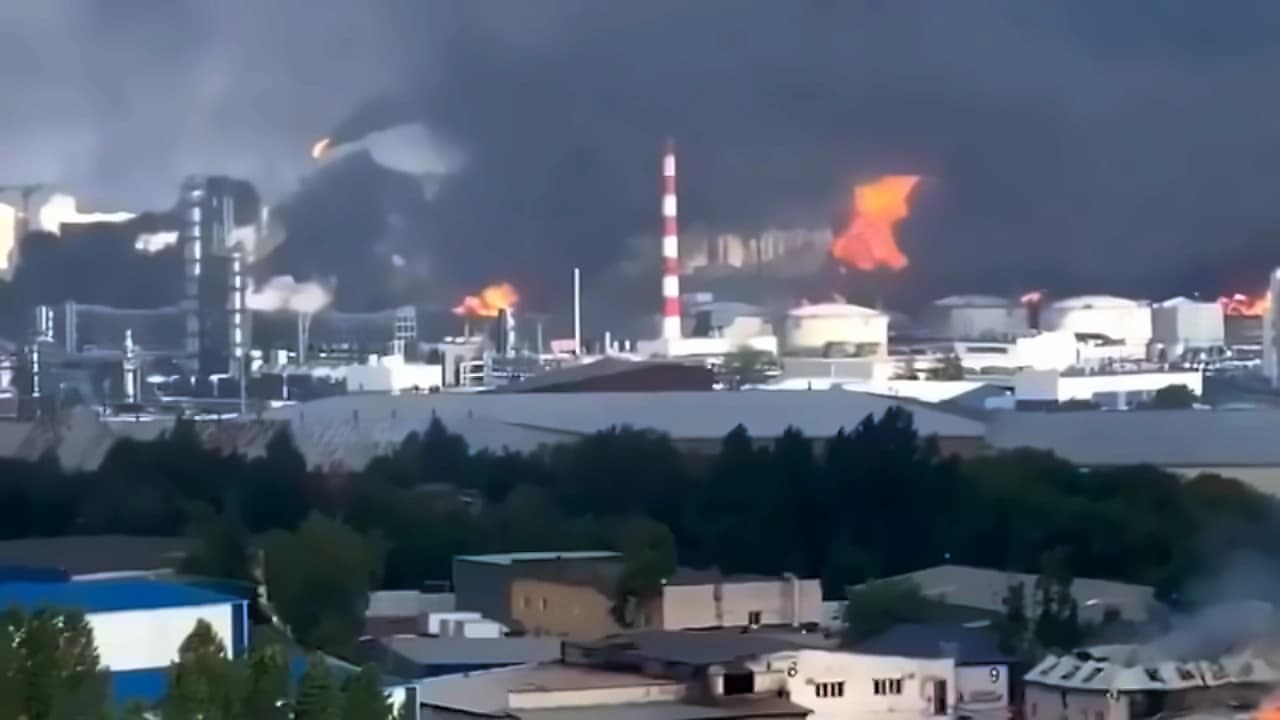
Ukraine has resumed attacks on Russian oil infrastructure after a three-day hiatus, with Kyiv launching more than 1,000 drones across Russia in one of its largest ever aerial bombardments. According to reports from Business Standard, the attack set an oil export terminal ablaze in St. Petersburg on Sunday, killing one person and wounding five more. The strikes also targeted the city's Ruchi oil depot, a logistics center belonging to Russian retailer Ozon, and a data center for local tech giant VK. Russia's Ministry of Defense confirmed that its forces destroyed 1,015 Ukrainian drones over 15 Russian regions, including the annexed Ukrainian peninsula of Crimea and the Black Sea.

The renewed strikes come despite US President Donald Trump's October 11 announcement of an "energy ceasefire" in the 4.5-year-old war, though he offered no details on the arrangement. As reported by Business Standard, Zelenskyy was outraged by Russia's continuing aerial bombardment of Ukrainian energy infrastructure, claiming that in the week since Trump's announcement, Russia attacked Ukraine's energy, oil and gas sectors 76 times. The Ukrainian president accused Russia of trying to cause a blackout and stressed that the war continues due to Russia's invasion, not because Ukraine is defending itself. The policy consequence remains clear: the pause has not secured reciprocal restraint, and Kyiv's stated conditions raise the cost of negotiating another one.
Donald Trump's announced plan to release 300,000 tonnes of Russian diesel to the US and global markets faces renewed uncertainty after Volodymyr Zelenskyy said Ukraine would resume strikes on Russian oil refineries. According to reports from PA Media, Zelenskyy would restart refinery strikes after accusing Russia of continuing attacks during the pause. The Kremlin never said it had agreed to Trump's proposed energy ceasefire, leaving no publicly confirmed bilateral commitment that Moscow would refrain from targeting Ukrainian energy infrastructure. During an October 9 meeting in Miami, presidential advisers Jared Kushner and Steve Witkoff informed Ukrainian and European officials that Trump was considering the Russian diesel agreement. Trump announced the arrangement after speaking by telephone with Putin that same day, declaring an immediate ceasefire covering Russian and Ukrainian energy infrastructure on Sunday.
Refinery attacks can affect diesel availability and regional refined-product markets more directly than global crude supply. If these outages reduce production or exports, diesel prices may rise; however, that doesn't necessarily mean crude benchmarks will follow suit. According to reports from Yellow.com, Brent crude was trading near $106 a barrel, while Bitcoin was around $83,450 as traders awaited U.S. inflation data. The Bitcoin transmission channel is influenced by inflation and financial conditions, with sustained energy price increases potentially raising inflation expectations and reducing Federal Reserve easing expectations.
The International Energy Agency estimates that Russian diesel production had fallen by nearly 30%, creating an already strained Russian fuel system. Another refinery disruption could tighten refined-product supply, but the immediate price effect will depend on the disruption's scale and duration, the availability of replacement supply, and whether Russia's projected volumes materialize. The reporting does not verify delivery of the diesel or establish the mechanics of its movement into markets, leaving uncertainty about the actual impact on global fuel markets.