Bitcoin is currently trading at $62,829.48 as of 6:45 a.m. Eastern Time, representing a $728.97 decline from yesterday's morning price and approximately $55,500 lower than it was one year ago. Despite this recent decline, Bitcoin maintains its position as the pioneering cryptocurrency with a market capitalization of roughly $1.33 trillion, significantly outpacing second-place Ethereum's $233 billion market cap. The cryptocurrency reached its highest price ever on October 6, 2025, at $126,198.07, demonstrating its continued dominance in the digital asset space. Over the past decade, Bitcoin has delivered impressive gains of more than 15,000%, though this tremendous growth comes with the inherent volatility characteristic of cryptocurrencies.
Despite Bitcoin's current calm market conditions, options pricing remains significantly elevated relative to actual market performance. According to recent analysis, Bitcoin's 30-day implied volatility of 36.35% is about two-thirds higher than realized volatility of 21.80%, creating a substantial disconnect between expectations and reality. As reported by Glassnode, the one-week implied-versus-realized volatility gap is near a one-year high, favoring options sellers while Bitcoin remains range-bound. This gap matters critically for traders, as flat markets and low realized volatility can pull in option buyers who assume they are getting a bargain, but the elevated implied volatility means options cost more than recent calm conditions would suggest. The same disparity extends to shorter timeframes, with one-week at-the-money implied volatility near 29% against realized volatility of roughly 16%, both figures near historical lows individually but the gap approaching a one-year high.
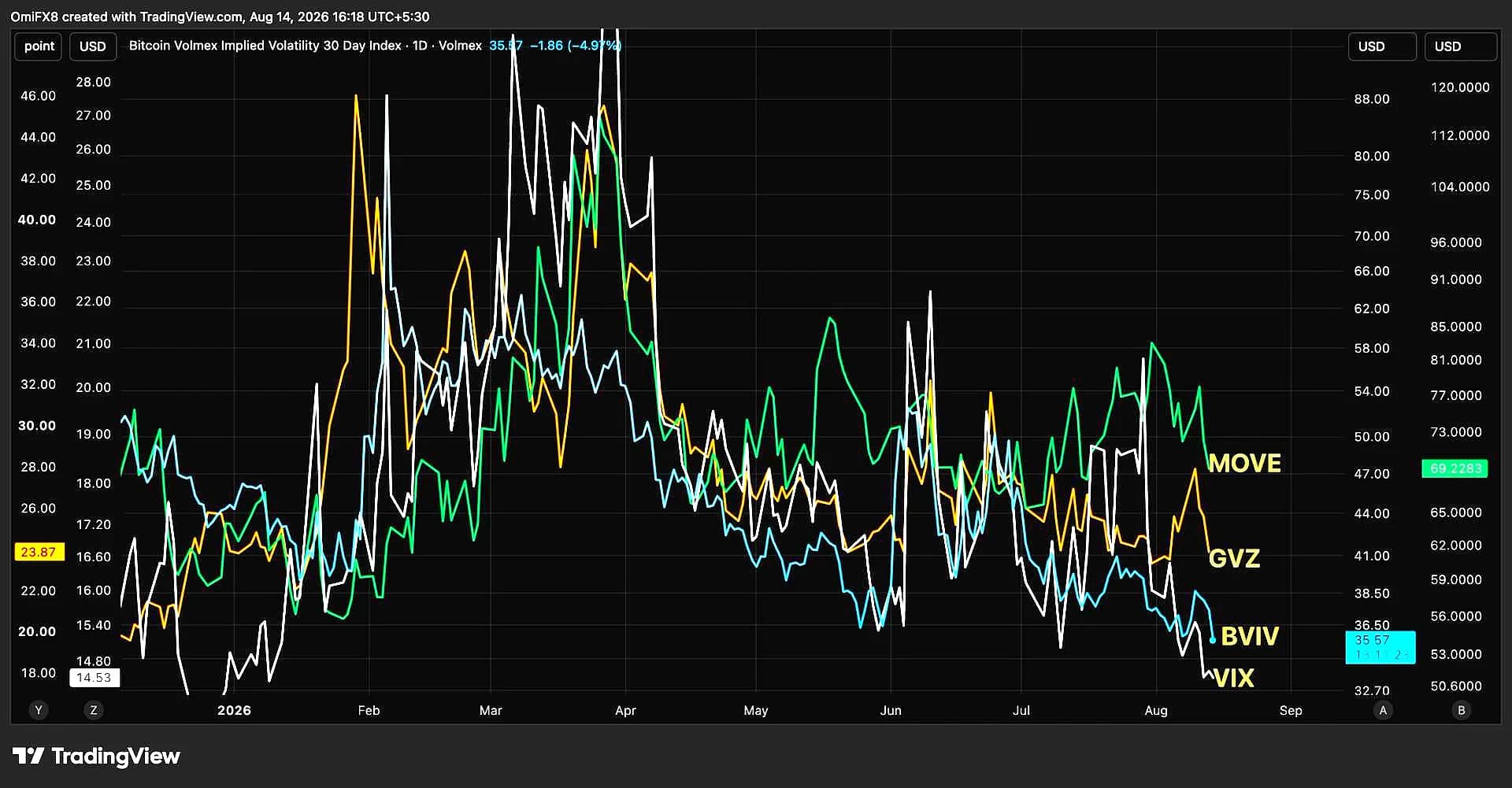
Cryptocurrency and traditional financial markets are experiencing unprecedented calm, with implied volatility readings across major asset classes hitting multi-year lows. According to reports from CoinDesk, Bitcoin's 30-day implied volatility index (BVIV) has dropped back to a 2026-low near 36%, reversing the minor pop to nearly 38% earlier this week. The same trend is visible in ether, the second-largest digital asset by market value, which is also showing reduced volatility expectations. This decline represents a significant shift from previous periods of market uncertainty, with investors appearing to chase a FOMO rally that has resumed after brief pauses in June and July. The calm sentiment is spreading across traditional financial markets, with Wall Street's VIX index declining to the lowest level since January. Bitcoin's 30-day realized volatility has dropped to an annualized 21.80%, the lowest since October 2025, though forward-looking measures remain elevated.
The calm sentiment is spreading across traditional financial markets, with Wall Street's VIX index declining to the lowest level since January. As reported by CoinDesk, the Treasury market equivalent, MOVE, is also under pressure, hovering near the lower end of its multi-month range of 66% to 84%. Even commodity markets are showing reduced volatility, with gold and oil volatility indexes falling alongside the broader market trends. This synchronized decline across asset classes suggests a coordinated reduction in market uncertainty expectations, though some analysts express concern that this complacency may be unhealthy for markets given the myriad risks present. The decline in the MOVE index particularly noteworthy because Treasury notes underpin global finance.
Despite the reduced volatility readings, several risk factors continue to influence market sentiment. According to CoinDesk, continued U.S.-Iran escalation risks, mounting sovereign debt and rising bond yields remain present concerns for investors. The SEC canceled its long-awaited Reg Crypto proposal, postponing Friday's meeting due to scheduling issues, adding regulatory uncertainty to the cryptocurrency market. Additionally, Treasury yields have risen after the U.S. announced its naval blockade of Iranian ports could continue indefinitely, with the 10-year bond yield rising to 4.661%. However, demand for put options that allow investors to protect their portfolios from drawdowns has eased significantly, raising concerns about potential complacency among market participants. Bitcoin's volatility history includes severe pullbacks—sometimes dropping tens of thousands of dollars within months—as well as dramatic recoveries, with the asset trading roughly 30% below its all-time high at the close of 2025.