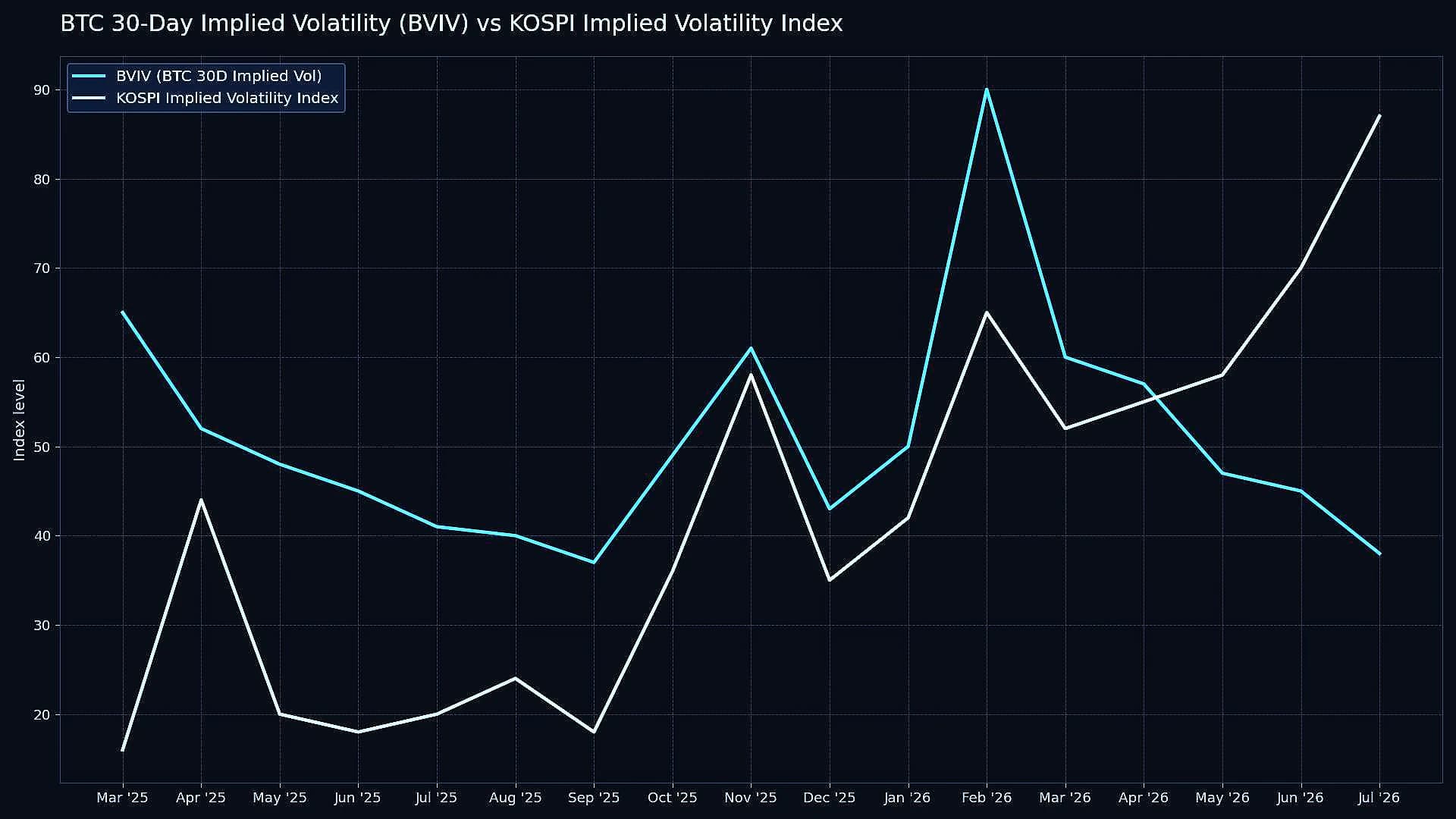
Despite Bitcoin's current market pressures, the cryptocurrency's 30-day implied volatility index (BVIV) has dropped to 36%, the lowest level since May 31, 2026. According to CoinDesk, this represents a significant decline from highs near 60% in early June, indicating that the market is showing remarkable resilience in the face of multiple headwinds. The BVIV measures demand for options or hedging bets sought when traders fear uncertainty and wild swings, making this drop particularly noteworthy as it suggests no signs of panic or stress in the market. However, analysts warn that volatility tends to be mean-reverting, with the current low levels potentially paving the way for a volatility boom that could be accompanied by a big directional move, either bullish or bearish. As Crypto Daily reports, low volatility is no reason to let your guard down, as when volatility is cheap, trading becomes cheap, encouraging punters to build large directional bets and hedging positions, leaving market makers with significant exposure.
Despite Bitcoin's repeated full cycles this month, including runs towards 66.5K, slides back near 64K, spikes past 65K, and pullbacks, the market sentiment remains remarkably flat. The Crypto Fear & Greed Index has a reading of 40 at press time, barely any movement on the scale in the last 24 hours, according to AMBCrypto. This finding is particularly interesting because the index's own history makes it obvious that it is capable of extremes - we were as greedy as 68 in mid-August last year, and in extreme fear at 5 as recently as February. The current month's run of 28 to neutral 40 means the index may be compressing into a narrow band despite having the full range available to it. As AMBCrypto notes, it is unnatural for the market to not sway while the prices do, suggesting either traders have grown numb to volatility inside this range or genuinely can't decide which way to lean even as prices go wild in both directions.
Institutional demand for Bitcoin remains anemic, with US-listed spot Bitcoin ETFs posting $61.53 million in outflows last week, snapping a three-week streak of tepid inflows. As reported by CoinDesk, this continued weakness in institutional flows contrasts sharply with the strong performance of AI-linked stocks in South Korea's market. The bear case scenarios include prolonged ETF outflows, delayed regulation, or tighter monetary policy keeping Bitcoin range-bound in the $60,000 to $100,000 zone through 2027. However, at least one data point suggests limited downside potential - approximately 155,000 BTC moved into the $62,000-$65,000 cost-basis range, indicating that selling was absorbed by buyers near current prices. This concentration now represents 0.7% of circulating supply and could keep Bitcoin range-bound until a stronger catalyst emerges. According to Crypto Daily, demand for puts, or downside protection, has weakened while there is a lack of strong bids for upside exposure, indicating that the bear market is close to trading at its lowest price range for this cycle.

The decline in major stablecoins provides a clear confirmatory signal of weak demand-side pressure in the broader crypto market. USDT's market capitalization has fallen to $183 billion from nearly $190 billion in April, while USDC's market value has dropped to $72 billion from $79.5 billion in March. According to CoinDesk, this slide in USDT and USDC represents less capital available to buy cryptocurrencies, tighter liquidity, and subdued investor risk appetite. The weakness in stablecoins, which are typically used as entry points into crypto markets, suggests that investors are reducing their exposure to digital assets amid the current bearish sentiment. This trend mirrors the broader market conditions affecting Bitcoin's performance.
The KOSPI's extreme volatility stems from heavy concentration in just two companies - Samsung Electronics and SK Hynix, which supply memory chips powering the AI boom. These two stocks now make up more than 50% of the KOSPI's weight, with listed affiliates pushing that share even higher. As reported by Bloomberg, this concentration turns Korea's benchmark into a leveraged AI bet, making the market's mood dependent on Wall Street sentiment. When the KOSPI reached record highs in June, more than 650 of its 831 stocks fell, demonstrating the extreme concentration risk in the market. The pair's shares have surged so fast that their combined weight has become a dominant factor in Korea's $3.4 trillion stock market. Samsung's shares slumped 21% in July while SK Hynix's stock lost 35%, though both remain up significantly since the start of 2025 with Samsung up more than four times and SK Hynix up nearly 10 times.
Individual investors hold most of the leveraged exchange-traded funds (ETFs) tracking Samsung and SK Hynix, amplifying market swings significantly. According to Bloomberg reports, at their peak, the ETFs and underlying stocks made up more than 70% of daily trading value in Korea's $3.4 trillion stock market. The leverage has been particularly evident in SK Hynix's dramatic movements, which lost 27% of its value over three trading days amid concerns about data center spending, before jumping by Korea's 30% daily limit once sentiment reversed. This volatility has forced the Korea Exchange to halt trading nine times this year, compared with just once in 2024. The extreme swings mirror an earlier AI memory stock selloff that hit the chipmaker this month. Retail investors sold a record amount of Kospi shares on Friday despite a stunning 18% rebound, with the gauge still capping a 22% loss for the month - the steepest since the global financial crisis.