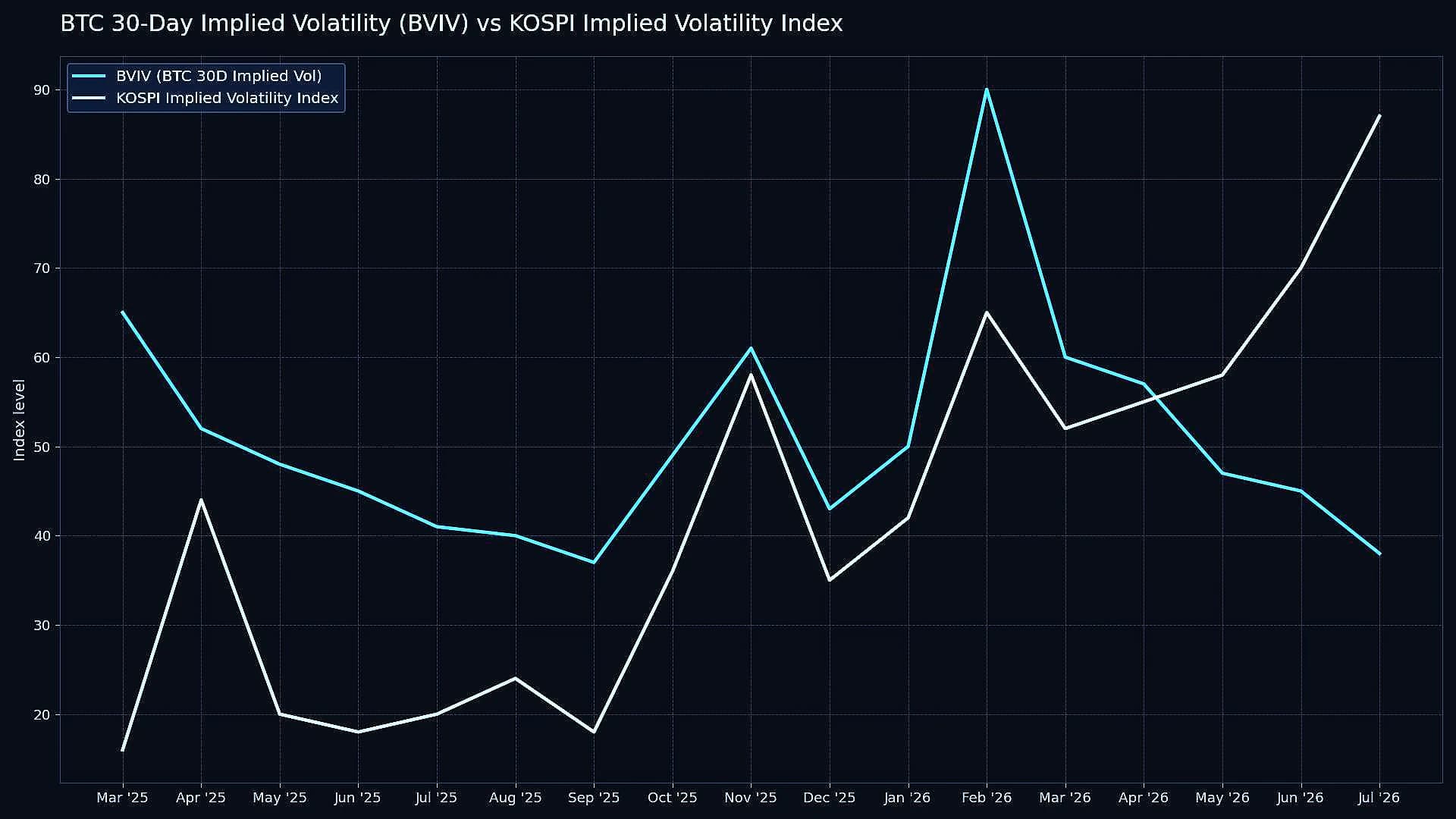
Bitcoin's volatility metrics are flashing warning signs as the cryptocurrency's 30-day implied volatility index (BVIV) reaches 38%, hovering near the upper end of a historically reliable support zone. According to CoinDesk analysis, this level has consistently preceded significant market turbulence in recent years. The index is currently trading below both its 30-day and 200-day simple moving averages, suggesting volatility remains relatively cheap and positioned at a historically reliable support zone. Previous instances where BVIV reached this 34-38% range included late May 2026, which preceded a drop from $74,000 to under $60,000 in less than a week, and similar patterns before the early February crash and October correction. While past patterns are not guarantees of future performance, the cyclical nature of volatility metrics suggests periods of below-average volatility are often followed by higher turbulence.
The South Korean market has experienced severe turbulence, with the Kospi index slumping nearly 25% in just four weeks as the AI investment frenzy cools. The crisis has reached unprecedented levels, with more than 1.2 million leveraged retail accounts triggering margin calls by July 13, according to Goldman Sachs. Approximately 320,000 to 360,000 accounts were fully liquidated by brokers, representing roughly one in every 30 working-age adults in South Korea's adult population of 35.7 million. The Bank of Korea's 25 basis point rate increase to 2.75% landed directly on top of an already unstable leveraged equity unwind, with the central bank's first rate rise in more than three years under Governor Shin Hyun-song. Retail brokerage deposits have fallen by approximately 30 trillion won to their lowest level since February 20, while the proportion of accounts facing margin calls reached around 5% last Friday.
The development represents a significant milestone for bitcoin supporters, as reported by CoinDesk. While bitcoin remains twice as volatile as the S&P 500's VIX index, which sits below 20%, the comparison with the Kospi index serves as a warning to other global markets where AI-fueled risk-taking has been prevalent. For Bitcoin supporters, BTC's lower volatility compared to the KOSPI is seen as a key signal of growing market maturity. The shift suggests that despite geopolitical pressures on bitcoin, the cryptocurrency is demonstrating relative stability compared to traditional equity markets. Kospi remains 2026's top-performing stock market of a major economy, still up about 60% despite shedding a quarter of its valuation since June, with the index setting a record close of 9,114.55 on June 22. However, the crisis has exposed the dangers of excessive leverage, with foreign investors selling approximately $1 billion and local institutions selling around $1.6 billion of technology shares, while retail investors purchased roughly $2.6 billion of the same stocks.
According to CoinDesk analysis, bitcoin's price remains under pressure, trading below its widely followed 50-day moving average. However, there are signs of potential recovery as analytics firm Nansen reports that wallets typically associated with large-scale geopolitical movements have not meaningfully shifted into stablecoins. Research analyst Nicolai Sondergaard from Nansen noted this pattern is consistent with previous Middle East flare-ups, where short-term leveraged positions are flushed before accumulation resumes. BTC has been trading relatively calmly in the $60,000s since the start of June, with its CME implied volatility gauge coming within three points of a 12-month low last week. On-chain data firm Nansen notes that wallets typically among the first to move large sums of capital during recent geopolitical tensions have not shown significant flows into stablecoins, with this behavior mirroring market dynamics observed during previous escalations in the Middle East. Additionally, CEX trading volumes rose for the first time in five months in June, with spot climbing 15.3% to $1.11T and RWA perpetual volumes surging to a record $311B.
Market observers are directing attention to upcoming regulatory developments, as reported by CoinDesk. The Clarity Act faces what could be its final test, with industry insistence on completion while the bill encounters Trump conflict of interest provisions and fresh Senate hurdles before the August recess. In response to the Korean market crisis, the Financial Services Commission announced measures to suspend new listings of single-stock leveraged ETFs, prohibit securities companies from advertising them, and triple minimum deposits to 30 million won (about $20,300) effective August 5. The central bank's 2.5% rate hold since May 2025 has been replaced with a restrictive stance as inflation concerns mount, with South Korean consumer prices rising 3.2% year-over-year in June, the fastest increase since December 2023. Global volatility gauges present mixed signals, with South Korea's KOSPI VIX currently above 70%, its highest level since the 1990s, while Wall Street's VIX jumped over 12% to reach 18% on Friday. However, these elevated levels have persisted for months, suggesting stocks are not in panic mode, and the MOVE index remains steady around 70% since April, offering constructive cues for risk assets.