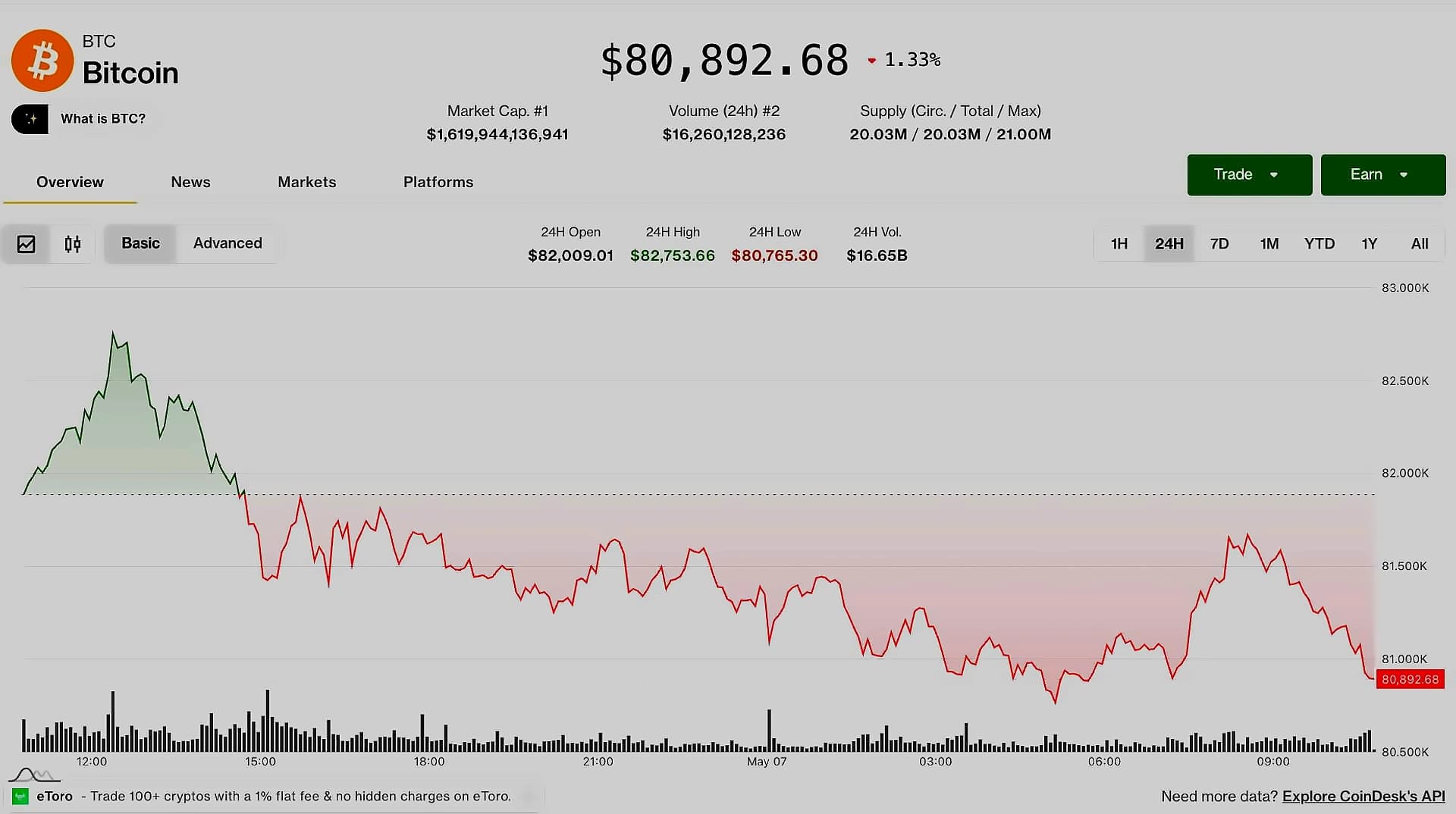
Bitcoin reached $80,529 on Monday, May 4, marking a four-month high and confirming a daily close above the psychological $80,000 level that had been acting as stiff resistance. The cryptocurrency gained nearly 3% on the day and over 20% in the past month, blowing through a resistance level that had held the price back all weekend. The move was supported by $160 million in short liquidations, with total crypto market liquidations crossing $300 million as the total crypto market cap shot up 1.6% overnight to $2.72 trillion. Among major altcoins, Ethereum and Bitcoin were up 3% and 2% respectively in the past 24 hours, while XRP, BNB, Solana, Tron, Dogecoin, Hyperliquid, and Cardano rallied up to 4%. The move was significantly supported by Project Freedom, Trump's initiative to guide foreign cargo ships safely through the Strait of Hormuz, which had been effectively closed due to US-Iran tensions.

Bitcoin has reclaimed $80,000 for the first time since January 31, ending a three-month price drought. The breakout completes a clean reclaim of the descending trendline drawn from the April 13 swing high, with the Relative Strength Index (RSI) trending steadily higher and now sitting just below overbought territory. The Moving Average Convergence Divergence (MACD) has flipped with a bullish crossover, while the 20-day moving average provides support. Immediate resistance sits at the 0.382 Fibonacci retracement near $85,000, with a clean break above that level opening the path to the 0.618 retracement at $100,900. Analyst Michael van de Poppe sees $86,000 to $88,000 as the first overhead resistance and $92,000 to $94,000 as the more decisive zone, noting that the recent consolidation has been relatively shallow with buyers absorbing dips quickly. However, the 4-hour chart shows potential for a pullback to $75,000 if the broken ascending channel is rejected, with bulls needing to defend the 0.236 Fibonacci retracement and rising 50-day moving average.
While retail attention focuses on price milestones, the more consequential development has been happening off-exchange for months. Spot Bitcoin ETF products, led by BlackRock's IBIT and Fidelity's FBTC, have been absorbing Bitcoin from the open market at a pace that consistently outstrips new miner supply. This is a gradual, structural compression of the supply of liquid Bitcoin that gradually makes each Bitcoin harder to acquire at current prices. Exchange reserves have dropped to multi-year lows, and the coins that retail investors would normally buy from other sellers are increasingly not there. On top of ETF demand, corporate treasury buyers continue to accumulate aggressively, removing coins from circulation with no near-term selling intention. This institutional accumulation has created a supply shock that makes each Bitcoin harder to acquire at current prices, providing structural support for sustained price appreciation. US spot Bitcoin ETFs recorded their fifth consecutive week of net inflows, adding $153 million last week alone, with a single-day surge of $629 million on April 30. The latest data shows $600 million in spot BTC ETF inflows on the first trading day of May, consistent with strong inflows recorded throughout April.
The latest surge was significantly supported by $160 million in short liquidations on May 4 alone, compared to approximately $56 million in long liquidations, according to AMBCrypto. This imbalance suggests that bearish positions were forced to close as the price moved higher, accelerating the upward move. Santiment data tracking social dominance and crowd sentiment showed a sharp uptick in bullish mentions as BTC crossed the $79,500 level, consistent with crowd enthusiasm that has historically preceded sharp reversals. The parallel to 2021 is worth examining carefully, as when Bitcoin first crossed $60,000, retail FOMO drove a powerful surge, but crypto retail FOMO at major milestones tends to compress the remaining upside while amplifying downside risk for latecomers. A recent 99Bitcoins analysis examining extreme bullish sentiment as a potential warning signal noted that crowd euphoria at technical inflection points has functioned as a contrarian indicator in prior cycles.
Project Freedom represents a significant geopolitical development that has flipped market sentiment from cautious to decisively risk-on. When Iran restricted access to the Strait of Hormuz in late April 2026, following a breakdown in nuclear talks and a series of Iranian naval maneuvers, global shipping insurance premiums jumped as much as 40%, and oil prices climbed sharply. President Trump announced the plan on May 3 via Truth Social, writing that his representatives were having "very positive discussions with the Country of Iran, and that these discussions could lead to something very positive for all." The initiative went live on May 4, with US naval escorts guiding foreign commercial vessels through the restricted waterway. This de-escalation signal has been reinforced by the CLARITY Act moving through Congress, which is explicitly protecting self-custody rights and clarifying which digital assets fall under SEC versus CFTC jurisdiction. The broader argument for BTC as a national security asset has been growing within the Trump administration, with the policy framing fitting squarely within that logic.