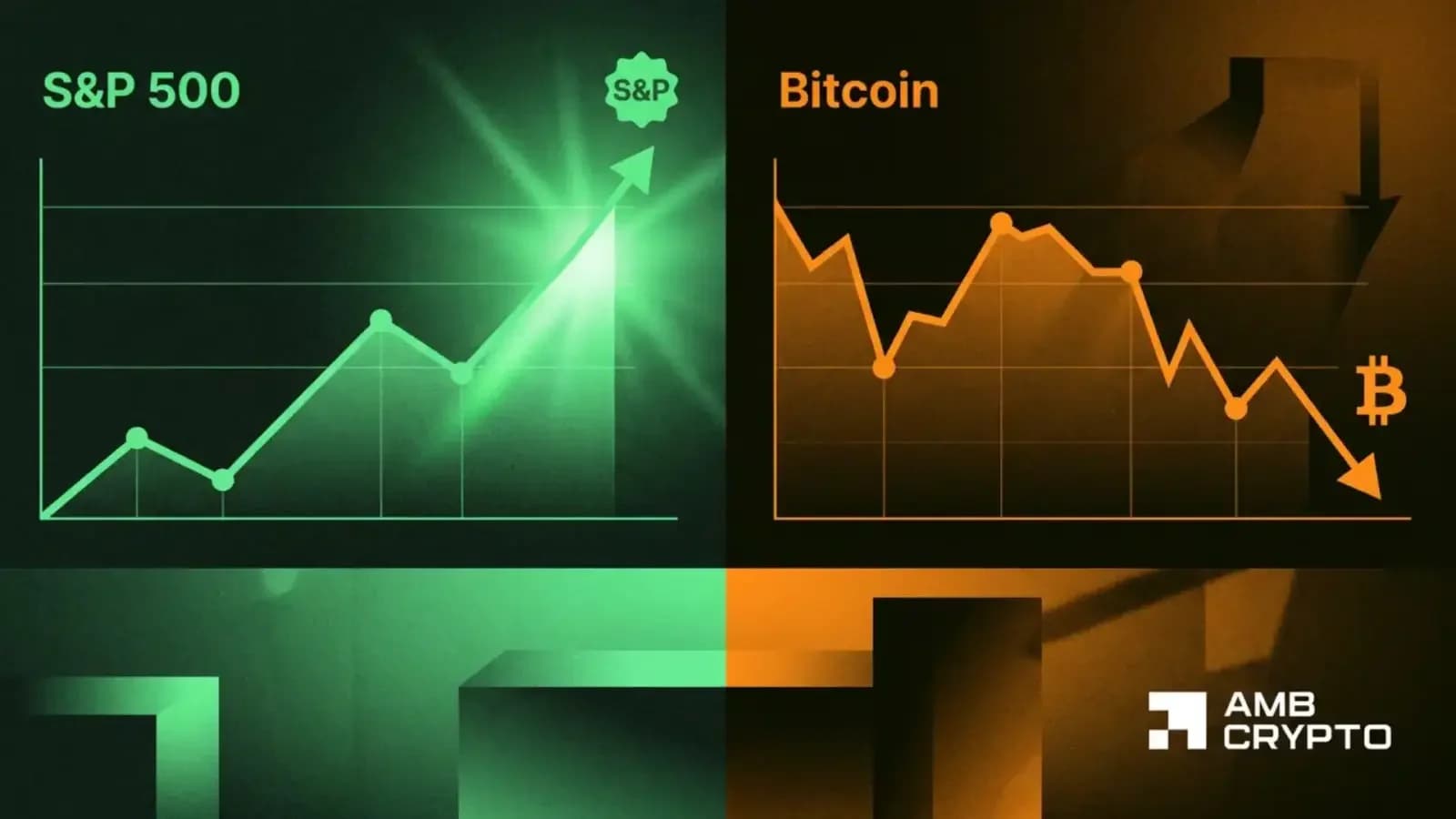
A significant market divergence has emerged as the S&P 500 approaches record highs while Bitcoin remains 39% below its October peak. According to reports from AMBCrypto, both assets received the same positive catalyst this week when Trump announced US-Iran talks had reached final stages, causing oil prices to drop over 5% with WTI crude settling around $98 per barrel. The S&P 500 closed up 1.1% near 7,433, while the Dow added 1.3% to reclaim 50,000, and the Nasdaq gained 1.5%. However, Bitcoin barely moved, trading around $76,677 on Saturday evening in New York, demonstrating starkly different market reactions to the same macro news. As reported by Barron's, crypto stocks lagged even as Wall Street climbed, with Coinbase down 4.4% to $184.99 on Friday.
The divergence stems from fundamental differences in market structure and liquidity conditions. As reported by AMBCrypto, equities benefit from structural demand including buybacks and passive inflows that continue regardless of headlines, while Bitcoin relies on liquidity and risk appetite at the margin. The 30-year Treasury yield touched 5.2% earlier this week, its highest since 2007, with the dollar holding firm near 99. CME FedWatch now puts odds of a December hike at around 51%, with barely 10% chance of cuts this year, creating a hostile macro backdrop for Bitcoin. In contrast, the S&P 500 chart shows healthy technical indicators with price bouncing from the 0.382 Fibonacci retracement around 7,360 and working toward the 7,500 swing high. The Dow ended at a record high and the S&P 500 posted its eighth weekly advance, while crypto stocks including Coinbase, Robinhood Markets, and Strategy all dropped as Bitcoin and Ether slipped.
The primary driver of Bitcoin's underperformance is significant institutional outflows from spot Bitcoin ETFs, compounded by Coinbase's own operational challenges. According to AMBCrypto, spot Bitcoin ETFs experienced their largest single-day outflow since January, with approximately $649 million leaving in one session, while digital-asset products shed around $1.07 billion across the week - the first negative week in seven. Coinbase shares have more to worry about than Friday's 4.4% drop, as the company posted its second consecutive quarterly loss earlier this month, losing $394.1 million as transaction revenue tumbled nearly 40% to $756 million. CEO Brian Armstrong announced plans to cut around 700 jobs, about 14% of staff, as part of a "leaner" operation strategy. The company is also counting on a crypto market-structure bill to get signed "by the end of the summer," according to Chief Legal Officer Paul Grewal, while trading on digital-asset exchanges fell in April.
From a technical perspective, Bitcoin's weekly chart shows continued weakness with the asset printing lower highs and lower lows within an ongoing downtrend. As reported by AMBCrypto, the most recent bounce ran into trouble with a bearish engulfing candle at the 80,000-85,000 resistance zone, confluent with the local short reload area and 0.618 Fibonacci retracement. Key resistance levels include the 80,000-85,000 band on the upside, with first support at 70,000 and larger structural floor at 60,000. Funding rates have remained negative for 82 consecutive days, the longest streak in Bitcoin's history, indicating defensive positioning rather than frothy market conditions. Coinbase shares have more to worry about than Friday's drop, as the company reported a record share of crypto trading volume for the first quarter, with prediction markets revenue topping $100 million annualized in under two months, though this remains a small portion of its overall business.

The current market divergence reflects fundamental differences in how assets respond to macro catalysts and regulatory developments. According to AMBCrypto, Bitcoin cannot ignore its hostile macro backdrop, while equities can look past it for now due to structural demand factors. The analysis suggests that until Bitcoin's liquidity conditions improve or it forces a break above the 80,000-85,000 resistance ceiling, the gap between the two markets is likely to remain open. Potential catalysts include continued oil price declines and cooling inflation data that could reopen rate-cut conversations, or alternatively, if equities price a soft landing while the bond market remains skeptical, Bitcoin's lag could persist. However, risk cuts both ways for Coinbase, as a strong Personal Consumption Expenditures price index reading on May 28 could be another hit for risk assets like crypto. The regulatory story remains on hold, with the SEC's decision to delay its plan for letting crypto firms trade tokenized stocks putting more pressure on markets, while Coinbase holders head into the week watching crypto prices move in real time.