
Crypto's aggregate combined value, excluding stablecoins, fell below $2.4 trillion on October 15, with the market down 1.94% for the daily session and roughly $47.14 billion in value dropping. The market slipped below its 50-day average near the $2.42 trillion area, with reclaiming that level would be the first improvement but the recent downtrend may present challenges for buyers. If the weakness continues, attention will turn to the $2.30 trillion level because the market previously traded around it. Bitcoin has fallen 3.6% over the past 24 hours to around $81,500 as a fresh inflation shock emerged with the US Producer Price Index (PPI) recording its largest monthly increase since March 2022, following yesterday's disappointing consumer inflation report.
The probability of an October interest rate increase has retreated to 34% following the hotter-than-expected inflation data, down from a spike near 47% after Wednesday's CPI release, according to CME's FedWatch data. Michelle Bowman, Vice Chair for Supervision of the US Federal Reserve, delivered a significant market-moving statement during the IMF-World Bank meetings in Bangkok, stating that the central bank does not feel urgency for further rate hikes at this time. As reported by Reuters, Bowman said "I don't feel any urgency for taking further action at this point. We really need to take some time and understand how things will evolve." The Fed had lifted its benchmark rate by 25 basis points last month, bringing the target range to 3.75%-4.00%, and Bowman's remarks follow comments from Boston Fed President Susan Collins, who said the central bank would likely need to raise rates again before the end of the year to curb high inflation. Her comments provide crucial relief to markets that had been pricing in multiple rate hikes following the hotter-than-expected inflation data.
Today's US Producer Price Index (PPI) report, released on October 15, recorded its largest monthly increase since March 2022, with U.S. producer prices rising 1.3% in September, accelerating from the previous month's revised 0.5% increase. Annual wholesale inflation reached 6.3%, the fastest increase since December 2022, following Wednesday's consumer inflation report that showed 3.7% annual inflation. Energy prices drove the September increase, with BLS attributing more than 80% of the final-demand goods price increase to energy, where prices jumped 10.8%. Wholesale gasoline prices surged 20.3% in September, alongside increases in diesel, jet fuel, residential electricity and crude petroleum. Final-demand goods overall rose 2.6% monthly, the largest increase since the series began in December 2009, with food prices up 1.2% and goods excluding food and energy increasing 0.3%. The selloff is being amplified by leveraged traders being forced to close positions, with the wider stock market, particularly technology shares, also under pressure.
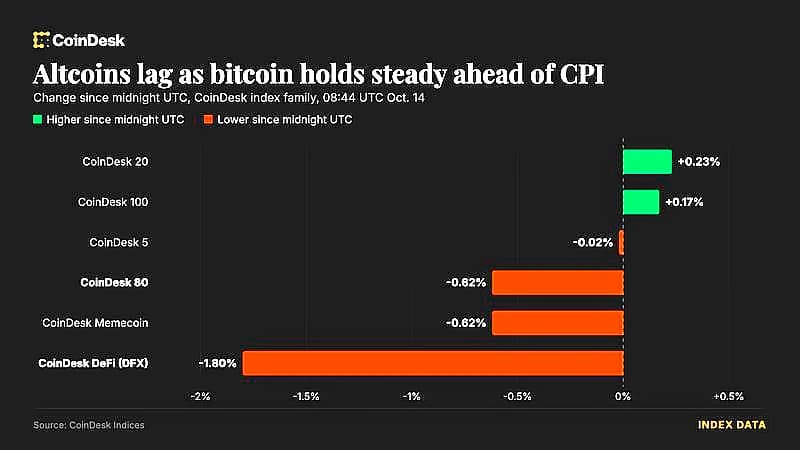
Nearly $1 billion in crypto futures bets were liquidated over 24 hours as the market wilted after Wednesday's hotter-than-expected U.S. inflation report, up from about $136 million a day earlier, according to CoinDesk data. Ether took a heavier hit than bitcoin, with longs worth $200 million liquidated in ether, significantly more than the $115 million in bitcoin. The difference points to heavier long leverage in ether. Silver outranked a top privacy coin on liquidations, with XAG (silver) perpetual futures seeing more liquidations than zcash (ZEC), one of the top privacy coins, in a sign of the growing popularity of TradFi assets on crypto platforms. Trading surged while open interest held steady, with 24-hour crypto futures volume reaching $252 billion, up 61% over the period, while open interest remained largely unchanged at $139.6 billion. The taker long/short volume ratio is again skewed bearish, with shorts accounting for 51.67% of the flow, little changed from 52% a day earlier. Traders are adding to bitcoin positions as the price falls, with BTC's spot price down over 2% but notional futures OI up 1.6%, implying the number of contracts rose by roughly 3.7% and net new capital entering during the drop.
US spot Bitcoin ETFs have been losing capital during this period, with the figures revealing the longer-running weakness: Last week, October 5–9: approximately $679 million in net ETF outflows. This week, October 12–14: another $151.1 million in net outflows. Yesterday alone: $261.4 million withdrawn, reversing Tuesday's $175.7 million inflow. The market has been losing a source of institutional demand even before today's inflation surprise. When investors are withdrawing money from Bitcoin funds, there is less consistent buying pressure to absorb selling from existing holders. Whales had made their move before the CPI print, with their holdings outside exchanges and mining pools reaching 3.03 million BTC, the highest since November 2025, according to CryptoQuant data. CryptoQuant CEO Ki Young Ju described the shift in an October 13 report, stating "The question is who is buying. Whales have switched from selling to accumulating... That is how early bull markets start, with retail still absent." Market-wide demand had also turned positive, with analyst Darkfost estimating 30-day spot and futures demand at 69,000 BTC.

