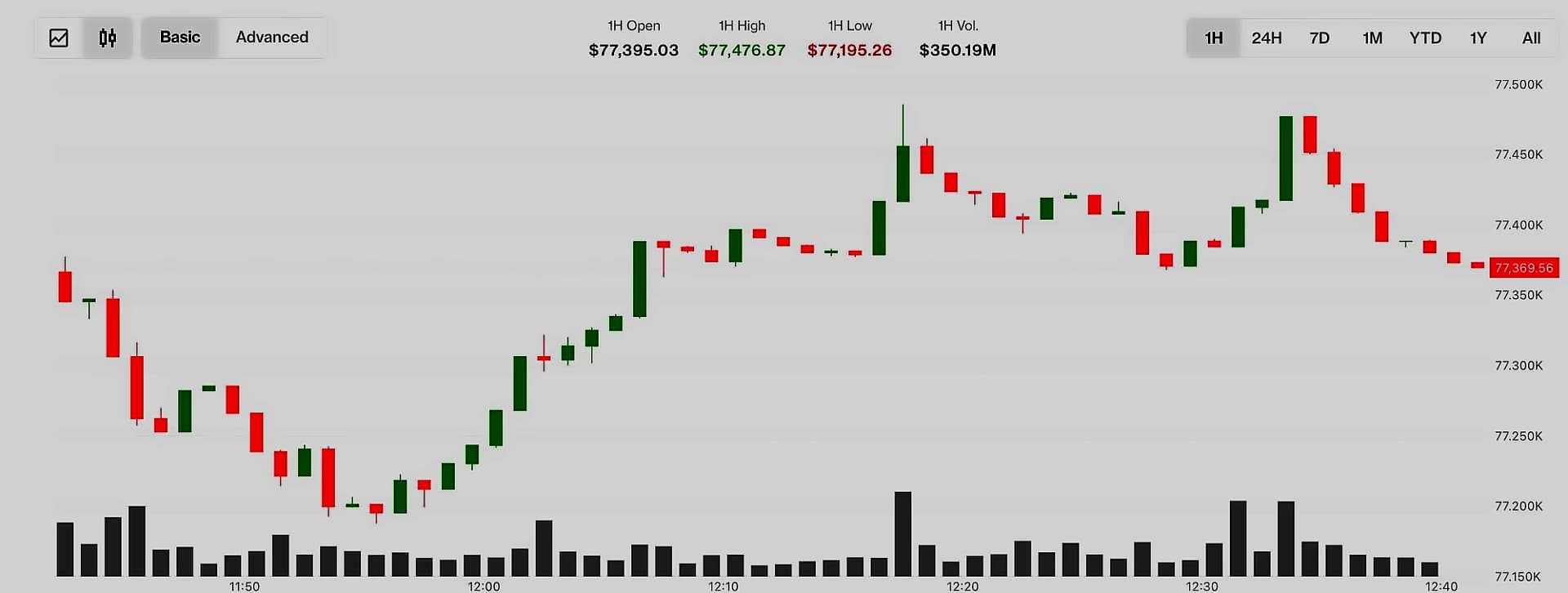
According to CoinDesk data, Bitcoin traded near $77,400 at 6:35 UTC, up 0.9% over the past 24 hours, maintaining its position above the widely tracked 50-day simple moving average of around $76,940. Other major cryptocurrencies showed modest gains, with XRP and Solana (SOL) rising 0.6% or more, while Ether (ETH) gained 0.4%. However, all three cryptocurrencies continued to trade below their respective 50-day moving averages, lagging Bitcoin on this key technical metric. Bitcoin faces key support at $75,000 and resistance at $78,800, with technical indicators suggesting cautious momentum and mixed signals for a potential bottom. The latest market data shows Bitcoin enjoys a lift albeit limited getting above $77K but yet to successfully breach a short-term bear trend line with much of the price action within a recently formed bear channel, as reported by Investing.com.
The US Securities and Exchange Commission granted Nasdaq PHLX conditional approval to list European-style, cash-settled BTC index options under the ticker QBTC, marking a significant milestone for Bitcoin institutional infrastructure. These contracts track the CME CF Bitcoin Real-Time Index (BRTT), settle in US dollars, and crucially require no separate derivatives account, meaning traders can execute bitcoin volatility bets directly through standard brokerage platforms. Each contract represents exactly 1 BTC of exposure versus CME's 5 BTC minimum, making precision hedging accessible to a much wider institutional audience. However, the Commodity Futures Trading Commission must still grant exemptive relief before QBTC options can actually trade, as the SEC approval is real but the product is not yet live. This development represents Bitcoin's growing presence on Nasdaq-listed vehicles becoming a pattern, not a novelty.
Timothy Misir, head of research at BRN, argued that tepid prices amid surging institutional outflows carries more weight than the headline rally, stating "The institutional bid hasn't disappeared — it's rotating." While spot BTC products logged redemptions, XRP ETFs attracted $22 million, Solana ETFs added $16 million, and newly launched Hyperliquid ETFs pulled in $72 million during the same window that Ethereum ETFs shed $216 million, according to BRN. U.S.-listed spot Bitcoin ETFs experienced $1.26 billion in outflows over six sessions from May 15 through May 22, signaling weaker demand despite recent geopolitical developments. Crypto.news reported that U.S.-listed spot Bitcoin ETFs recorded net outflows in six straight sessions, totaling $1.26 billion across 11 funds. Santiment noted that weak ETF flows do not always signal deeper market stress, emphasizing that past outflow streaks have sometimes appeared near periods when long-term buyers started rebuilding positions instead of exiting the market.
Binance recorded nearly 10 consecutive days of rising BTC inflows, with the exchange's weekly average inflows jumping from 378 BTC on May 16 to 1,190 BTC, marking a more than threefold increase in less than 10 days, according to latest data from analyst Darkfost. The exchange recorded one daily inflow of more than 3,600 BTC on May 18, while Binance reserves rose from 616,000 BTC on April 24 to 632,000 BTC, an increase of 16,000 BTC in one month. Analysts view these Binance inflows as potential sell signals amid a market correction influenced by geopolitical tensions and risk aversion. The exchange's strategy has paused Bitcoin purchases to focus on managing its debt and treasury, including a $1.5 billion buyback of convertible bonds. Despite the pause, Binance holds 843,738 BTC worth about $64.45 billion, aiming to strengthen liquidity and capital position.
Bitcoin was trading around $77,400 at the time of reporting, up 0.9% in 24 hours, according to crypto.news price data, with 24-hour volume near $24.98 billion, a market cap of about $1.54 trillion, and a 24-hour range between $76,053 and $77,400. The price remains below the 20-day Bollinger Band midline near $78,877, showing Bitcoin has not yet reclaimed short-term average resistance. The lower Bollinger Band near $75,000 remains the key support area, while the upper band near $82,751 is the next resistance zone if buyers regain control. The RSI sits near 48.00, slightly below its moving average at 49.13, keeping momentum in neutral territory with a mild bearish bias. Volume is also low at about 2.58K BTC on the chart, suggesting the latest rebound lacks strong participation. A close above $78,800 would improve the short-term setup, while a break below $75,000 would renew downside pressure. Analysts remain split on the outlook, with the 50-day EMA already breached during recent US trading sessions, shifting near-term momentum firmly to the bears, while the 200-day EMA near $76,500 is now the line in the sand.