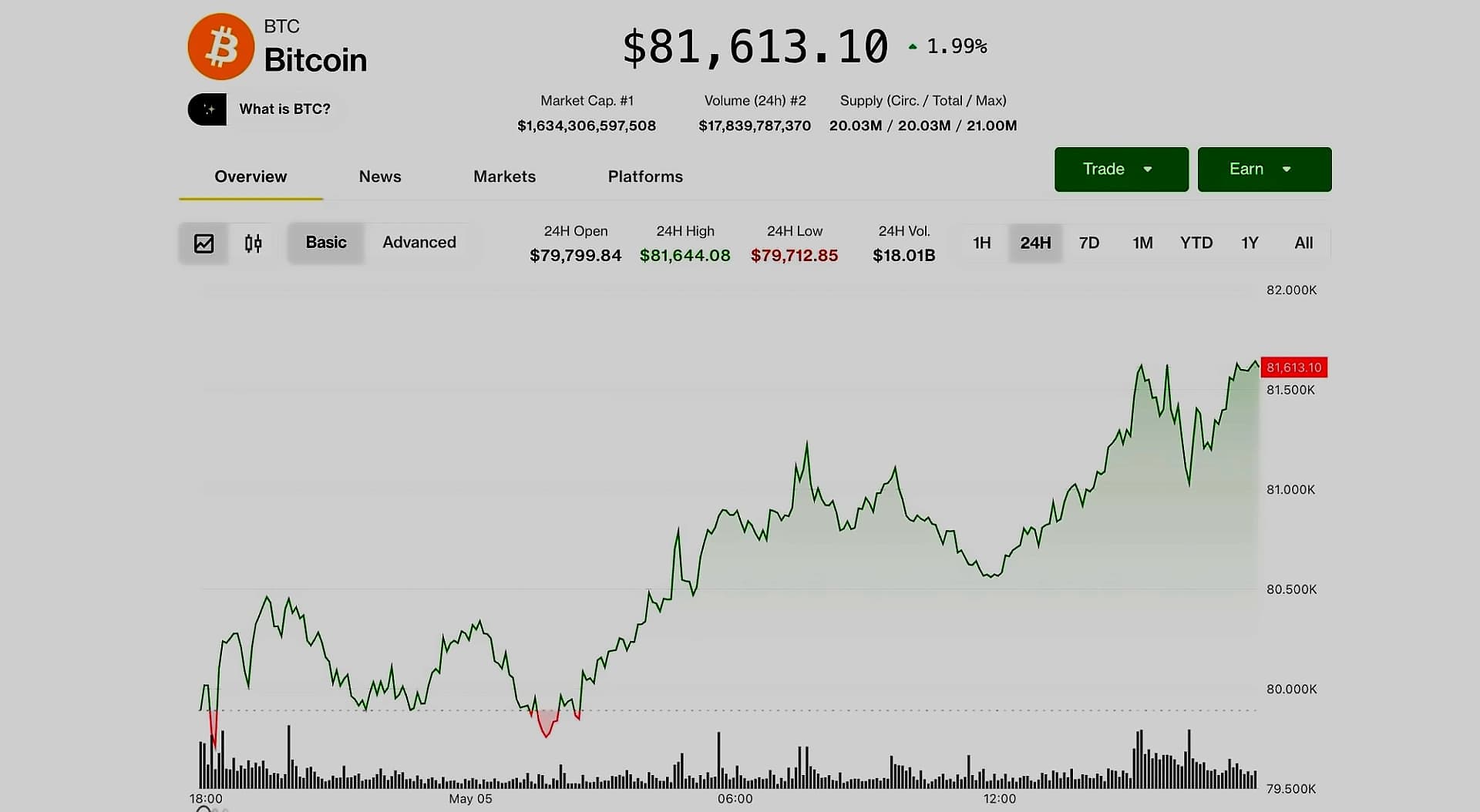
Bitcoin has successfully reclaimed the $80,000 level on May 4, 2026, marking the first time it has broken above this resistance since January 31, 2026. The breakthrough coincided with the opening of Consensus 2026 at the Miami Beach Convention Center, where the cryptocurrency conference is expected to attract 20,000+ attendees covering tokenization, stablecoins, and CLARITY Act developments. According to crypto.news, the rally was supported by $630 million in US spot Bitcoin ETF inflows on May 1, which provided crucial institutional backing for the move. 21Shares chief market strategist Adrian Fritz noted that $80,000 represents "quite a resistance" and that a confident break above it "could spark some momentum" as recent buyers return to profit. The breakthrough comes after Bitcoin had previously tested $80,000 twice in 2026 and been rejected both times, making this current attempt particularly significant for market sentiment.
CryptoQuant's BitcoinBTC-- Bull Score Index has flipped to neutral 50, marking its first such reading since the 2021 peak and signaling a clear shift from the extended bearish regime. This neutral reading reflects an even split between bullish and bearish on-chain signals, with price action now stuck in a tight $75,000 to $80,000 range. The index's transitional phase indicates that while the market has moved beyond the bearish conditions of recent months, it has not yet confirmed a sustained trend. Historical precedent raises caution, as a similar neutral reading in March 2022 preceded a sharp price collapse, with Bitcoin more than halving in the following months. The current setup shows improved on-chain conditions compared to previous bearish periods, but the neutral reading serves as a reminder that transitional phases can go either way, especially when derivatives positioning points to range-bound conditions rather than a sustained breakout.
Despite the technical breakout and significant ETF inflows, Bitcoin's weekly trading volume remains 17% below average, indicating a lack of broad market participation. The April rally was a classic case of leverage-driven speculation, with Bitcoin's 12.7% monthly gain powered almost entirely by perpetual futures demand, while outright spot purchases remained negative. However, April's $1.97 billion in spot Bitcoin ETF inflows was the highest monthly total of 2026, setting the stage for the current $80,000 reclaim. As crypto.news reports, US spot Bitcoin ETFs logged eight consecutive days of net inflows totalling $2.1 billion through April 23, with BlackRock's IBIT responsible for roughly 75% of all capital entering the category. This divergence between institutional ETF flows and retail spot demand creates fragile conditions, with Strategy, the largest corporate Bitcoin holder, pausing its weekly purchases ahead of its May 5 earnings report. Current derivatives positioning confirms a lack of conviction, with open interest steady at $19 billion and negative funding rates indicating traders are still shorting rallies.
The derivatives landscape confirms that perpetual futures funding rates remain deeply negative, a clear signal that the market is being pushed higher by institutional investors' hedging strategies rather than leveraged long bets from retail traders. This creates a tale of two markets: steady spot buying supports the climb, while the derivatives side shows a lack of bullish positioning. Polymarket's implied probability of $90,000 in May stands at just 23%, placing the market in the "possible but not expected" category. The key overhead zone remains a liquidity cluster at $80K, with a clean break above this level potentially triggering a short squeeze toward $84K–$85.5K. However, the negative funding rates and low options volatility suggest the market lacks built-in momentum to achieve this move easily. The primary near-term risk is a breakdown below the $75,000 support level, given the weak spot demand and the market's reliance on futures leverage. Such a move could trigger forced selling and lead to a retest of lower support, mirroring the pattern seen in April where a rally driven by perpetual futures demand collapsed when that speculative flow unwound.
A sustained breakout above the current $75,000 to $80,000 range requires two key conditions. First, the crypto market must remain stable, free of the kind of major liquidation events that have historically derailed rallies. Second, broader equity markets need to stay steady, as a sharp pullback would dampen risk appetite for all assets, including crypto. The improved geopolitical risk sentiment after Trump's "Project Freedom" military operation has lifted risk appetite across global markets, providing additional support for the current rally. Consensus 2026, running May 5-7 at Miami Beach Convention Center, gives the $80,000 level a public stage just as Bitcoin attempts to turn it from a headline level into support. The Bull Score Index itself is the ultimate signal for the next phase, with a shift from neutral to bullish requiring a clear, sustained increase in spot accumulation metrics. Until that happens, the index will remain a lagging indicator of on-chain health, not a leading signal for price. The current setup mirrors the pattern seen in April, where a rally driven by perpetual futures demand collapsed when that speculative flow unwound, highlighting the importance of fundamental demand over leveraged positioning in determining Bitcoin's next directional move.