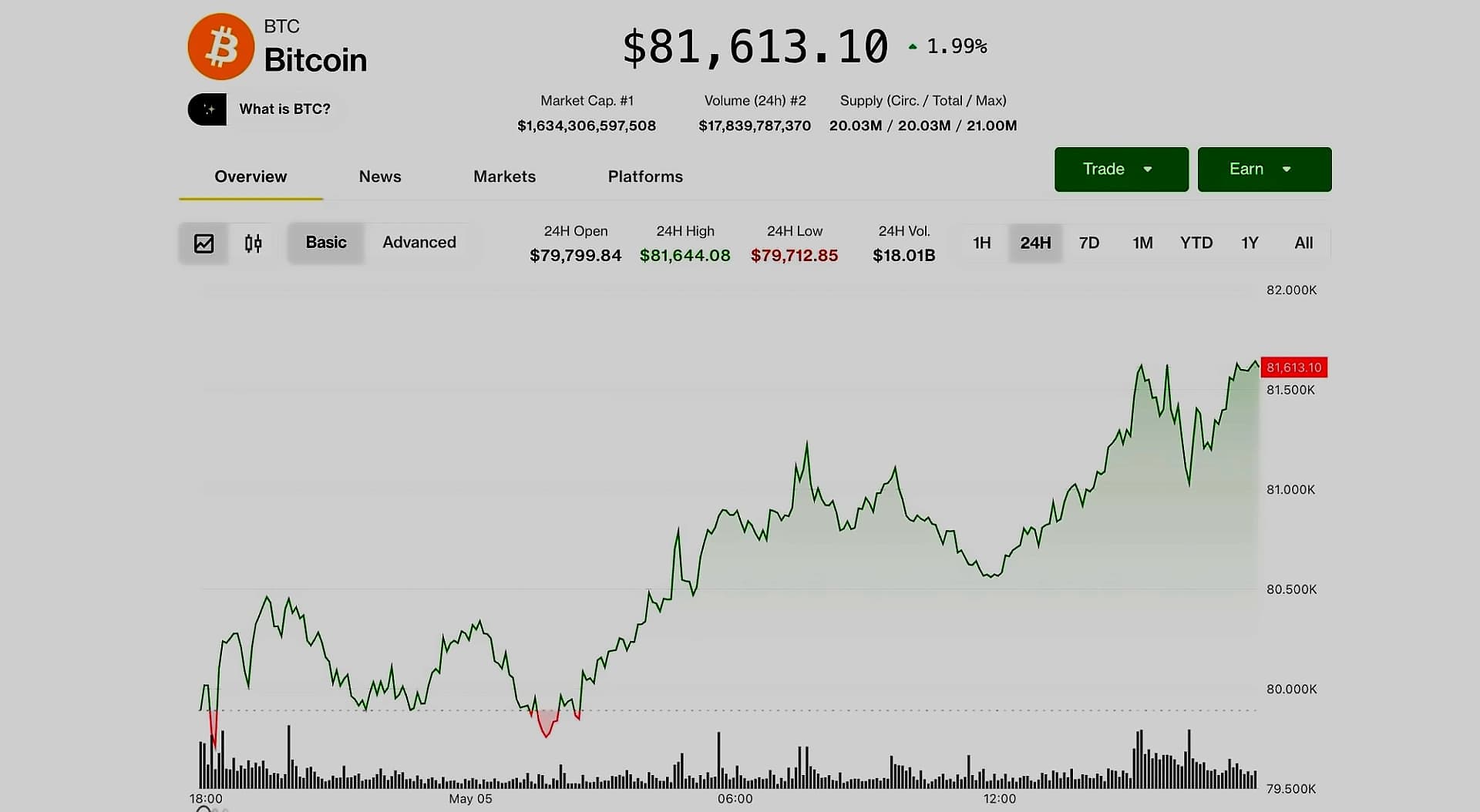
Bitcoin achieved a significant milestone by crossing $81,000 on May 5, 2026, reaching a high of $81,000 according to latest reports. This breakthrough represents a structural shift rather than a temporary spike, as the $79,537-$80,000 band that previously served as resistance is now acting as support. The move comes with substantial institutional backing, including $1.97 billion in April ETF inflows and $500 million in whale accumulation between $75,000-$78,000 over just 48 hours. The $80,000 level marks a structural resistance zone that defined Bitcoin's November 2025 lows and has acted as a ceiling through months of consolidation. As per Barron's, Bitcoin rose as high as roughly $80,042 after gaining more than 2%, with market analysts pointing to the $81,000 to $83,000 zone as the next key technical resistance area. The latest advance marks a notable recovery from earlier 2026 lows near $62,000, underscoring how quickly sentiment can shift in the crypto market.
US spot Bitcoin ETFs recorded their fifth consecutive week of net inflows, totaling $153.87 million according to SoSoValue data as reported by 99Bitcoins. This five-week streak, combined with April's $1.97 billion in net ETF inflows, demonstrates that institutional capital isn't merely testing the market but is returning with conviction. The technical backdrop supports this institutional confidence, with a Golden Cross forming when the 50-day moving average crosses above the 200-day moving average, signaling that short-term momentum is outpacing longer-term trends. The move above $80,000 has triggered a wave of short liquidations, forcing bearish positions to close and amplifying the rally. These inflows have coincided with a decline in Bitcoin held on exchanges, a dynamic often interpreted as a sign that long-term holders are accumulating rather than preparing to sell, tightening available supply and supporting upward price pressure. The institutional fingerprints on this rally are hard to ignore, with institutional hands not shaking as capital returns with conviction.
Bitcoin's surge above $81,000 comes amid heightened geopolitical tensions, particularly ongoing US-Iran conflicts that continue to influence global markets. Rising oil prices, with WTI above $105 and Brent near $119, are shaping sentiment and keeping investors cautious. According to CoinSwitch, since the conflict began, BTC has gained more than 20 percent, while gold has declined 13-14 percent, reflecting rate-driven pressure on non-yielding assets. The combination of geopolitical uncertainty and macro pressures has created a 'risk-on' phase in the cryptocurrency market. As per Delta Exchange, Bitcoin's move above $80K reflects a mix of technical breakout momentum, improving institutional flows, and a return of risk appetite despite geopolitical uncertainty. Spot BTC ETF inflows above $600 million on consecutive sessions show traditional capital is using dips to accumulate, helping absorb supply and accelerating upside momentum through short squeezes. Easing geopolitical concerns in some regions and a steadier outlook for interest rates have further contributed to the improved tone, with equities posting gains and volatility easing, creating a more supportive backdrop for assets like Bitcoin.
The rally that sent Bitcoin above $80,000 came amid persistently negative funding rates for Bitcoin perpetual futures contracts, a key gauge for market sentiment in which crypto traders add wagers on a further decline in token prices. The call options at the strike price of $80,000 on crypto exchange Deribit have seen a significant increase in open interest, remaining to be the most in-demand contracts on the platform. The elevated demand suggests more bets have been placed on an upward move in Bitcoin prices from that price level this month. This derivatives activity indicates strong bullish conviction among traders, with the negative funding rates suggesting that short positions are being squeezed as prices rise. Bitcoin reached a record of just above $126,000 in October last year, before a months-long swoon that dragged it down to around $60,000 in February. The token has gradually regained ground from there, driven in part by rising institutional demand.
The technical structure shows EMA 50 and EMA 100 holding on the 12-hour chart, with momentum building toward a bullish continuation according to 99Bitcoins analysis. The $80,000 level's significance as a magnet zone where long-term trendlines converge makes the current breakout particularly meaningful. Analysts are watching the $81,000 to $83,000 range as the next key resistance zone, with the $86,000 level as the first major resistance zone if $80,000 holds. The $90,000-$93,000 band represents the next structural target if momentum extends further. A Golden Cross is forming, when the 50-day moving average crosses above the 200-day moving average, signaling that short-term momentum is outpacing longer-term trends. Barron's cited market commentary pointing to resistance near $81,000 and $83,000, with the 200-day moving average around $83,863 viewed as a key level for a more constructive medium-term outlook. Delta Exchange estimates that Bitcoin now needs sustained closes above $80K-$82K to confirm continuation toward $84K-$85K, while failure to hold this range could trigger a retracement toward $78K-$79K. While the level is within reach from a technical standpoint, expectations remain measured, with market-based probability indicators suggesting traders see further upside as possible but not yet highly likely in the near term.
Bitcoin's strength has spilled over into the broader cryptocurrency market, though the response has been uneven. Ethereum has moved higher alongside Bitcoin, reflecting an improvement in overall sentiment, while performance across smaller tokens has been more mixed. Total crypto market capitalization has edged higher, suggesting capital is returning to the sector. At the same time, the lack of uniform strength across altcoins indicates that investors remain selective, favoring larger and more established assets. This pattern is often seen in the early stages of recovery, when capital first concentrates in Bitcoin before gradually rotating into other parts of the market. However, several risks remain in focus. The speed of the recent move raises the potential for a short-term pullback, particularly if profit-taking emerges near resistance levels. The market is also relying heavily on institutional flows, which can shift quickly if broader financial conditions change. A slowdown in inflows could remove a key source of support. Uncertainty around global growth and monetary policy continues to shape the backdrop, with Bitcoin's performance this year showing it remains sensitive to macro developments even as its role within the financial system evolves. Some analysts continue to argue that the market is in a transitional phase rather than a full bull cycle, pointing to the absence of a single dominant catalyst driving the rally.