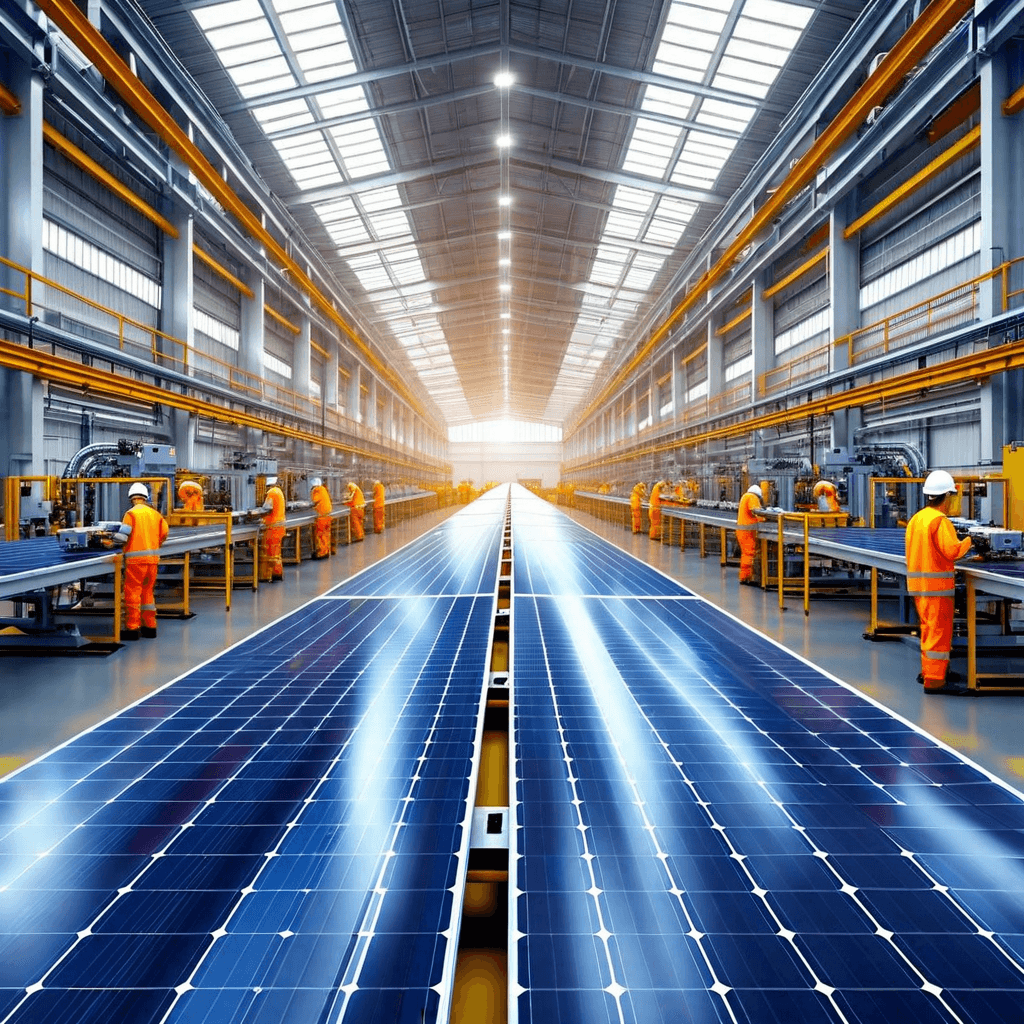
Waaree Energies, India's largest solar module manufacturer with a 13-14% domestic market share, is executing an ambitious expansion strategy that could reshape its competitive landscape. The company is rapidly scaling its US manufacturing footprint from 1.6 GW to 4.5 GW within six months, targeting a slice of the 50-60 GW annual American solar market where 80-85% of demand still relies on imports. This move isn't just about geography—it's a calculated bet on the structural shift toward non-Chinese supply chains driven by US trade policy and the Inflation Reduction Act (IRA). Transcripts +1
The US Market Opportunity
The US expansion represents a significant market share opportunity. With 4.5 GW of capacity, Waaree could theoretically capture 7.5-9% of annual US demand, up from its current "very small" presence. The economics are compelling: US module prices command 30+ cents per watt compared to 17-17.5 cents in India—a 71% premium. Export margins run 18-20% versus 15-16% for domestic utility sales. The company has already realized ₹28-30 per watt in the US, up from ₹24-25 previously, achieving 25% quarter-over-quarter margin expansion driven by strong US order mix. Transcripts +2
However, this expansion comes against a backdrop of escalating trade tensions. The US has imposed preliminary anti-dumping duties of 123.04% on Indian solar imports, with combined duties reaching approximately 234% for most manufacturers. These tariffs make importing from India economically unviable, effectively forcing localization. Waaree's early mover advantage in US manufacturing—building 1.6 GW in Texas in just 12 months—provides insulation from these trade barriers. Transcripts
The Meyer Burger Acquisition
This acquisition cost is roughly 78% cheaper than the $80-85 million spent on the 1.6 GW Texas facility. The HJT technology provides diversification beyond TOPCon, offering higher efficiency potential and a hedge against patent disputes—First Solar has alleged patent infringement against Waaree's TOPCon cells.
The facility offers flexibility: it can produce HJT modules or convert to TOPCon manufacturing, as most capex is common. This technology diversification positions Waaree in the premium segment while providing cost advantages through the fire-sale acquisition. However, Swift Solar separately acquired Meyer Burger's HJT intellectual property portfolio, meaning Waaree can manufacture using the equipment but may need licensing arrangements for the underlying technology. InvestorPresentations
Capital Structure and Fundraising
To fuel this expansion, Waaree has approved an enabling resolution to raise up to ₹10,000 crore. The company's current financial position is strong: debt-equity ratio of 0.13x, ROE of 47.9%, and ample capacity to absorb large-scale fundraising [stock_agent]. A hybrid approach (50:50 equity:debt) appears optimal, balancing ~26% dilution with leverage benefits while maintaining a healthy debt-equity ratio of 0.41x.
The ₹10,000 crore fundraising supports a comprehensive ₹30,000 crore capex program across verticals. Approximately 70-75% will flow to India for near-term returns, while 25-30% targets US expansion for long-term positioning. This back-end loaded deployment strategy—10-15% in the current year, intensifying over the next two years—balances immediate growth with strategic expansion. Transcripts +1
EBITDA Growth Drivers
The primary driver is cell capacity expansion from 5.4 GW to 15.5 GW (10 GW new capacity going live in H2 FY27), which provides sufficient cells for all module production and reduces dependency on external procurement. This vertical integration significantly improves the domestic content requirement mix and margin profile. Transcripts
US operations are expected to contribute approximately 25-30% of this EBITDA growth. Assuming 4.2 GW US capacity at 80% utilization and ₹28-30 per watt realizations, US operations could generate ₹1,700-2,000 crore in EBITDA. IRA incentives of approximately ₹7 per watt provide additional support, with the company having received ~$40 million cumulatively at $0.07 per watt. InvestorPresentations
The Path to ₹1 Trillion Revenue
Waaree's mission to reach ₹1 trillion revenue by 2030—up from ₹26,537 crore in FY26—requires a 39% CAGR over four years. This ambitious target depends heavily on successful US expansion and global value chain integration. The company is transforming from a module manufacturer into a fully integrated energy transition platform spanning batteries, electrolysers, inverters, transformers, solar glass, smart meters, and transmission & distribution. InvestorPresentations
The diversification strategy creates powerful synergies. Battery energy storage systems (BESS) with 18-20% margins match export module margins, while solar glass benefits from "very high" margins due to anti-dumping protection. The company is commencing 20 GWh BESS and 1 GW electrolyser manufacturing operations this year, with BESS alone potentially contributing ₹14,720-16,000 crore annually at full capacity. Transcripts +2
By FY30, non-module revenue could grow from ₹3,430 crore (13%) to ₹40,000-45,000 crore (40-45%), reducing solar module dependence from 93% to 55-60% [stock_agent]. This diversification is central to achieving the ₹1 trillion target while reducing cyclical risk.
Strategic Trade-offs and Execution Risks
Waaree faces significant trade-offs in allocating capital between defending its Indian market share and building US presence. The company's 28.4 GW global capacity (24.2 GW India + 4.2 GW US) enables sophisticated supply chain optimization, with flexibility in cell manufacturing and module assembly between geographies based on market conditions. InvestorPresentations
The dual-market strategy provides a natural hedge against policy changes and tariff fluctuations. However, execution risks are elevated. The company must simultaneously ramp up multiple new manufacturing facilities (BESS, electrolysers, inverters, transformers, solar glass) while navigating US trade policy volatility, ongoing tariff evasion investigations, and competitive pressure from established players like First Solar and Q Cells. Transcripts
The Verdict
Waaree Energies' US expansion and diversification strategy represent a comprehensive transformation from a solar module manufacturer into a full-stack energy transition platform. The company is well-positioned with strong fundamentals, exceptional returns, and strategic alignment with non-Chinese supply chain trends. However, achieving ₹1 trillion revenue by 2030 is ambitious and depends heavily on successful US expansion, capital execution, and favorable policy environment.
The 28 GW capacity provides the scale and flexibility to capture growth in both markets while maintaining margin stability through geographic diversification. For investors, the key questions center on execution risk across multiple simultaneous facility ramp-ups, the sustainability of US margins amid intensifying competition, and the company's ability to maintain its competitive moat as trade policies evolve.