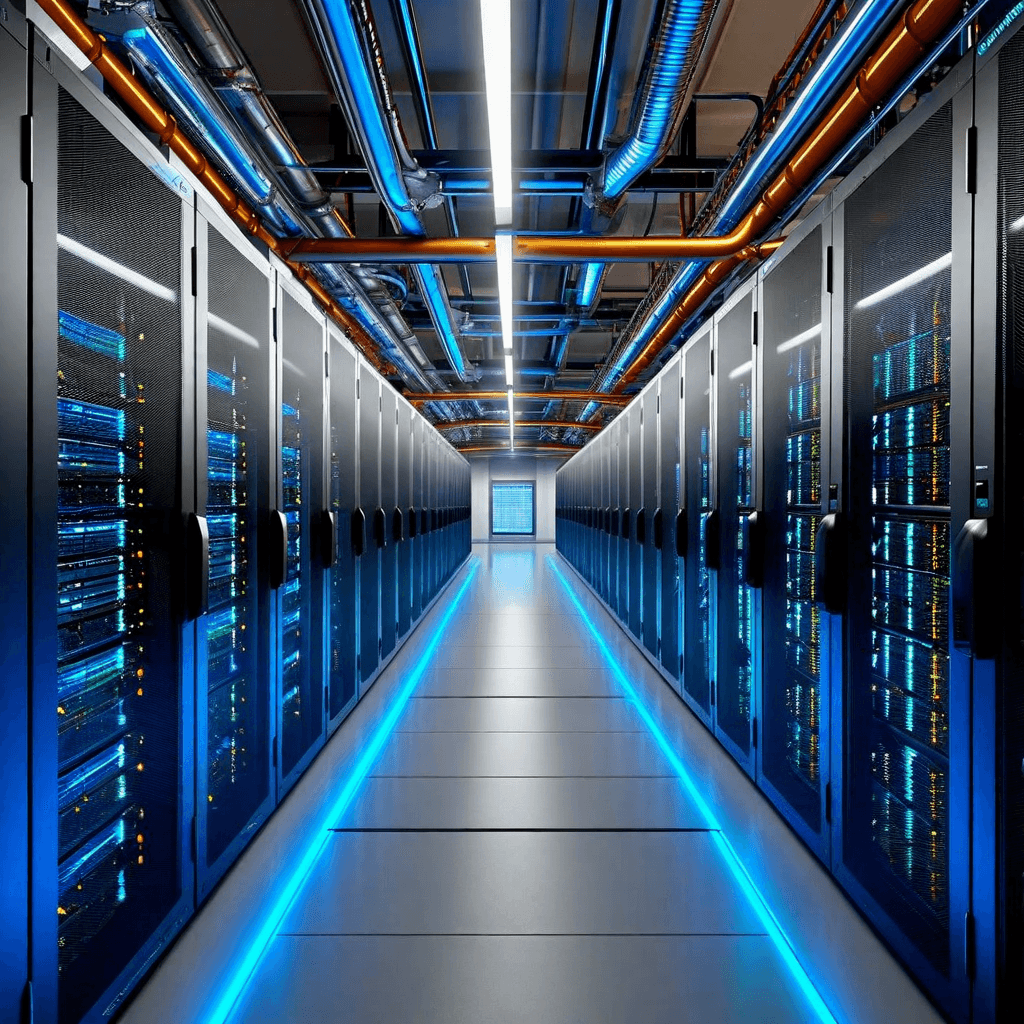
Tata Consultancy Services has signed dual Memorandums of Understanding with Siemens Energy AG and Siemens Energy India Limited, strengthening a collaboration spanning over two decades. The partnership focuses on accelerating AI-led industrial transformation and developing AI-ready data center infrastructure through TCS's HyperVault platform. This initiative targets 1 GW of capacity with demand converging around large anchor AI workloads in the 100-200 MW range per customer. Others +1
India's AI data center market presents substantial growth potential, projected to reach $41.74 billion by 2033, growing at 28.2% CAGR from 2026. The broader data center market was valued at $13.39 billion in February 2025 with 1.5 GW installed capacity expected by end-2025. Government support remains robust, with India announcing a 20-year tax exemption for hyperscalers using data centers in the country to service global clients.
Revenue Growth and Margin Expansion
The partnership creates multiple revenue streams for TCS. Infrastructure services encompass power infrastructure design, grid connection, and electrification systems—commanding premium pricing for specialized expertise. Managed services provide recurring revenue through ongoing power management, monitoring, and optimization. Digital solutions, including digital twins, predictive analytics, and intelligent vision systems, deliver premium AI services.
TCS reported operating margins of 25% in FY26 (70 bps expansion YoY), with management indicating a long-term target of 26%. The partnership supports this margin expansion through higher-value services, recurring revenue models, and operational efficiencies. For the 1 GW HyperVault target, potential annual electricity cost savings could reach $340 million through PUE improvement from industry average 1.67 to Google-level 1.09, while freeing capacity for 58,000 additional GPUs within the same power envelope. Transcripts
Siemens Energy stands to gain significant revenue opportunities, estimated at $500 million to $1 billion over five years from power infrastructure and services, plus $100-200 million annually in recurring O&M revenue. The partnership provides guaranteed demand through TCS's committed pipeline, reducing commercial risk compared to speculative partnerships. Siemens Energy's solutions with 99.999% availability track record and comprehensive portfolio covering the entire energy value chain provide competitive differentiation.
Competitive Differentiation
TCS's HyperVault initiative represents a fundamentally different approach compared to Indian IT peers Infosys, Wipro, and HCLTech. TCS is the only Indian IT company with 1 GW physical AI data center capacity, exclusive Siemens Energy partnership with 99.999% availability track record, and Tata Group synergies integrating Tata Power, Tata Projects, and Tata Communications. TCS maintains the highest margins in the industry at 25%, with $40.7 billion in deal TCV including five mega deals. Transcripts +1
Competitors operate primarily at the services layer, dependent on hyperscalers for infrastructure. Infosys has comprehensive AI strategy with Topaz platform and partnerships with Anthropic and OpenAI, but lacks physical infrastructure. Wipro is pivoting to AI-native business with WINGS and WEGA platforms but appears behind in frontier model partnerships. HCLTech focuses on engineering-led AI with AI Force platform and hyperscaler partnerships but manages infrastructure rather than owning it. Transcripts +2
Against global cloud providers AWS (31% market share), Azure (25%), and Google Cloud (12%), TCS-Siemens Energy positions as complementary for India-focused and sovereign AI requirements while competing effectively for enterprise workloads requiring dedicated infrastructure and energy optimization. The partnership offers full control over physical infrastructure in India, 20-35% energy cost advantage through PUE optimization, and deep domestic relationships for regulatory navigation.
Technology Integration and Intelligent Operations
The partnership creates a multi-layered integration framework combining TCS's AI/ML capabilities with Siemens Energy's industrial IoT and energy management technologies. TCS brings AI-first business architecture with domain-specific models pre-trained with 40+ years of transformation experience, delivering 40-70% efficiency improvement and 2x speed in program delivery. The company's ignio™ AIOps platform provides unified observability, AI-powered insights, and closed-loop automation with 10,000+ modular automations across 45+ technologies. InvestorPresentations
Siemens Energy contributes Omnivise T3000 control system with integrated simulator, remote access, and SCADA functionality, plus predictive maintenance solutions using AI, advanced data analysis, and digital twins. The integration enables AI-powered predictive maintenance with 35-45% reduction in downtime, 25-30% drop in maintenance costs, and 70-75% elimination of breakdowns versus reactive approaches.
The collaboration delivers quantified business impact: 90% reduction in Mean Time to Resolution (MTTR) through autonomous resolution, 60% reduction in manual efforts, and 40% proactive issue elimination. For data center clients, this translates to 99.999% availability, 20-35% energy cost reduction, and significantly improved operational resilience.
Execution Risks and Mitigation
The partnership faces significant execution risks, particularly around power infrastructure dependencies. Transformer lead times average 128 weeks for power units and 144 weeks for generator step-up transformers, with costs up 77-95% since 2019. Grid interconnection queues create 24-72 month delays in constrained markets. TCS mitigates these risks through early procurement 18-24 months ahead, Siemens Energy's priority access, and Tata Group synergies for powered-land development that can compress timelines to 90 days.
Technology integration presents IT/OT convergence challenges, including expanded attack surfaces, legacy OT systems with limited security, and protocol incompatibility between IT (TCP/IP) and OT (Modbus/Profibus) systems. Mitigation strategies include zero-trust architecture, network segmentation, comprehensive testing programs, and integrated development teams with IT and OT expertise.
Financial risks include cost overruns with AI-ready facilities costing $20 million+ per MW versus $10-12 million for standard builds, plus utility interconnection deposits requiring 20% of total project cost as non-refundable payments. TCS addresses these through fixed-price contracts, phased investment, and partnership models reducing CAPEX by 15-20%.
Regulatory and Compliance Challenges
Cross-border data transfer regulations present significant complexity. India's DPDP Act 2023 permits cross-border transfers but allows government restrictions, with penalties reaching ₹250 crore for serious violations. The EU's GDPR requires adequacy decisions or Standard Contractual Clauses, while China's PIPL imposes strict localization requirements for Critical Information Infrastructure Operators. TCS mitigates these through regional data centers, on-premises HyperVault infrastructure for data sovereignty, and comprehensive compliance frameworks.
Energy and environmental regulations vary by region. The EU's Energy Efficiency Directive mandates reporting for facilities with 500kW+ power demand and PUE limits. China requires 4A level under Data Center Low-Carbon Rating. India mandates BEE Star Rating compliance. The partnership addresses these through PUE optimization targeting 1.09, SF6-free portfolio, green fuel readiness, and automated compliance monitoring.
Siemens Energy India plays a crucial role in adapting global solutions for local market requirements, including tropical climate challenges (40°C+ ambient temperatures), power grid constraints, and India-specific regulatory frameworks. The company provides dedicated feeders for data center parks, free cooling leveraging monsoon temperatures, and round-the-clock renewable power agreements.
Strategic Outlook
The TCS-Siemens Energy partnership creates a unique competitive position in the AI-ready data center market. TCS differentiates through physical infrastructure ownership and power expertise unavailable to Indian IT peers, while Siemens Energy gains guaranteed demand in a high-growth market with first-mover advantage. The joint offering positions as complementary to hyperscalers for India-focused requirements while competing for enterprise workloads requiring dedicated infrastructure.
Success depends on managing execution risks around power infrastructure dependencies, navigating complex regulatory landscapes across geographies, and delivering on the promised operational efficiencies. With proper risk mitigation and leveraging partnership synergies, the collaboration is well-positioned to capture significant share of India's rapidly expanding AI data center market while establishing a model for potential geographic expansion.