German automobile parts maker Robert Bosch GmbH is in early talks to sell part of its Indian technology operations as part of cost-containment measures. According to Mint, Tata Consultancy Services Ltd (TCS) is among the prospective suitors, with the potential to absorb as many as 3,000 employees of Bosch's India operations if the deal proceeds. The development reflects a growing trend of multinationals handing over their global capability centres (GCCs) to Indian IT firms as they seek to rationalize costs. Bosch first established its tech unit in Bengaluru as Bosch Global Software Technologies (BGSW) in 1997, now operating three additional units in Hyderabad, Pune and Coimbatore, with its Indian workforce comprising about four-fifths of its total global capability centre headcount of 28,900 employees.
According to stock market experts, large-cap IT stocks are emerging as attractive investment opportunities amid the anti-AI trade and stable Indian currency conditions. As reported by Live Mint, Avinash Gorakshkar, Founder of Avinash Mentor Research, highlighted that IT stocks are FIIs' favourite, with the stable Indian Rupee expected to attract smart money moving out of bond and currency markets. The experts advise long-term investors to consider TCS and Infosys shares as Indian trade with the US is expected to improve after the US Midterm Election Results 2026. Recent market developments show Nvidia shares slipped 1.6% after recording their longest weekly losing streak since October 2012, reflecting broader AI-linked stock volatility ahead of the company's quarterly earnings announcement.
The investment case for IT stocks is supported by three key factors according to market experts. As reported by Live Mint, anti-AI trade sentiment, setback to Donald Trump's Republican Party in the US Midterm Elections, and stable Indian Rupee are driving the positive outlook. Anuj Gupta, a SEBI-registered market expert, explained that TCS shares are most suitable for investors seeking stable, lower-risk compounding with superior free cash flow and industry-leading operating resilience. Meanwhile, Infosys shares offer higher dividend income stream at ~4.5% and a slightly cheaper valuation relative to its earnings power. The latest developments show TCS's acquisition of Best Buy's India tech centre for ₹1 lakh on October 1st and the $373 million acquisition of Porsche's MHP arm for $373 million in August, demonstrating the company's active expansion strategy.
According to technical analysis from KC Securities, Infosys shares have strong supports at ₹1125 and ₹1112, while facing resistance at ₹1163. As reported by Live Mint, on breaking above ₹1163, Infosys shares are expected to reach ₹1200. On the downside, if the stock falls below ₹1090, it may decline to ₹1075. For TCS shares, technical analysis shows strong support at ₹2378 with resistance at ₹2440. On breaking above ₹2440, TCS shares are expected to reach ₹2500, while a decline below ₹2378 could lead to ₹2316. The latest acquisition activity demonstrates TCS's strong financial position to pursue strategic opportunities in the competitive IT services market.
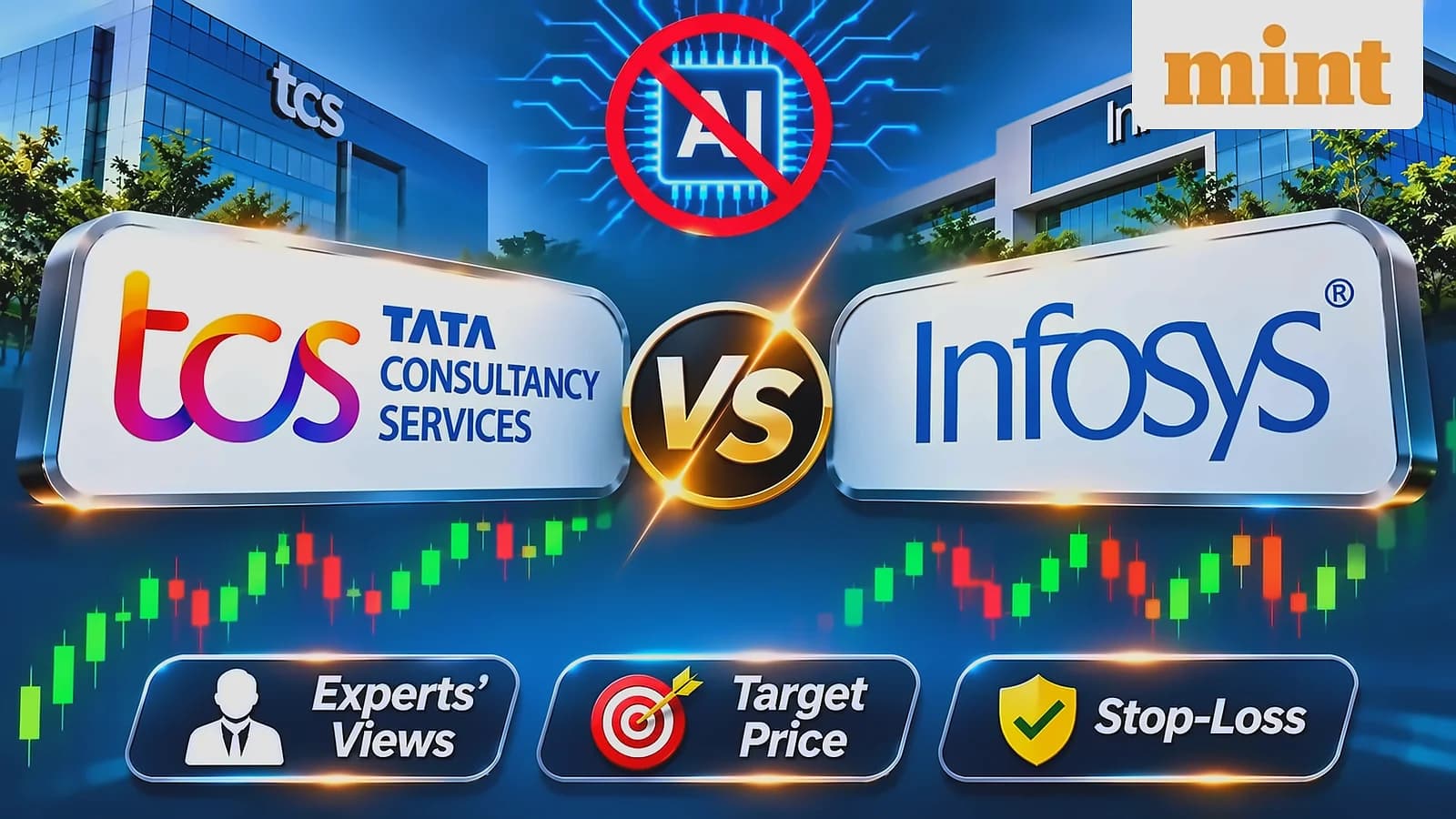
The experts emphasize that IT stocks are beneficiary segments expected to attract maximum long-term bets alongside banking and auto sectors. According to Live Mint, large-cap IT stocks, especially TCS and Infosys, are suitable because they have significant exposure in US and European markets. The improved India-EU trade deal and setback to Donald Trump in US Midterm Polls are expected to benefit these IT companies through improved trade relationships with the US market. Recent global developments include the US unveiling new interim rules tightening China's access to advanced AI chips from companies such as Nvidia, as President Donald Trump began a trip to China for meetings with counterpart Xi Jinping. The trend of multinationals transferring GCC operations to Indian IT firms is expected to gain momentum, with analysts noting that such buyouts represent "a sure-shot way" for IT services firms to secure guaranteed revenue in the volatile demand environment.