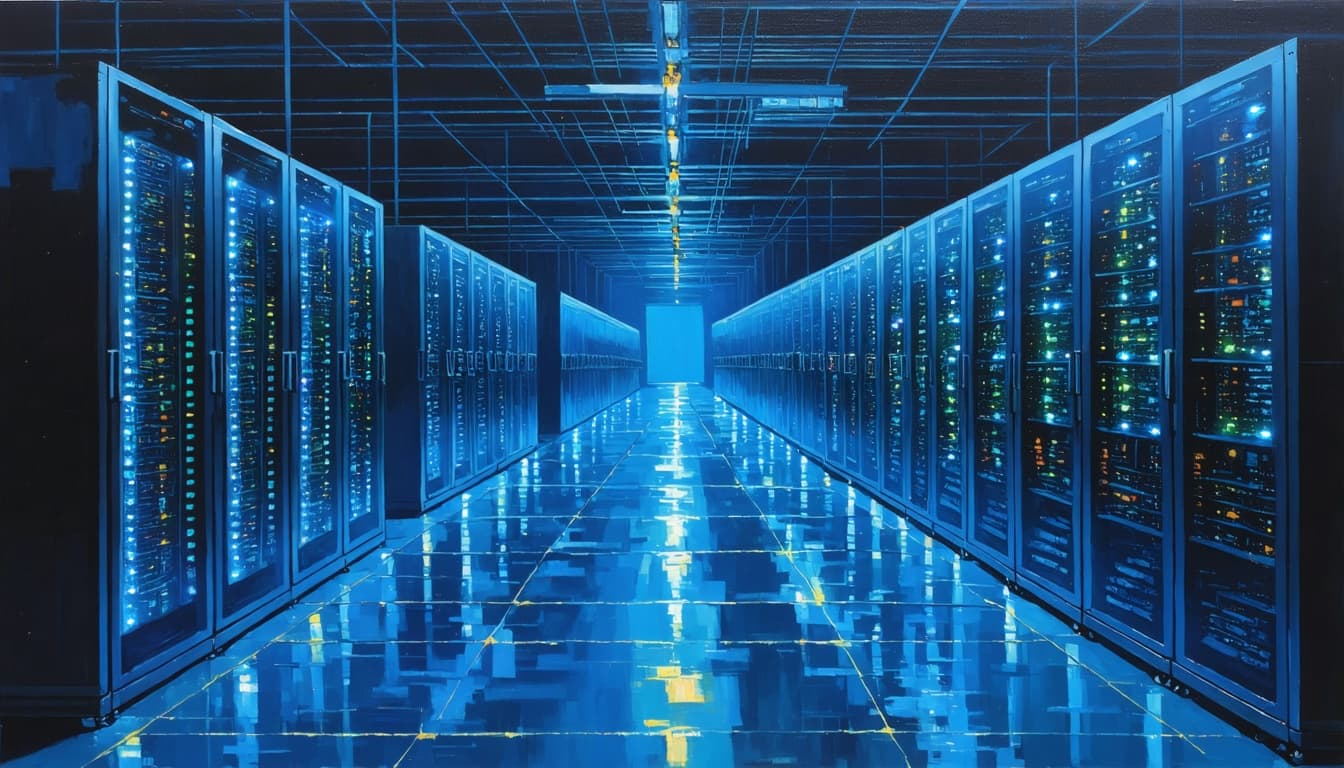
Tata Consultancy Services (TCS) is making a move that would have seemed unthinkable just a few years ago. The company's data centre subsidiary, HyperVault, has committed up to Rs 70,000 crore to build a 1 gigawatt (GW) AI data centre campus in Hyderabad. This isn't just another data centre—it's a strategic bet on the future of artificial intelligence infrastructure in India, and it represents a fundamental shift in how TCS creates value.
Let's break down what this massive investment means for TCS's financial profile, competitive positioning, and strategic direction.
The Capital Question: How This Changes TCS's Financial DNA
First, the numbers.
The HyperVault commitment represents roughly 17 times that annual run rate. But here's the crucial detail: this investment will be phased over multiple years based on customer demand, not deployed in a single lump sum.
The funding structure tells an interesting story. TCS and TPG have committed Rs 18,000 crore in equity, with TPG investing up to Rs 8,820 crore for a 27.5-49% stake. The remaining Rs 52,000 crore will come through debt financing. This structure significantly reduces TCS's direct capital outlay while still giving it majority control.
For context, TCS generated Rs 47,948 crore in free cash flow in FY26. Even with HyperVault's phased deployment, the company's strong cash generation provides substantial buffer. Management has emphasized that these investments are "structured and prudent," anchored by secured customers rather than speculative builds. Others
The return profile looks different from TCS's traditional IT services business.
However, the revenue potential per megawatt tells a different story.
Revenue Diversification: Beyond Traditional IT Services
This investment isn't just about building infrastructure—it's about transforming TCS's revenue mix. Currently, TCS earns over 90% of its revenue from IT services, with AI services contributing about $2.6 billion in annualized revenue. HyperVault creates new revenue streams that complement rather than replace the core business.
The "Infrastructure-to-Intelligence" strategy positions TCS to capture value across the entire AI value chain. At the foundation level, HyperVault provides AI-ready infrastructure with liquid cooling, high-density GPU support, and green energy integration. Moving up the stack, TCS offers AI platforms and solutions, then AI consulting and implementation services, and finally industry-specific AI solutions that drive business transformation. Transcripts
This full-stack approach enables TCS to create what management calls "360-degree partnerships" where partners can also become customers. The OpenAI partnership exemplifies this: TCS has committed 100 MW of capacity with a path to 1 GW, transforming the relationship beyond traditional partnership models. Transcripts
The revenue potential is significant.
Even at conservative estimates, this could add 6-8% to TCS's total revenue within five years, while also creating annuity revenue streams that complement the company's existing services business.
The Hyderabad Advantage: Why This Location Matters
Location matters immensely in the data centre business, and Hyderabad offers distinct advantages. The city sits on the Deccan Plateau, making it relatively earthquake-safe compared to coastal hubs like Chennai and Mumbai. Its central location provides equidistant connectivity to major Indian metros, making it ideal for disaster recovery and low-latency services.
Telangana's policy environment is equally important. The state classifies data centres as "essential services," exempting them from statutory power cuts. The government offers power at the cost of generation, which can reduce operating expenses by 30-40% compared to grid tariffs. Land subsidies, building fee rebates, and a single-window clearance system through TG-iPASS 2.0 further improve the economics.
The talent ecosystem is another critical factor. Hyderabad hosts over 700,000 IT professionals, with major campuses from Microsoft, Google, Amazon, and Apple. The city offers 20-25% lower salary costs and 25-30% lower office rents compared to Bangalore, while maintaining tier-1 talent quality. This cost advantage becomes significant when scaling operations for a 1 GW facility.
Competitive Positioning and Barriers to Entry
The AI infrastructure market is becoming increasingly competitive, but barriers to entry are substantial. Building a 1 GW AI data centre requires Rs 70,000 crore in capital, specialized expertise in liquid cooling and high-density power systems, and 24-36 month timelines for grid interconnections alone.
HyperVault's 1 GW capacity positions it as a potential top-3 player in India's AI infrastructure market, with the ability to capture 10-12% market share by 2028. The partnership with TPG provides critical access to international hyperscaler customers through its global network, differentiating HyperVault from domestic competitors who lack similar connections.
The competitive landscape includes established players like Yotta (planning 20,736 NVIDIA Blackwell GPUs), Nxtra (targeting 1 GW), CtrlS, and AdaniConneX. However, HyperVault's pure AI focus and TCS's existing relationships with hyperscalers—who are also large clients and GTM partners—create natural collaboration opportunities that competitors may find difficult to replicate.
Operational Economics: The Cost of AI Infrastructure
Operating an AI data centre is fundamentally different from traditional facilities. High-density GPU deployments consume significantly more power—up to 10-50x traditional rack densities. Liquid cooling systems, while adding 30-50% to capital costs, can reduce cooling energy consumption by 40%, creating long-term operational savings.
Green energy integration is both a cost and sustainability consideration. Open access solar PPAs can secure power at Rs 4-5 per kWh compared to Rs 7-10 from state utilities, creating material operating cost savings over a 20-25 year facility life. Water-neutral design principles, while adding to upfront costs, address emerging regulatory constraints and reduce long-term operational risks.
The phased development approach based on customer demand affects capacity utilization and breakeven timelines. Initial phases (100-200 MW) may operate at 40-50% utilization with negative EBITDA, but as capacity scales to 800-1,000 MW with 70-80% utilization, the business can achieve positive EBITDA and attractive returns.
Strategic Alignment: The Bigger Picture
This investment represents a strategic shift for TCS from its traditional asset-light IT services model toward a hybrid model with strategic infrastructure assets. While this will modestly dilute ROCE in the near term, it positions TCS to capture value across the entire AI value chain—from physical infrastructure through to business transformation.
The cross-selling opportunities are substantial. HyperVault's AI infrastructure capabilities create natural adjacencies with TCS's cloud services, engineering services, and enterprise transformation offerings. Bundling AI compute infrastructure with AI and analytics services can deliver margin accretion of 7-10 percentage points compared to standalone offerings.
This aligns with TCS's broader strategic shift toward higher-margin digital and AI services. The company's AI revenue has grown to $2.6 billion in annualized run rate, and management has set an aspiration to become "the world's largest AI-led technology services company". HyperVault provides the infrastructure foundation to support this ambition. Transcripts
The Verdict
The Rs 70,000 crore HyperVault investment is a bold strategic move that transforms TCS's competitive positioning. While it represents a departure from the company's traditional asset-light model, the phased development approach, anchored by secured customers and strategic partnerships like TPG, provides a prudent path to capturing this massive opportunity.
The key to success will be execution—securing anchor customer commitments in the 100-200 MW range to accelerate utilization, while leveraging the phased approach to incorporate technological advances and optimize capital deployment. With India's data center capacity expected to grow from 1.5 GW to 10-14 GW by 2030, HyperVault is well-positioned to capture significant market share while establishing TCS as a leader in the AI infrastructure revolution.